
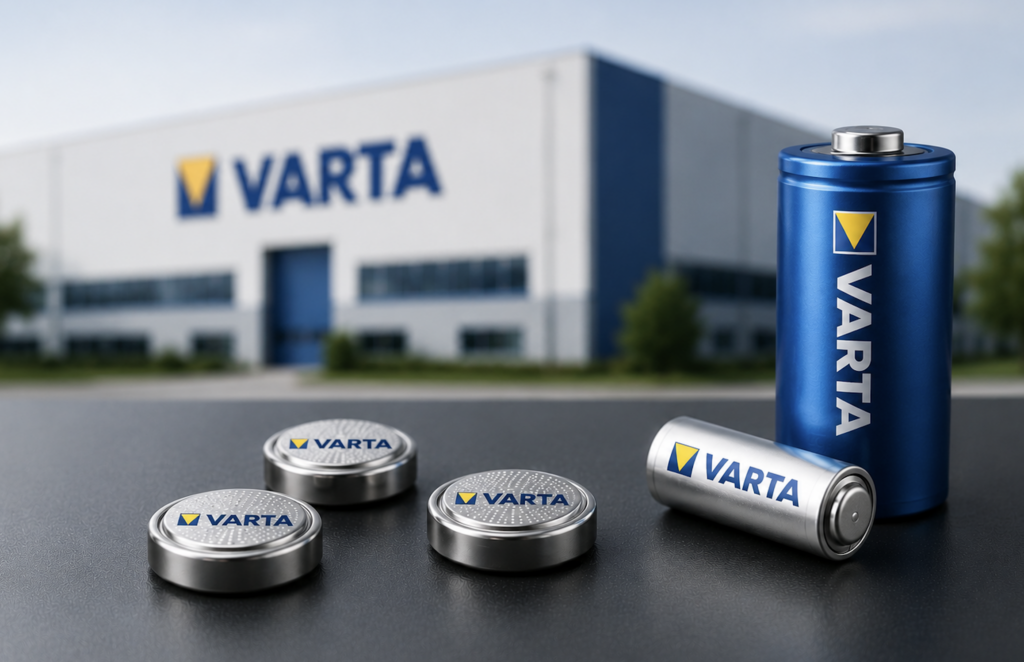
ELLWANGEN, Germany — VARTA AG, once celebrated as one of Europe’s most advanced battery producers, has been thrown into renewed turmoil after Apple informed the company that it would stop sourcing rechargeable coin-cell batteries from the German supplier beginning in late 2026.
The decision, which VARTA disclosed this week, threatens the future of its highly specialized CoinPower battery plant in Nördlingen, Bavaria, where roughly 350 jobs are now at risk. Additional positions could also be affected at the company’s headquarters in Ellwangen, underscoring the vulnerability of Europe’s battery sector amid intensifying competition from Asia.
For years, VARTA had been the exclusive supplier of miniature lithium-ion button cells used in Apple’s wireless earbuds, including early generations of AirPods. The partnership elevated the mid-sized German manufacturer into a strategically important supplier for one of the world’s most valuable technology companies. But industry analysts say the relationship also left VARTA dangerously dependent on a single customer.
Apple Accelerates Shift Toward Asian Suppliers
According to people familiar with the matter, Apple selected lower-cost Asian battery manufacturers for its next generation of audio products after determining they could deliver comparable performance at significantly lower prices. Sources close to VARTA maintain that the German company remained competitive — and in some areas superior — on quality and engineering standards, but could not match the cost structure of large-scale Asian rivals.
The move reflects a broader restructuring of global electronics supply chains. Over the past decade, Apple has increasingly diversified its supplier network across China, South Korea, Vietnam, and other Asian manufacturing hubs in an effort to reduce costs, increase flexibility, and secure higher-volume production capacity.
Industry experts note that European battery makers face mounting pressure from competitors backed by massive industrial ecosystems, lower labor costs, and extensive government support programs in Asia. China in particular has come to dominate large segments of the lithium-ion battery supply chain, from raw materials processing to cell manufacturing.
A Factory Built for One Customer
The consequences for VARTA are especially severe because the Nördlingen facility had been expanded largely to meet Apple’s demand. Under pressure from the American technology giant during the AirPods boom, VARTA invested heavily in new production capacity financed in part through debt.
When global demand for wireless earbuds softened after 2022 and Apple diversified its supplier base, utilization rates at the plant reportedly fell below 50 percent. The new announcement effectively removes the final pillar supporting the factory’s economic viability.
“The anchor customer’s decision has dramatic consequences for the Nördlingen site,” VARTA Chief Executive Michael Ostermann said in a statement. “The people most affected are our employees, who bear no responsibility for this development.”
The company said it would work closely with labor representatives to manage the restructuring process “fairly and responsibly.”
Europe’s Battery Ambitions Under Pressure
The setback comes at a delicate moment for Europe’s broader battery ambitions. Governments across the European Union have spent billions of euros attempting to build a domestic battery industry capable of competing with Asian and American manufacturers, particularly as demand rises for electric vehicles, energy storage systems, and consumer electronics.
But several European battery projects have struggled with financing pressures, scaling difficulties, and fierce price competition from China. Analysts say VARTA’s difficulties illustrate the challenge facing smaller specialized producers that lack the scale advantages of Asian conglomerates.
At the same time, Europe remains eager to reduce dependence on foreign battery suppliers amid growing geopolitical tensions and concerns over supply-chain resilience.
A Company Searching for Reinvention
Despite the loss of Apple business, VARTA insists its other divisions remain stable. The company says its consumer battery and energy-storage businesses continue to perform satisfactorily and are largely unaffected by the latest development.
After undergoing restructuring under Germany’s corporate stabilization framework, known as StaRUG, VARTA has been attempting to reposition itself beyond its historic reliance on Apple. Since taking over in 2024, Ostermann has pushed to diversify the company’s lithium-ion strategy into broader applications, including larger-format cells for stationary energy storage.
“We have the know-how,” Ostermann said in an interview last year, emphasizing that the company remained Germany’s largest producer of lithium-ion cells. “In the end, scaling is the key issue.”
That vision now faces a more difficult test. With Apple’s departure, VARTA must convince investors, policymakers, and customers that a European battery manufacturer can survive — and compete — without the backing of Silicon Valley’s most influential client.