
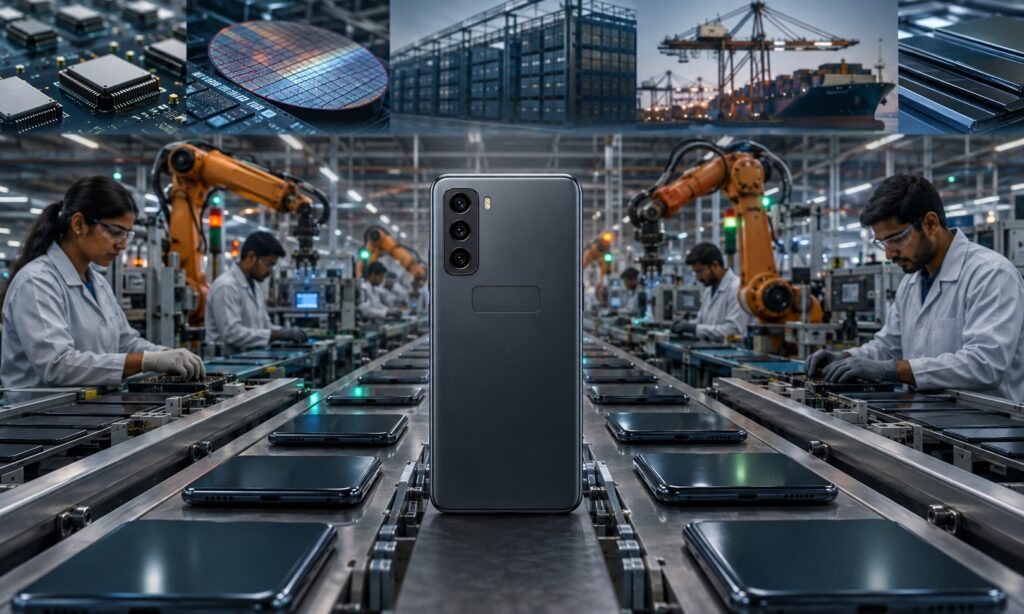
NEW DELHI, India — India’s smartphone industry has reached a scale that would have seemed implausible a decade ago. The country is the world’s second-largest mobile-phone manufacturing base, the government says, and 99.2 percent of the phones used in India are now made domestically. Mobile-phone output reached ₹6.27 trillion in the 2025-26 financial year, while exports climbed to ₹2.60 trillion. India is also expected to assemble 26 percent of the world’s iPhones in 2026, up from 6 percent four years earlier.
Yet the brands commanding Indian consumers’ attention and money remain foreign. In the first quarter of 2026, the five largest were Vivo, Samsung, Oppo, Apple and Motorola. Not one was Indian.
That is not evidence that India cannot build smartphones. It is evidence that India mastered the easier, more policy-responsive part of the business — assembly, contract manufacturing and exports — faster than the harder one: creating a company that controls product architecture, industrial design, software, patents, suppliers, distribution, service and brand.
The missing institution is what economists call a lead firm. India makes a growing share of the world’s phones. But the companies that decide what those phones are, and retain the most valuable returns from them, are still overwhelmingly based elsewhere.
“Made in India” Is Not the Same as Indian
The national debate often collapses four different claims into one. An Indian-owned brand may still buy a nearly finished design from a foreign original-design manufacturer. A phone “developed in India” should imply domestic control of its circuit-board layout, antennas, thermal design, camera processing, quality assurance and product road map. “Made in India” may mean final assembly and circuit-board mounting even when most valuable inputs are imported. A fully indigenous phone — with an Indian processor, modem, display, memory, sensors, operating system and production equipment — is neither economically necessary nor realistic in the near term.
No major smartphone company is nationally self-sufficient. Apple, Samsung and Xiaomi all rely on global suppliers and contract manufacturers. The credible test of an Indian phone is therefore not whether every chip is fabricated in India. It is whether an Indian company controls the design decisions, source code and signing keys, approves suppliers, runs the update system, governs data flows and owns the customer relationship.
That distinction matters because assembly captures only a limited portion of the industry’s rewards. The World Intellectual Property Organization has estimated that a smartphone contains 1,500 to 2,000 physical parts. Its value-chain study found that lead firms and advanced-component suppliers retain much of the value, while final assembly generates comparatively thin margins. The advantage comes from brand, design, patents, software, scale and distribution — assets that do not appear on a factory floor.
Micromax’s Rise Contained the Seeds of Its Fall
India did once appear close to producing a national champion. Micromax briefly surpassed Samsung in domestic smartphone sales. Along with Karbonn, Intex and Lava, it understood Indian demand: dual-SIM devices, long battery life, low prices and distribution beyond the biggest cities.
But much of that success was built on Chinese reference designs and contract manufacturers. Indian companies localized, branded and distributed phones whose technological foundations they did not fully control. That model worked while Nokia and Samsung underserved the low-cost market. It broke when Chinese manufacturers and their industrial neighbors entered India directly.
Micromax outsourced production to companies including Coolpad and Oppo, Reuters reported in 2016. As Chinese brands expanded through online retail, cut out intermediaries and offered better specifications at similar prices, Micromax’s share fell to 13 percent from a 22 percent peak. A plan to deepen in-house software and hardware development was scaled back after financing and management problems.
The transition to 4G after Reliance Jio’s 2016 launch exposed the same weakness. Companies that controlled product planning, modem relationships, antenna engineering and certification could move their portfolios quickly. Indian vendors, with longer procurement cycles and too much 3G inventory, could not. The 4G shock did not create their vulnerability; it revealed it.
China’s advantage was also larger than cheap labor. Shenzhen and other manufacturing clusters connected brands to original-design manufacturers, tooling companies, display and battery suppliers, camera specialists, circuit-board makers and testing laboratories. Xiaomi, Oppo and Vivo could amortize development and tooling across a huge home market, then reuse platforms abroad. They also spent aggressively on Android software, camera tuning, cricket sponsorships, Bollywood endorsements, retailers and service networks.
An Indian entrant with 1 percent of a roughly 150-million-unit annual market would sell about 1.5 million phones, probably divided among several models. At that scale, it pays more for components, receives less customization and spreads software and marketing costs across fewer units. The cycle is punishing: low volume produces a weaker cost position; weaker products suppress sales; and low sales further reduce scale.
A Deep Pool of Engineers, but Too Little Indian-Owned IP
India’s component base has improved, but it remains shallow in the parts that determine performance and cost: processors and modems, memory, displays, image sensors, radio-frequency and power-management chips, and much of the machinery and materials used to make them.
The government says domestic value addition across electronics manufacturing has risen from 15 to 23 percent. That is meaningful progress, but it is a sectorwide administrative estimate, not an audited local-content ratio for smartphones alone.
The contradiction is most visible in semiconductors. A May 2026 road map from NITI Aayog says imports still meet roughly 90 to 95 percent of Indian semiconductor demand. It also says nearly one-fifth of the world’s semiconductor-design work force is in India. Much of that talent works for foreign companies, however, so the resulting intellectual property generally belongs to foreign employers. India has engineers; it has far fewer Indian product companies able to turn their work into proprietary platforms.
This is why the presence of large Indian electronics manufacturers such as Dixon and Tata Electronics does not automatically produce an Indian handset brand. Contract production for Apple, Xiaomi or Motorola offers committed volume without forcing the manufacturer to finance consumer marketing, dealer credit, inventory, warranties, software support and patent litigation. Building a factory and building a brand are different risk businesses.
Industrial Policy Is Beginning to Recognize the Gap
India’s production-linked incentives were highly effective at attracting factories and expanding exports. They naturally favored companies that already possessed global demand, mature products and enormous purchase orders. The result was a powerful manufacturing base serving foreign lead firms.
The government’s new five-year, ₹625 billion Mobile Phone Manufacturing Scheme, approved in July, marks a notable change. Alongside incentives for sales and domestic sourcing, it offers Indian brands an additional 3 percent incentive for product design and research and development. The policy explicitly seeks Indian patents and brands — an acknowledgment that production subsidies alone do not create technological ownership.
Tariff policy poses a second dilemma. Duties on finished phones helped shift assembly to India, but duties on inputs and equipment also raised costs for exporters. An industry-sponsored study by the India Cellular and Electronics Association estimated that, even after partial localization, Indian producers faced a roughly 6 percent bill-of-materials disadvantage against China and Vietnam. The study is an advocacy document, not a neutral audit, but its underlying point is widely recognized: protection downstream can impede competitiveness upstream.
New Delhi has started to adjust. In July it removed duties of 5 and 7.5 percent on selected electronics inputs, including parts used in wireless-charging modules and lithium-ion cells.
Geopolitics has complicated the fastest route to supplier know-how. After the deadly India-China border clashes in 2020, India tightened screening of investment from neighboring countries. Xiaomi told the government in 2024 that scrutiny of Chinese companies was deterring component suppliers. In March 2026, India partially eased the rules, allowing faster processing for certain electronics joint ventures while retaining Indian control requirements. The policy reflects an uncomfortable reality: India wants to reduce dependence on China while still needing selective access to Chinese capital, equipment and production experience.
The Market Has Become Less Forgiving
The domestic opportunity is enormous, but the entry point is narrowing. IDC said India shipped 31 million smartphones in the first quarter of 2026, down 4.1 percent from a year earlier, while the average selling price reached a record $302. The sub-$100 segment fell 59 percent, and 62 percent of shipments moved through offline channels.
Conditions worsened in the second quarter: Counterpoint Research estimated that shipments fell 10 percent from a year earlier, the steepest June-quarter decline in six years, as high memory prices and weak discretionary spending pushed up handset prices. The mass-market segment below ₹15,000 fell 45 percent.
That squeeze leaves a newcomer with few easy choices. Budget phones offer little margin. Midrange buyers expect polished cameras, years of security updates, installment financing, trade-ins, resale value and reliable repairs. A digital-only launch is insufficient in a market still dominated by physical retail. A new brand must finance dealers, sales staff, service centers, spare parts and advertising at the same time it invests in engineering.
Patriotism may win attention. It cannot compensate for a weaker camera, uncertain updates or poor resale value when a phone is a multiyear purchase for a household.
AI+ and the Problem of Proving “Sovereignty”
The controversy surrounding AI+, a brand owned by the Indian-registered NxtQuantum Shift Technologies, illustrates the credibility problem.
The company says its phones are made in Noida, its NxtQuantum operating system was developed in India and its cloud infrastructure keeps user data in India. It repeated those claims in a Delhi High Court case against reviewers. In an initial ex parte order in April, the court temporarily restrained material it considered potentially disparaging. The order was interim, based on a prima facie review, and was not a final technical adjudication of where the phones or software were developed.
Reviewers reported Chinese-developed applications associated with Sprocomm and similarities to Chinese original-design-manufacturer devices. AI+ said the disputed apps appeared only on preproduction units. In a later public statement, the company said it was learning and improving, but did not answer the hardware, software and supplier allegations point by point.
In July, the founder, Madhav Sheth, told the Press Trust of India that he was drawing on two decades of experience in the Chinese smartphone ecosystem. He said AI+ had invested ₹600 million in software, an Indian engineering team and domestic servers, and planned a research staff of more than 150 engineers supported by about 30 expatriate experts. Those are material commitments, but they remain company claims awaiting independent technical validation.
The available public evidence does not establish that AI+ is Chinese-owned. It does, however, raise substantial questions about Chinese original-design-manufacturer and software dependence — questions difficult to reconcile with expansive marketing about complete technological sovereignty. Using a Chinese supplier is not itself disqualifying. Misstating the degree of Indian control would be.
A brand built around privacy and national sovereignty should be held to a higher standard: independent audits of firmware, preinstalled applications, signing keys, update servers, telemetry and external data endpoints, along with clear disclosure of the original-design manufacturer and the origin of core components.
The Path to an Indian Champion
India’s best remaining incumbent, Lava, shows both the possibility and the distance still to travel. The company says its smartphone share remains below 2 percent, though it has grown rapidly from a small base. It is seeking ₹6 billion for research, marketing and overseas expansion and aims for 10 percent of India’s sub-₹30,000 segment by 2030.
A successful Indian brand would need to do several things at once: control product architecture and supplier approval; own its software-release and security infrastructure; concentrate on two or three long-lived hardware platforms instead of flooding the market with models; export the same platforms across South Asia, Africa and the Middle East; and secure patient capital for five to 10 years of research, inventory, dealer finance, marketing and service.
Localization should also be selective. Circuit boards, enclosures, battery packs, chargers and, eventually, cells, camera modules and display modules are plausible targets. Requiring an Indian flagship processor or a wholly domestic display fabrication plant before a phone can be called Indian would waste capital and impose a standard that no global brand meets.
China built component depth and manufacturing scale first, learned by producing for foreign companies, developed powerful original-design manufacturers and suppliers, and then created brands that expanded abroad. India followed almost the reverse order: local trading brands emerged before industrial depth; they depended on Chinese designs; Chinese brands entered directly; the local brands collapsed; and only afterward did India build manufacturing at scale.
India is now trying to repair that sequence. The factories, work force, domestic market and semiconductor-design talent are increasingly present. What is missing is a well-capitalized Indian lead firm capable of coordinating them — and of earning consumer trust over many product cycles.
Such a company is possible. Its first credible phone will probably be Indian-owned, designed and software-controlled in India, assembled in India and built with processors, displays, memory and sensors purchased from global suppliers. That would be no less Indian than an iPhone is American.
The more dangerous shortcut is to proclaim a “fully indigenous” phone before the underlying capability exists. That path leads either to exaggerated claims or to a foreign-designed device with a new label. The central lesson of Micromax — and the central test for AI+ — is that a national brand cannot be sustained by branding alone. (AT/hz)
Sources: IDC, The Economic Times, Free Press Journal, Reuters, Government of India, ICEA, WIPO
Source note: Market trackers use different methodologies, so quarterly shipment estimates can vary.