
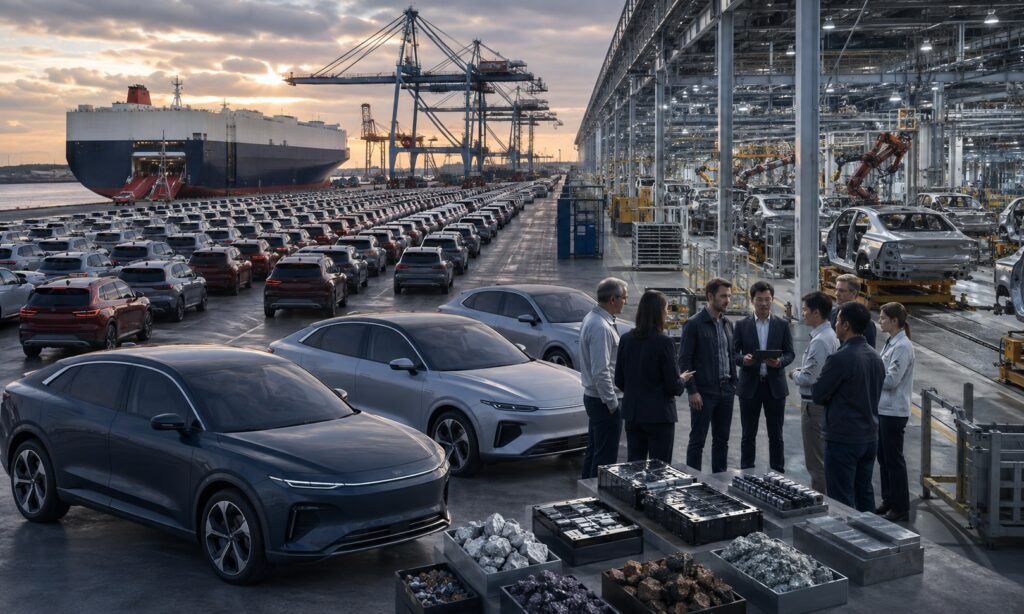
BRUSSELS, Belgium — The European Union is exploring an automotive partnership with Britain, Japan and South Korea that would combine preferential market access, coordinated trade defenses and cooperation on critical minerals, reflecting growing concern that Chinese manufacturers are rapidly redrawing the global automobile industry.
The initiative, first reported Monday by the German business newspaper Handelsblatt, would represent a significant shift in European industrial policy: protecting established manufacturing economies collectively while limiting the competitive advantages enjoyed by Chinese vehicle exporters. However, the proposed alliance has not been formally announced, and its specific provisions remain under discussion.
A Broader Definition of “Made in Europe”
Under the reported proposal, vehicles manufactured in Britain, Japan and South Korea could receive treatment comparable to European-made cars when governments distribute electric-vehicle subsidies or extend tax advantages to corporate fleets.
The discussions build on the European Commission’s proposed Industrial Accelerator Act, introduced in March, which would attach European-origin and low-carbon requirements to public procurement and financial support across strategic industries, including automobiles.
The legislation also proposes additional conditions for large investments in sensitive sectors when a single foreign country controls more than 40 percent of global manufacturing capacity. Those requirements include local economic benefits, technology transfer and domestic production. The legislation remains a proposal and must still pass through the European lawmaking process.
For Britain, participation would address industry concerns that a narrowly defined European preference could undermine deeply integrated cross-Channel supply chains. The Society of Motor Manufacturers and Traders has warned that excluding British vehicles and components would threaten an automotive trading relationship worth approximately £70 billion annually.
Chinese Competition Is Advancing Faster Than Existing Tariffs
European officials are confronting a market in which Chinese brands are expanding despite existing countervailing duties on Chinese-made battery-electric vehicles, which range from 7.8 percent to 35.3 percent.
Those measures apply to fully electric vehicles rather than plug-in hybrids, creating an opening for manufacturers to increase hybrid exports. Handelsblatt reported that China accounted for 60 percent of plug-in hybrids imported into the European Union during the first quarter of 2026, although that specific figure could not be independently verified against publicly available official statistics.
The broader competitive shift is better established. Reuters, citing Counterpoint Research, reported that Chinese automakers held approximately 16 percent of Europe’s passenger-vehicle market in the first quarter, compared with roughly 12 percent for Japanese manufacturers. China’s vehicle exports increased 71 percent during the first half of the year even as its domestic market weakened.
Demand for electric vehicles is also strengthening. Data reported Monday showed battery-electric cars accounted for 25.7 percent of new registrations across 16 major European markets in July, with market shares reaching 35 percent in France and 29.3 percent in Germany.
Germany’s Industrial Crisis Increases the Pressure
The political urgency is particularly acute in Germany, where automotive employment fell to approximately 691,500 by the end of the first half of 2026, down 42,300 jobs, or 5.8 percent, from a year earlier. It was the sector’s lowest employment level since 2005 and the sharpest decline among Germany’s major industrial branches.
German manufacturers are simultaneously contending with Chinese competition, the cost of electrification and American tariffs. Germany’s automobile industry association says U.S. duties of 15 percent on European passenger cars and automotive parts remain a significant burden.
Yet Berlin’s position remains complicated. Germany opposed the European Union’s original China-focused electric-vehicle tariffs in October 2024, reflecting concern among manufacturers that depend on the Chinese market and fear retaliatory measures.
The Industry Is Not United Behind the Proposed Coalition
European manufacturers support strengthening domestic production but disagree over how widely preferential treatment should extend.
In a July position paper, the European Automobile Manufacturers’ Association called for limiting the main geographic scope of European-origin preferences to the 27 EU member states and Britain, while selectively protecting existing European investments in countries such as Turkey and Morocco.
That position does not endorse automatically extending equivalent treatment to vehicles produced in Japan and South Korea, suggesting that Brussels’ proposed geopolitical coalition could face resistance from the very manufacturers it aims to protect.
Questions of ownership further complicate the policy. Chinese manufacturer Chery recently announced a British research center and is exploring potential production at Nissan’s Sunderland factory. Such arrangements expose the difficulty of distinguishing between a vehicle’s manufacturing location, the nationality of its brand and the origin of its technology.
Trade Law and Beijing’s Response Could Limit Brussels’ Options
The proposed alliance could also consider safeguard tariffs modeled on measures used in the steel industry. But World Trade Organization rules require governments to demonstrate that rising imports are causing, or threatening to cause, serious injury to domestic producers. Such safeguards generally must apply to imports regardless of their country of origin.
That requirement creates a fundamental legal problem: a measure designed to constrain Chinese imports while exempting favored industrial partners would require careful justification and could invite legal challenges.
China has already criticized the broader Industrial Accelerator Act. Its Commerce Ministry described the proposed investment restrictions and European-origin preferences as discriminatory barriers that could violate international trade principles and create uncertainty for Chinese companies operating in Europe. That statement addressed the existing legislation, not specifically the newly reported alliance. China’s Ministry of Commerce
Meanwhile, cooperation on critical minerals would connect the automotive proposal to a wider industrial-security agenda. In June, the Group of Seven established a nonbinding alliance to diversify critical-mineral supply chains, reflecting concerns about excessive dependence on concentrated suppliers.
Europe’s central challenge is therefore broader than whether to impose additional tariffs. It must determine whether a coalition of established industrial powers can preserve manufacturing capacity without increasing vehicle prices, fracturing global supply chains or slowing the transition to electric mobility.
Sources: EU Commission, European Council, China’s Ministry of Commerce, WTO, European Automobile Manufacturers’ Association, German Association of the Automotive Industry, Reuters