
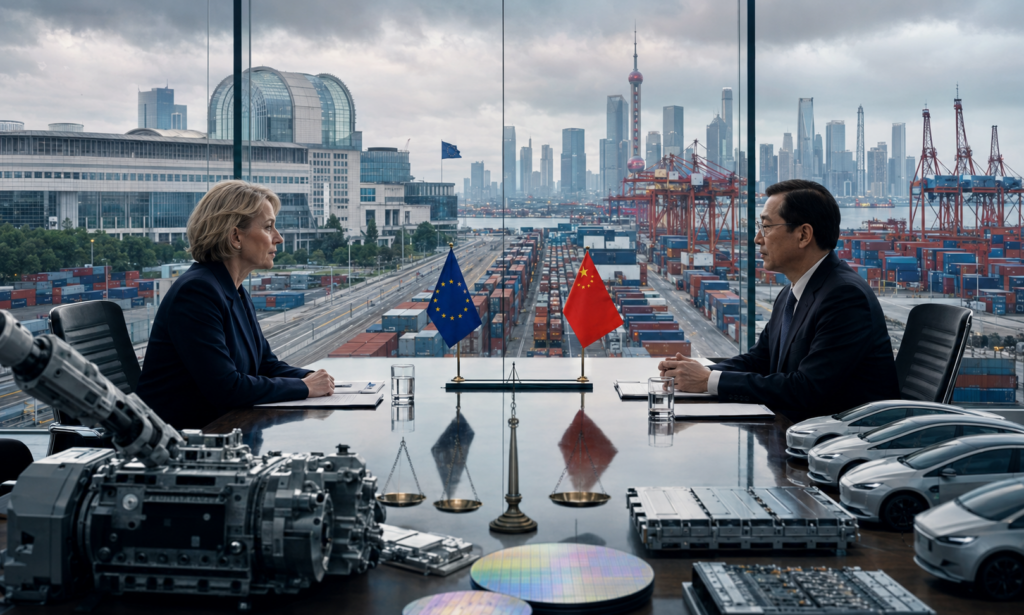
BRUSSELS, Belgium — The European Union’s relationship with China is entering a more confrontational phase, driven less by ideology than by an increasingly difficult economic calculation.
China remains an indispensable supplier, a major market and a potential partner in areas ranging from climate technology to artificial intelligence. But it has also become a formidable competitor in industries Europe once regarded as its own strengths: automobiles, machinery, chemicals, batteries and advanced manufacturing.
For years, European governments assumed that greater trade would gradually produce a more balanced relationship. Instead, Chinese exports to Europe have continued to rise while European companies’ share of the Chinese market has declined. China’s goods surplus with the European Union reached approximately €360.6 billion in 2025, 15 percent higher than the previous year, and continued to expand during the first months of 2026. EU Trade Commissioner Maroš Šefčovič has called that trajectory unsustainable.
The question facing Brussels is no longer whether it should respond, but how forcefully it can do so without provoking retaliation, damaging European companies operating in China or replacing one form of dependency with another.
A New Forum, With an October Test
On June 29, Mr. Šefčovič and China’s commerce minister, Wang Wentao, established the China-EU Trade and Investment Consultations, or TIC. It is intended to provide a regular ministerial channel through which disputes can be addressed before they become full-scale trade conflicts.
Four working groups will focus on:
- Balancing trade and investment;
- Export controls;
- Intellectual-property protection;
- Reform of the World Trade Organization.
The two sides also agreed to monitor trade flows and exchange information on unusual market developments. Ministerial meetings are expected once or twice a year, with the next session planned for October in Beijing.
The mechanism is more substantial than a ceremonial dialogue, but it is not yet a settlement. It contains no binding targets, automatic enforcement provisions or firm Chinese commitments to increase European imports.
Its credibility will therefore depend on practical results. European officials will look for faster approval of rare-earth export licences, improved access to Chinese public procurement, fairer treatment of European companies and fewer restrictions on data, technology and investment.
Mr. Šefčovič has said that October should produce “tangible results.” China, by contrast, appears to view the process as a longer-term framework for managing tensions and discouraging new European trade restrictions.
Beijing’s Strategy: Preserve Europe, Resist Its Conditions
China’s approach to Europe combines reassurance, economic incentives and carefully targeted pressure.
Publicly, Beijing advocates what it calls an “upward dynamic balance”: Europe should export more to China rather than restrict Chinese exports. Chinese officials have proposed deeper cooperation in artificial intelligence, green technologies, services and advanced manufacturing. They have also urged Europe to relax controls on high-technology exports and reject what Beijing describes as protectionism.
Foreign Minister Wang Yi repeated that message during a July 21 meeting with members of the European Parliament, presenting China and Europe as long-term partners capable of stabilising the international economy.
But China is also demonstrating that it is prepared to retaliate. On July 24, Beijing imposed export restrictions on 14 European entities after the EU sanctioned Chinese organisations accused of supporting Russia’s war economy. The restrictions cover Chinese-origin dual-use goods and potentially sensitive components.
This dual approach is likely to continue:
- keep the European market open;
- offer selected commercial opportunities to cooperative countries and companies;
- contest EU tariffs and local-content rules through negotiation and the WTO;
- use critical-material and export-control leverage when European measures affect Chinese interests;
- engage individual European capitals as well as EU institutions.
The last point is particularly important. Beijing understands that member states do not share identical interests. France and Italy have generally advocated stronger industrial defences, while Germany and Spain have traditionally placed greater emphasis on commercial engagement. Analysts have long warned that bilateral incentives can make it more difficult for the EU to maintain a common position.
China’s Domestic Weakness Increases Europe’s Importance
The argument that China needs Europe more because American market access is becoming difficult and Chinese households are saving rather than spending is broadly correct — but requires qualification.
China’s economy grew 4.3 percent year on year in the second quarter of 2026, down from 5 percent in the first quarter and below market expectations. Retail sales of consumer goods increased only 1.3 percent in the first half, while the broader official measure covering goods and services rose 2.7 percent. The property downturn, uncertain employment prospects and inadequate social protection continue to encourage precautionary saving.
Chinese households have not collectively “decided” to stop spending in a coordinated sense. Rather, many are responding rationally to falling property values, employment insecurity, limited pension and health coverage, and uncertainty about future income. Household deposits had already exceeded 160 trillion yuan by March 2025, illustrating the scale of precautionary savings.
Nor are all unemployment figures rising. China’s official unemployment rate for people aged 16 to 24, excluding students, fell from 15.6 percent in May to 14.9 percent in June 2026. But that level remains high, and a record 12.7 million university graduates are entering the labour market this year. Unemployment among 25- to 29-year-olds stood at 7.1 percent.
The more accurate conclusion is that China faces persistent weak domestic demand and elevated youth unemployment, even though the most recent unemployment readings have improved.
Manufacturing and exports have consequently become even more important. Industrial profits rose 18.7 percent in the first half of 2026, but much of that improvement came from exports, electronics and raw materials rather than a broad domestic recovery.
The American Factor
China’s need to preserve European access has also increased as its relationship with the United States remains unstable.
On July 24, Washington imposed new duties of 10 to 12.5 percent on goods from dozens of trading partners, including China and the European Union, under a forced-labour justification. Beijing called the measures protectionist and warned that they could undermine the fragile trade understanding reached with Washington.
The American market has not closed to Chinese goods, but it has become less predictable and more politically risky. That gives Chinese manufacturers a powerful incentive to expand in Europe and other markets.
For the EU, this creates bargaining power — but also danger. Goods displaced from the United States can be redirected into Europe, intensifying price pressure on European producers. European machine-tool manufacturers are already warning that China has overtaken Germany as the leading global exporter in parts of the sector. China’s share of global metalworking machinery exports rose from 8 percent in 2016 to 23 percent in 2025.
Europe’s leverage exists precisely because China values its market. But that leverage will decline if individual member states compete for Chinese investment and market access instead of negotiating collectively.
Germany Moves From Beneficiary to Front-Line State
No European country illustrates the change more clearly than Germany.
For decades, the relationship appeared complementary: Germany sold cars, machinery and chemicals to China, while importing consumer goods and components. That model is breaking down as Chinese companies move into higher-value industries and replace German imports with locally manufactured alternatives.
China became Germany’s largest trading partner again in 2025, with bilateral goods trade worth €252.4 billion. But the headline conceals a dramatic imbalance: Germany imported approximately €170.6 billion in goods from China while exporting only €81.3 billion.
The trend continued in 2026. German imports from China reached €72.4 billion between January and May, while the German import surplus with China widened to approximately €42.8 billion. Exports of German motor vehicles to China have fallen particularly sharply.
Germany is therefore no longer merely defending access to a profitable Chinese market. It is defending its industrial position both in China and at home.
Could China’s Position Benefit Germany and Europe?
Potentially — but only if Europe converts China’s need for market access into reciprocal conditions.
The opportunity for Germany and other EU countries lies in negotiating:
- Increased Chinese purchases of European goods and services;
- Equal access to Chinese government procurement;
- Enforceable protection of intellectual property;
- European employment and technology-transfer requirements for subsidised Chinese investment;
- Local production of batteries, vehicles and clean-energy equipment;
- Secure supplies of rare earths and other critical materials;
- Reciprocal environmental, safety and labour standards.
Chinese investment in European factories could create employment, reduce prices and accelerate the energy transition. Joint ventures can also give European companies access to efficient battery and manufacturing technologies.
But investment is not automatically beneficial. If Chinese companies assemble products in Europe using predominantly Chinese components, receive state support unavailable to European competitors and retain control over technology, Europe may gain factories while losing the wider industrial ecosystem.
The strongest European position would therefore be neither indiscriminate protectionism nor unconditional openness. It would be conditional access: Europe remains open to Chinese goods and investment, but only under transparent and reciprocal rules.
The Decision Europe Actually Faces
Europe does not have to choose simply between China and the United States. Nor can it realistically separate itself from either.
Its more credible course is strategic pragmatism:
- Cooperate with China on climate, health, trade and global stability;
- Diversify critical supply chains;
- Protect strategically important industries where unfair competition is demonstrated;
- Maintain trans-Atlantic security ties without automatically adopting every American trade measure;
- Negotiate with China through the EU rather than through competing national arrangements.
China’s economic pressures and its more difficult relationship with Washington give Europe a temporary negotiating advantage. But that advantage will benefit Germany and the rest of the EU only if the bloc remains united.
If Europe uses its market collectively, it can demand greater reciprocity while continuing to trade with China. If its members negotiate separately, Beijing will retain the stronger position — and the new consultation mechanism may become little more than a means of postponing a deeper confrontation.
Sources: Reuters, European Commission, Chinese Ministry of Commerce