
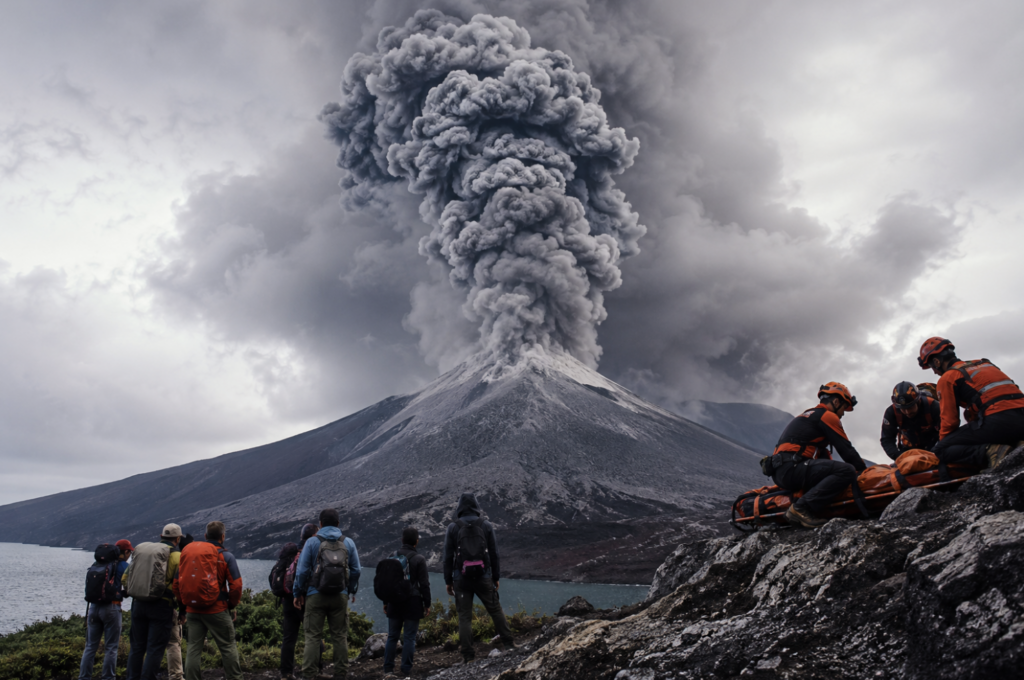
JAKARTA, Indonesia – At least three hikers were killed after Mount Dukono erupted violently on Friday morning, sending a towering ash plume nearly 10 kilometers into the sky and triggering a large-scale rescue operation on the remote Indonesian island of Halmahera.
Indonesian authorities said the victims included two Singaporean nationals and one Indonesian woman from the nearby city of Ternate. The hikers were part of a group of 20 Indonesians and Singaporeans who had reportedly climbed the volcano despite an active exclusion order and repeated government safety warnings.
Seventeen members of the group were rescued and evacuated, several suffering minor injuries and burns, while emergency teams continued difficult recovery operations near the crater amid ongoing eruptions and unstable terrain. Indonesian rescuers temporarily suspended parts of the search because of renewed volcanic activity and dense ash emissions.
A volcano under constant alert
The eruption occurred at approximately 7:41 a.m. local time, accompanied by a loud explosion and thick columns of ash visible for miles across North Maluku province. Indonesia’s volcanology agency maintained Dukono at the country’s third-highest alert level and reiterated that visitors are prohibited from approaching within a four-kilometer radius of the crater.
Scientists and disaster officials noted that Dukono is among the most persistently active volcanoes in Indonesia, erupting almost continuously since 1933. Authorities reported that activity has intensified sharply in recent months, with hundreds of eruptions recorded since March and increasing concerns over ash rain, toxic gases and sudden explosive bursts.
Volcanic ash drifted northward after Friday’s eruption, prompting warnings for nearby communities and transport operators. Although no major flight disruptions were immediately reported, disaster officials cautioned that changing wind conditions could affect regional aviation routes.
Social media tourism and ignored restrictions under scrutiny
The tragedy has reignited debate inside Indonesia over the rise of high-risk adventure tourism at active volcanoes — a growing trend fueled in part by social media travel culture and the demand for dramatic summit footage.
Authorities said the mountain had been officially closed to climbers weeks earlier after increased seismic activity. Indonesian police have launched an investigation into tour operators and organizers who allegedly facilitated the ascent despite the ban. Several individuals have reportedly been questioned.
Local officials and volcanologists warned that many travelers underestimate the unpredictability of Indonesia’s volcanoes, particularly those in remote eastern regions where eruptions can intensify with little notice.
Analysts in Indonesian media described the incident as part of a broader pattern in which safety advisories are routinely ignored at popular volcanic destinations. Tourism experts have also pointed to gaps in enforcement, guide certification and multilingual hazard communication for foreign visitors.
Regional concern in Singapore and renewed calls for stricter enforcement
The deaths of the two Singaporean hikers drew widespread attention in Singaporean media, where the incident prompted renewed discussions about outbound adventure tourism and traveler safety in high-risk destinations.
Officials in both countries have not yet released the full identities of the victims, pending family notifications. Singaporean authorities are believed to be coordinating with Indonesian agencies regarding consular assistance and repatriation procedures.
Disaster response experts say the Mount Dukono eruption underscores the difficult balance Indonesia faces as it attempts to promote eco-tourism while managing one of the world’s most volatile geological environments.
Located along the Pacific “Ring of Fire,” Indonesia sits atop some of the most seismically active tectonic zones on Earth and is home to more than 120 active volcanoes. Fatal eruptions and sudden ash events remain a recurring danger across the archipelago.