
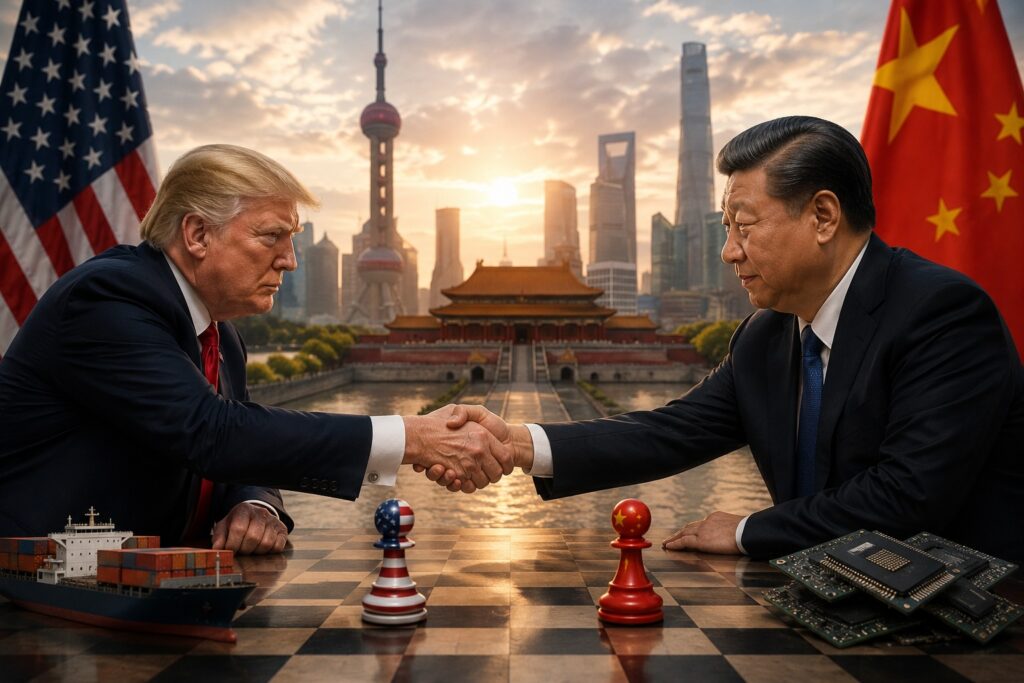
BEIJING, China — Chinese officials have confirmed that President Donald Trump will travel to Beijing from May 13 to 15 for a summit with Chinese leader Xi Jinping, marking the first visit to China by a sitting American president in nearly a decade and one of the most consequential diplomatic encounters between the two powers in years.
The meeting arrives at a moment of profound strain in U.S.-China relations. Once defined largely by trade interdependence, the relationship has hardened into a broad geopolitical contest encompassing tariffs, semiconductors, artificial intelligence, Taiwan, energy security and military influence across Asia and the Middle East.
While both governments have publicly framed the summit as an opportunity to stabilize ties, analysts in Washington, Beijing and Europe describe the meeting less as a breakthrough moment than as an attempt to prevent a deeper rupture between the world’s two largest economies.
CEOs, Commercial Deals and the Return of Transactional Diplomacy
Executives from several major American corporations — including Boeing, Citigroup, Qualcomm and other technology and finance firms — are expected to accompany Trump during the visit, underscoring the administration’s effort to place economic deliverables at the center of the summit.
Among the potential outcomes under discussion are large-scale Chinese purchases of Boeing aircraft, expanded agricultural imports from the United States and renewed investment frameworks designed to ease pressure on both economies after nearly two years of escalating tariffs and export controls.
Business leaders on both sides are cautiously optimistic that the summit could prolong the fragile trade truce reached after Trump and Xi last met in South Korea in October 2025. That agreement temporarily halted a spiraling tariff war that had seen both nations impose duties exceeding 100 percent on some goods.
Still, many economists warn that structural disagreements remain unresolved. Washington continues to accuse Beijing of unfair industrial subsidies, intellectual property violations and strategic overcapacity, while China has sharply criticized U.S. restrictions on semiconductor exports and investment barriers targeting Chinese firms.
From Trade War to Strategic Confrontation
The current tensions trace back to April 2025, when Trump unveiled sweeping global import tariffs affecting allies and rivals alike, reigniting protectionist policies that reshaped global supply chains and rattled financial markets.
China responded with retaliatory tariffs and export restrictions, particularly targeting rare earth minerals and industrial materials critical to American technology and defense manufacturing. The dispute rapidly evolved beyond trade into a broader struggle over technological dominance and geopolitical influence.
Since then, the rivalry has increasingly intersected with wider global crises, including instability in the Middle East, tensions in the Taiwan Strait and competition over artificial intelligence governance.
Recent reports suggest the Beijing talks will also cover Iran, maritime security and AI risk management, areas where both countries see growing strategic urgency despite their deep mistrust.
Taiwan and Technology Loom Over the Summit
Taiwan remains among the most politically sensitive issues on the agenda.
Chinese officials are expected to press Washington for stronger language opposing Taiwanese independence and may seek limits on future U.S. arms sales to Taipei. American officials, meanwhile, remain concerned about China’s military activity near the island and Beijing’s increasingly assertive regional posture.
Technology competition is expected to be equally central. Beijing has pushed for easing U.S. export controls on advanced chips and AI-related technologies, while Washington is seeking greater Chinese cooperation on rare earth supplies and fentanyl precursor exports.
Several foreign policy analysts describe the summit as a high-risk balancing act: China wants economic stability to support its slowing domestic economy, while Trump seeks visible commercial victories without appearing weak toward Beijing ahead of intensifying political battles at home.
A Summit Shaped by Global Anxiety
International reaction to the visit has been mixed.
Asian governments are closely watching for signs that either side could alter longstanding positions on Taiwan or regional security arrangements. European officials have privately expressed concern that any bilateral economic concessions could reshape global trade flows without broader allied consultation.
Financial markets, meanwhile, have reacted cautiously positively to the prospect of extended tariff pauses and renewed dialogue. But geopolitical analysts warn that the summit’s success may ultimately be measured not by sweeping agreements, but by whether Washington and Beijing can avoid another rapid descent into economic confrontation.
“The best realistic outcome,” one recent policy analysis concluded, “may simply be the avoidance of further escalation.”