
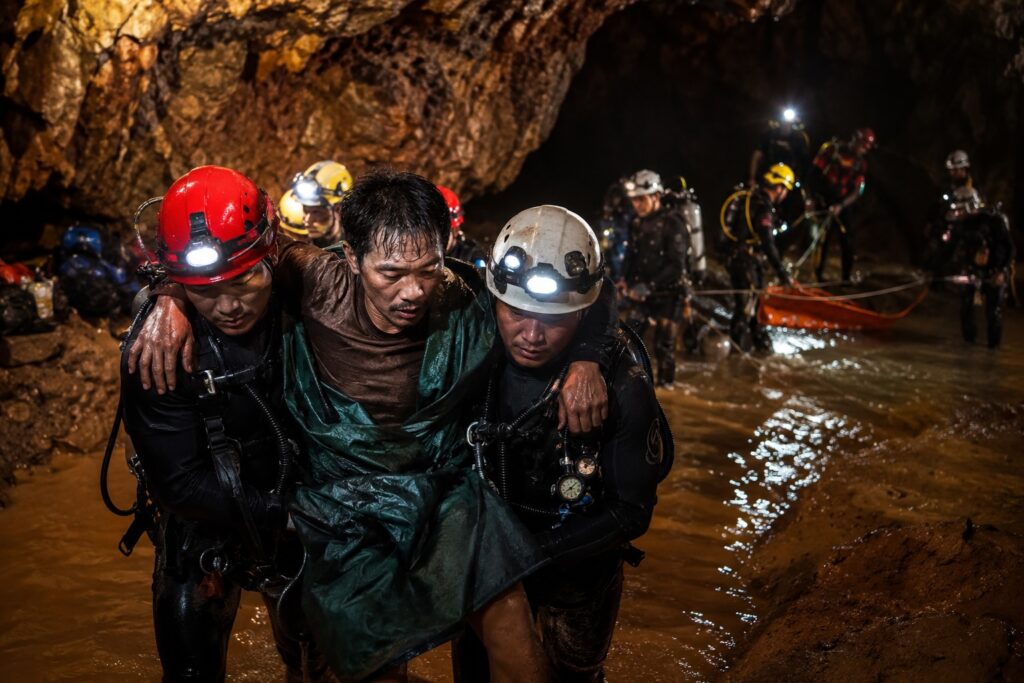
XAYSOMBOUN, Laos — Rescue teams in central Laos achieved a major breakthrough on Friday after successfully bringing the first survivor out of a flooded cave where a group of villagers had been trapped for more than a week following heavy rain and landslides.
The extraction marks the most significant development since rescuers located five survivors deep inside the cave system earlier this week. Two members of the original group remain missing.
The villagers had entered the cave in Xaysomboun Province reportedly in search of gold deposits and wildlife before torrential rainfall flooded passages and blocked the exit, trapping them underground.
A turning point in one of Southeast Asia’s most dangerous rescue operations
The successful evacuation of the first survivor signals that rescue teams may now be entering the most critical phase of the mission: moving weakened survivors through narrow, flooded tunnels that even experienced cave divers have described as exceptionally hazardous.
Specialist divers from Thailand, Australia, France, Indonesia, Japan and other countries have joined the operation, many bringing experience from previous high-profile cave rescues across Asia.
Rescuers have spent days delivering food, water and medical supplies while pumping floodwater from the cave and assessing whether survivors could safely navigate submerged passages.
Officials have not released detailed information about the survivor’s medical condition, but earlier reports indicated that those found alive were suffering from exhaustion, dehydration and prolonged exposure after spending days trapped underground.
“Diving in coffee”: Mud, floodwater and collapsing passages challenge rescuers
The cave’s extreme conditions continue to complicate the mission.
Divers have described visibility inside the flooded tunnels as nearly nonexistent, comparing the experience to “diving in coffee” because thick mud and clay suspended in the water make navigation extraordinarily difficult.
Some sections of the cave reportedly narrow to roughly 50 centimeters in width, forcing divers to maneuver through tight passages while transporting equipment and guiding survivors toward safety.
Experts involved in the operation say the Laos rescue differs from the famous 2018 Thailand cave rescue because the tunnels are shorter but significantly narrower, increasing the risks of evacuation.
Search continues for two missing villagers
Despite the successful extraction, the mission remains far from complete.
Rescue teams continue searching for two villagers who have not yet been located. Concerns are growing that continued rainfall, fluctuating water levels and deteriorating air conditions could further complicate rescue efforts.
Families gathered near the rescue site have followed developments anxiously, while messages recorded by trapped survivors and shared with relatives have drawn widespread attention across Southeast Asia.
The operation has become a rare moment of international cooperation in the region, bringing together volunteer rescue groups, cave-diving specialists and emergency teams from multiple countries.
For rescuers, however, the first evacuation is only the beginning.
Finding the survivors was the first victory. Bringing everyone home safely remains the far greater challenge.
The latest rescue reports indicate that international cave-diving teams have now shifted from search operations to active extraction efforts after successfully evacuating the first survivor, while the search for the remaining missing villagers continues.
Picture: AI