
International Rescue Veterans Join Search for Villagers Trapped Underground
VIENTIANE, Laos – Rescue teams in Laos are racing against worsening weather and rising floodwaters to reach seven villagers trapped for nearly a week inside a narrow cave system in the mountainous province of Xaysomboun, in what has become Southeast Asia’s most closely watched cave rescue effort since the dramatic Thai cave operation of 2018.
The group entered the cave last Wednesday searching for gold deposits and wildlife, according to local authorities and volunteer rescue organizations. Heavy rains and landslides later sealed parts of the entrance and flooded key passages, leaving the villagers trapped deep underground.
Officials say one survivor managed to escape and alert authorities, triggering a large-scale rescue mission involving Lao emergency workers, Thai volunteer rescue teams, military personnel, cave divers, and specialists who previously took part in the internationally renowned 2018 Thailand cave rescue.
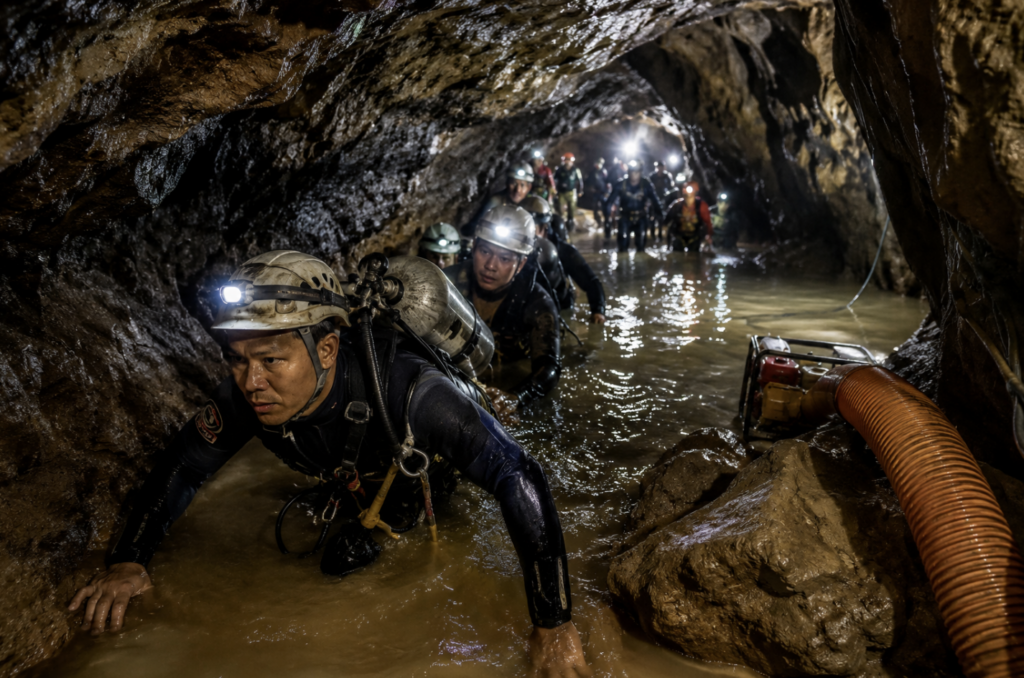
Footage released by rescue groups shows divers squeezing through muddy, nearly submerged tunnels barely wide enough for a single person. Some sections of the cave system reportedly narrow to just 50 centimeters, making movement exceptionally dangerous even for experienced cave divers.
Echoes of Thailand’s 2018 Cave Rescue
The operation has drawn comparisons to the rescue of 12 boys and their football coach trapped in Thailand’s Tham Luang cave system in 2018 — a mission that captivated the world and later inspired the films Thirteen Lives and The Rescue.
Among those assisting in Laos is Kengkard Bongkawong of the Thai rescue organization Metta Tham Rescue, who also participated in the Tham Luang operation. In a Facebook update, Kengkard said rescue crews believe they are “less than 20 meters away” from the chamber where the missing villagers may be sheltering.
“All day, all night, water was still being pumped out,” he wrote, describing the exhausting effort to lower water levels enough for divers to advance deeper into the cave.
Despite continuous pumping operations and the removal of rocks blocking parts of the entrance, rescuers say water levels remain unstable because of ongoing rainfall in the region. So far, no confirmed signs of life have been detected.
Rural Poverty, Informal Mining and Hidden Risks
The incident has also highlighted the dangerous realities facing many rural communities in Laos, one of Southeast Asia’s poorest countries. Informal gold prospecting and wildlife hunting remain common sources of supplemental income in remote mountainous regions where economic opportunities are limited.
Analysts say the rescue effort underscores broader concerns about unregulated cave exploration, weak rural infrastructure, and the increasing risks posed by extreme weather events linked to climate change across mainland Southeast Asia.
The cave in Xaysomboun, according to local rescuers, is frequently visited by villagers searching for small gold deposits. Such expeditions are often conducted without professional equipment, weather monitoring, or formal safety procedures.
Regional Solidarity and Growing Public Attention
The unfolding rescue has generated intense public attention across Laos and neighboring Thailand, where memories of the 2018 Tham Luang operation remain deeply emotional. Thai rescue volunteers and divers have once again emerged as key regional responders, reinforcing growing cross-border cooperation in Southeast Asian disaster response.
International cave rescue experts note that operations of this kind remain among the most technically difficult missions in emergency response because of limited visibility, unstable terrain, flooding, and the physical exhaustion faced by divers operating in confined spaces.
For now, rescuers continue working around the clock, balancing urgency against the dangers posed by the cave itself. With monsoon rains continuing in parts of Laos, officials warn that the coming hours may prove decisive.
Picture: AI