
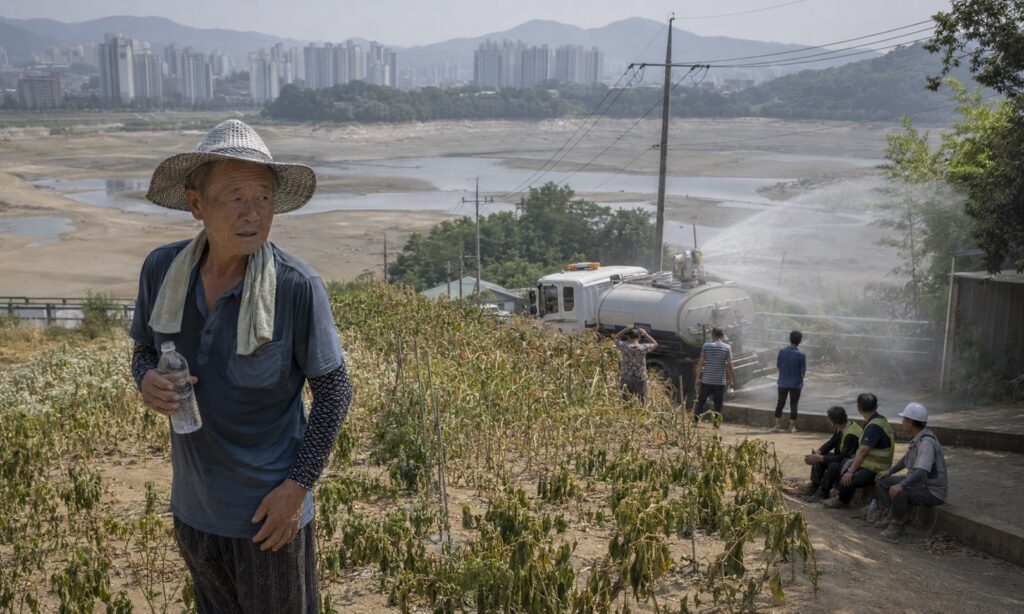
SEOUL, South Korea — An extraordinary heat wave has settled over South Korea, breaking the national temperature record repeatedly, contributing to at least 14 deaths and placing mounting pressure on farms, construction sites, reservoirs and the country’s electricity network.
The southeastern city of Yangsan recorded 42.5 degrees Celsius, or 108.5 Fahrenheit, on Sunday, the highest temperature measured during 122 years of Korean weather observations. It was the fifth consecutive day that the city exceeded 40 degrees, an intensity and duration once considered highly unusual on the Korean Peninsula.
The heat, initially concentrated in the southeast, has spread toward Seoul, Gyeonggi Province and western South Korea. The Korea Meteorological Administration issued its new highest-level “severe” heat warning in parts of the Seoul metropolitan area for the first time, while similarly grave warnings remained in effect across Busan, Ulsan, South Gyeongsang and portions of the southwest. Officials have described buildings without air-conditioning as potentially dangerous and urged residents to suspend outdoor activity during the hottest hours.
A Heat Dome Over the Peninsula
Meteorologists say two powerful atmospheric systems — the North Pacific High and the Tibetan High — have overlapped above the peninsula. Together, they have acted like a lid, suppressing clouds and trapping warm air close to the surface.
High sea-surface temperatures around Korea may be reinforcing the humidity and limiting overnight cooling. The result has been not only extreme daytime heat but persistent “tropical nights,” when temperatures fail to fall below 25 degrees Celsius.
Yangsan first surpassed the previous national record on July 31, reaching 41.4 degrees. Temperatures then rose further during the weekend, culminating in Sunday’s 42.5-degree reading. Other major cities, including Daegu, Gwangju, Seoul, Busan and Ulsan, have endured daytime highs generally in the mid- to upper 30s, with humidity making conditions feel still hotter.
South Korea’s weather agency had already assessed a 50 percent probability that August temperatures would be above the historical average, compared with only a 10 percent probability of below-average temperatures. It also warned that warmer-than-normal seas and strong high-pressure circulation could encourage further episodes of abnormal heat. Korea Meteorological Administration
The possible development of El Niño provides a broader background risk for elevated global temperatures, according to international forecasters. But no formal attribution study has yet determined precisely how much human-caused climate change or El Niño contributed to this particular Korean event. Scientists generally caution that such attribution requires model-based analysis after the event, even though the long-term warming trend makes extreme heat more likely and more severe.
Deaths and Illnesses Rise
From May 15 through the latest national reporting period, the Korea Disease Control and Prevention Agency recorded 1,889 heat-related illnesses and 14 suspected deaths.
The toll is almost certainly incomplete. Emergency surveillance figures generally include patients treated at participating hospitals, while deaths may be revised after medical investigation. People who become ill at home or who do not seek emergency treatment may not appear in the count.
Older adults, agricultural workers, construction laborers and people living without reliable air-conditioning face the greatest danger. Earlier surveillance data showed that roughly four-fifths of patients became ill outdoors, particularly at workplaces, farms and along roads. Men and people over 65 were disproportionately represented.
The government has raised its national heat response to the second-highest level. Prime Minister Han Seong-sook directed ministries and local governments to mobilize additional personnel and emergency funds. Municipalities have extended cooling-center hours, distributed drinking water and umbrellas, checked on isolated residents and increased street-spraying operations.
Seoul has also introduced limited financial assistance for lower-paid construction workers whose shifts are suspended during severe heat warnings. The measure addresses a persistent dilemma: stopping work protects laborers but can deprive daily workers and subcontractors of income.
Professional sports and public events have also been disrupted. The Korea Baseball Organization canceled games in Busan and Changwon during the weekend and said further schedule changes remained possible.
Farms Confront Mass Animal Deaths
The agricultural losses are already substantial. By July 30, authorities had recorded the deaths of more than 419,000 farm animals, predominantly chickens and ducks but also more than 25,000 pigs. Poultry houses are especially vulnerable because densely stocked buildings can heat rapidly, while pigs have limited ability to cool themselves.
Aquaculture farms reported the deaths of more than 130,000 fish, more than nine times the number recorded during the equivalent period last year. Warm water holds less oxygen, increasing the likelihood of mass mortality in enclosed fish farms and coastal pens.
For crop farmers, the consequences are less immediately visible but potentially longer-lasting. High temperatures accelerate evaporation, damage flowers and fruit, interrupt pollination and cause vegetables to wilt or mature unevenly. Irrigation demand rises precisely as small reservoirs and farm ponds decline.
There is not yet a complete national estimate of crop losses, and reports of damage vary widely by province. But prolonged heat and drought threaten rice, peppers, fruit, leafy vegetables and late-summer field crops. Previous Korean heat waves have produced sharp increases in cabbage and other vegetable prices, raising concern that this year’s event could contribute to another round of “heatflation.”
Water Remains Available — but Not Everywhere
The national government says South Korea’s major household and industrial water systems remain secure. The immediate concern is concentrated in the south and southeast, where monsoon rainfall was unusually poor.
Seven dams in the Nakdong, Yeongsan and Seomjin river basins are operating under drought-management designations. Unmun Dam, an important source for Daegu and nearby communities, has reached the most serious category.
Southern Korea received less than half its normal monsoon rainfall, while South Gyeongsang recorded only about 22 percent of normal rainfall during the preceding month. Officials expect the regional drought to continue until at least mid-August.
The presidential office nevertheless says reductions in withdrawals and connections to alternative sources should allow Unmun Dam to continue supplying household and industrial users for approximately 330 days even without significant rain. That projection means a broad urban or industrial cutoff is not imminent, but it does not eliminate local hardship.
Some agricultural reservoirs around Miryang have fallen to critically low levels, with two reported at effectively zero to 1 percent usable capacity. Islands and coastal settlements without access to large regional water networks have begun intermittent rationing. Those communities are receiving emergency water deliveries while authorities develop groundwater sources, connect pipelines and expand desalination capacity.
The distinction is important: South Korea is not facing a nationwide failure of drinking-water or industrial supply, but parts of its agricultural and isolated-island water systems are already under acute strain.
Industry and the Power Grid Under Pressure
The economic effects are spreading beyond agriculture.
Construction companies and other outdoor industries have shortened shifts, added rest periods or stopped afternoon operations. Heat reduces worker concentration and physical capacity, increases accident risk and can delay large infrastructure and industrial projects. Smaller subcontractors bear much of the cost because they have less flexibility to absorb schedule changes.
Factories must also spend more on cooling machinery, production floors and data facilities. Some temperature-sensitive operations may need to reduce output if cooling equipment approaches its limits, although no widespread manufacturing shutdown had been reported as of Aug. 4.
Electricity is the larger systemic concern. Air-conditioning demand is climbing sharply, and power authorities have activated emergency monitoring measures. The government entered the summer expecting national peak demand to reach roughly 98.8 gigawatts, already above the previous annual record. Authorities now expect the most difficult period to arrive in the second half of August, when factories return from summer holidays while household cooling demand remains high.
So far, officials have not reported a national supply failure. But sustained nighttime heat is particularly challenging because it prevents the usual evening decline in air-conditioning consumption and leaves less time for generating equipment to recover.
Little Immediate Relief in the Forecast
For the next several days, the Korea Meteorological Administration expects widespread daytime temperatures of approximately 33 to 38 degrees Celsius, with some inland and western locations potentially approaching 40 degrees. Seoul is likely to remain near the upper 30s, and overnight lows around 27 to 29 degrees will prolong the health risk.
Localized thunderstorms or brief showers are possible, particularly around the edges of the high-pressure system. Such storms could temporarily lower temperatures but are unlikely to provide the sustained, evenly distributed rainfall needed to replenish southern reservoirs. They may also bring flash flooding without materially easing the drought.
Through the middle of August, forecasters expect heat warnings and tropical nights to persist. Meaningful rain is not currently anticipated in the most drought-affected southern river basins before midmonth.
Beyond roughly 10 days, daily forecasts become substantially less reliable. The official monthly outlook nevertheless favors above-normal temperatures for August, with rainfall near the seasonal average overall. That does not guarantee relief: a monthly “normal” rainfall total can come from a few intense storms while long dry intervals continue elsewhere.
The path of tropical systems in the western Pacific remains another source of uncertainty. A typhoon could disrupt the high-pressure pattern and bring rain, but it could also transport additional tropical humidity toward Korea or create destructive wind and flooding. No specific storm should yet be treated as a dependable end to the heat wave.
For now, South Korea is preparing for a crisis measured not only by the height of the thermometer but by duration — day after day of dangerous heat, followed by nights too warm for people, animals, reservoirs or the power system to recover.
Sources: Korea Meteorological Administration, Seoul Economic Daily, SBS News