
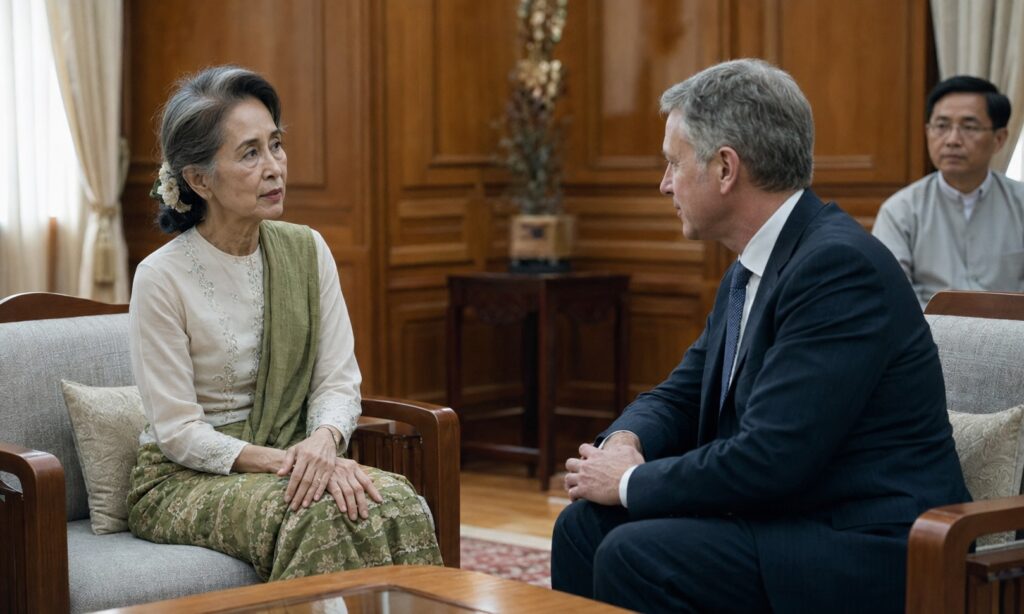
NAYPYIDAW, Myanmar — Aung San Suu Kyi, Myanmar’s deposed civilian leader, met privately on Monday with a senior representative of the International Committee of the Red Cross, providing the first independently confirmed contact between the 81-year-old Nobel laureate and an international official since the military seized power in February 2021.
Photographs released by Myanmar’s military-dominated government showed Ms. Aung San Suu Kyi standing, smiling and shaking hands with Arnaud de Baecque, the ICRC’s representative in Myanmar. In another image, apparently taken around her 81st birthday on June 19, she was shown cutting a cake.
She appeared alert and physically composed. But neither the photographs nor the visit amounted to a medical examination, and the ICRC disclosed no details about her health, detention conditions or conversation with Mr. de Baecque.
The organization said only that the visit followed its established procedures for people deprived of liberty and included an opportunity to speak with Ms. Aung San Suu Kyi in private. Under ICRC practice, findings from such visits are generally shared confidentially with the detaining authorities rather than released publicly.
A Carefully Controlled Proof of Life
Ms. Aung San Suu Kyi had been almost completely isolated from relatives, lawyers and independent observers since the coup. Although military officials repeatedly insisted that she was alive and receiving appropriate care, they had offered little verifiable evidence.
Her son, Kim Aris, who lives in Britain, had intensified an international campaign seeking proof of life after going more than two years without direct communication from his mother. He said the new photographs appeared genuine and that she seemed to be in good health, while emphasizing that a single visit was no substitute for regular family contact, independent access and her unconditional release.
The meeting is therefore significant as verified evidence that Ms. Aung San Suu Kyi was able to receive an international visitor and communicate privately. It does not establish the full extent of her health, her freedom of movement or the conditions under which she is being held.
The United Nations welcomed the ICRC’s access. A spokesman noted that the U.N. special envoy for Myanmar, Julie Bishop, had previously requested independent and verifiable information about Ms. Aung San Suu Kyi’s circumstances. The United Nations maintained its broader demand for the release of political detainees.
Detained Since the 2021 Coup
The military arrested Ms. Aung San Suu Kyi shortly after overthrowing her elected government on Feb. 1, 2021. Closed courts later convicted her of corruption, election-related offenses and other charges that supporters and international rights groups described as politically fabricated.
Her cumulative sentence initially reached 33 years and was subsequently reduced; current reporting places the remaining term at 18 years. She was later transferred from prison to house arrest, though the location and precise conditions of her confinement have remained unclear.
Her detention forms part of a much wider campaign of repression. Thousands of political opponents, activists, journalists and elected officials have been arrested since the coup, while armed resistance groups and ethnic forces continue to fight the military across large parts of the country.
Myanmar’s opposition National Unity Government described the Red Cross access as welcome but insufficient, arguing that the authorities should not receive political credit for allowing limited contact with a leader whom they had unjustly imprisoned. Domestic independent media similarly treated the photographs with cautious relief, while warning that the release appeared carefully timed and controlled.
A Gesture Amid a Push for Regional Acceptance
The images emerged as Min Aung Hlaing, the coup leader who now heads a nominally civilian administration, seeks to reduce Myanmar’s diplomatic isolation following military-organized elections held in stages in late 2025 and early 2026.
The vote excluded Ms. Aung San Suu Kyi’s dissolved National League for Democracy and could not be conducted across many conflict-ravaged areas. Critics contend that the new administration represents a consolidation of military power rather than a democratic transition.
Thailand welcomed the ICRC meeting, linking it to recent discussions among Southeast Asian foreign ministers and an anticipated visit by Myanmar’s president. The timing suggests that regional diplomacy may have helped secure access. Thai Ministry of Foreign Affairs
ASEAN governments continue to press Myanmar’s authorities to halt attacks on civilians, permit humanitarian assistance, begin an inclusive political dialogue and free those detained for political reasons. Myanmar’s senior leadership remains excluded from many of the bloc’s highest-level meetings because of its failure to implement ASEAN’s peace plan.
A Possible Opening — but Not Yet a Release Signal
Allowing the visit may be intended to demonstrate limited cooperation before further regional engagement. It could also reflect recognition that prolonged secrecy over Ms. Aung San Suu Kyi’s condition had become diplomatically costly.
But there is not yet sufficient evidence to conclude that the military is preparing to release her. No timetable, legal review or change in her sentence was announced, and the government has not committed to further visits, family communication or broader access to political prisoners.
For Ms. Aung San Suu Kyi’s family and supporters, the photographs answer one urgent question: she is alive and appears outwardly stable. The larger questions — whether she will be allowed regular independent contact, whether her health can be properly assessed and whether she will be freed — remain unresolved.
Sources: U.N., International Committee of the Red Cross, Thai Ministry of Foreign Affairs
Photo: AI generated