
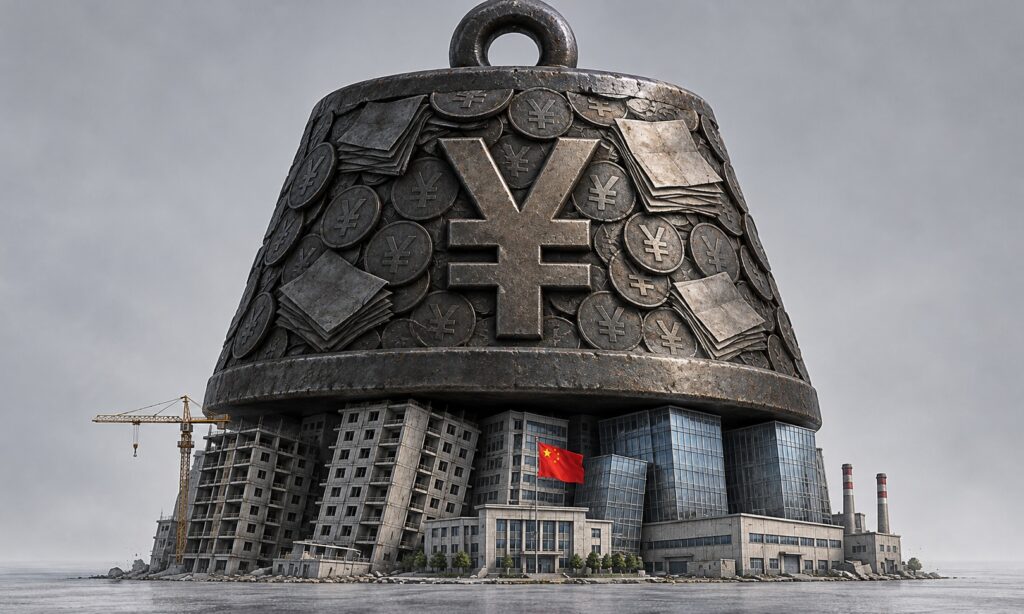
BEIJING, China – China is expanding government borrowing capacity again as weak consumption and a prolonged property downturn strain its economy. The intervention underscores a difficult policy choice: supporting growth today while addressing debts that could constrain it for years.
On October 9, Beijing allocated 550 billion yuan in unused local-government debt quotas to support public finances and investment. Of that amount, 300 billion yuan was designated for county- and district-level government operations, according to the Finance Ministry announcement reported by Reuters. These are borrowing authorizations, rather than evidence that the money has already been spent.
What the Debt Figures Actually Measure
China’s debt burden extends well beyond its government accounts. Bank for International Settlements data published through the Federal Reserve’s FRED database put credit to the country’s nonfinancial sector at 300.1 percent of gross domestic product at the end of 2025. That measure includes government, corporate and household borrowing. It is not a sovereign-debt ratio.
The International Monetary Fund’s February country report projected nonfinancial-sector debt at 323 percent of GDP in 2026, using its own methodology. Its broader measure of government-related debt, including local financing vehicles and certain off-budget funds, was projected at 135.3 percent. Both are forecasts, and the overlapping measures cannot be added together.
Beijing disputes parts of that broader classification. In the IMF report, Chinese authorities argued that commercial obligations of local financing vehicles should not automatically count as government debt, and maintained that fiscal risks remained manageable. The disagreement concerns which liabilities taxpayers may ultimately have to bear.
Local Debts, Weak Household Demand
Local government financing vehicles, commonly known as LGFVs, sit at the center of the problem. These companies borrowed to fund infrastructure and development outside conventional budgets. The property downturn has weakened local land-sale revenues, while some projects generate insufficient income to service their obligations. Refinancing can reduce immediate repayment pressure without restoring their commercial viability.
The wider economy offers limited relief. In its October 6 outlook, the World Bank forecast Chinese growth of 4.4 percent for 2026, citing a soft labor market and continuing property-sector adjustment as constraints on domestic demand.
The argument for a stronger response is also being made inside China. Huang Yiping, a member of the central bank’s monetary policy committee, argued in September that the central government should consider additional borrowing to help repair the finances of strained local governments, financial institutions and companies. He also urged policies to raise household incomes and strengthen consumption. His proposals were recommendations, rather than announced government policy.
The Risk of a Prolonged Drag
China has substantial tools to contain immediate financial stress. Domestic savings have financed much of its credit expansion, while capital controls and state-owned banks make it easier to roll over troubled loans.
Those protections can also delay the recognition of losses. Economists writing for the Dallas Fed have identified growing evidence of lending that keeps unprofitable businesses operating, drawing parallels with Japan’s experience. Such practices can tie up capital and weaken productivity even without a sudden banking collapse.
The IMF’s September study of local-government finances recommends restructuring unsustainable obligations through corporate insolvency procedures, coordinated by the central government and accompanied by fiscal reforms. Its broader advice calls for stronger household support and social protection, alongside a retreat from inefficient investment. Implementing those changes would require politically difficult decisions about creditor losses, public spending and the distribution of income.