
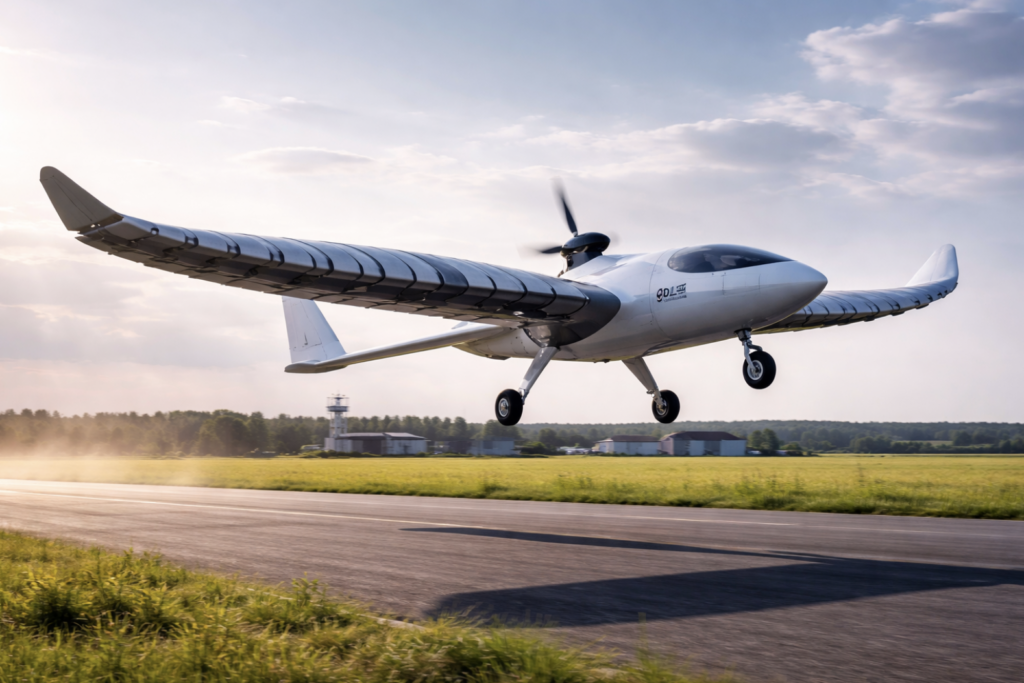
BERLIN, Germany — A new generation of aircraft wings that can change shape mid-flight — long imagined in aerospace research — has taken a significant step toward reality.
Engineers at the German Aerospace Center (DLR) have successfully conducted early flight tests of a morphing wing system designed to make aircraft more efficient, more controllable and potentially safer. The experimental platform, an unmanned aircraft known as PROTEUS, was equipped with both conventional wings and a novel adaptive wing configuration, allowing researchers to compare performance under real flight conditions.
The trials, conducted at a national test center for unmanned aerial systems in Cochstedt, mark one of the most advanced demonstrations yet of adaptive wing technology outside laboratory settings.
A Wing That Adapts in Real Time
At the core of the project — known as morphAIR — is a wing capable of continuously reshaping itself during flight. Unlike traditional aircraft surfaces, which rely on discrete control elements such as flaps and ailerons, the morphing wing transitions smoothly between configurations.
“The morphing wing can adjust its shape in flight to optimally match different aerodynamic conditions,” said Martin Radestock, project lead at DLR’s Institute of Lightweight Systems.
This adaptability allows the aircraft to respond dynamically to changing speeds, altitudes and maneuvers, potentially reducing drag while improving lift and handling.
Replacing Mechanical Surfaces With Smart Materials
The breakthrough lies in a system called Hyperelastic Trailing Edge Morphing (HyTEM). Built entirely from advanced fiber composite materials, the wing’s trailing edge can deform seamlessly without gaps or mechanical hinges.
Instead of large moving flaps, HyTEM distributes control across multiple small actuators embedded along the wing span. These actuators adjust the wing’s profile at up to ten distinct points, creating a smooth aerodynamic surface.
The result: lower aerodynamic resistance, more precise control of lift and drag, and improved flight stability. Researchers also point to enhanced safety — since control authority is distributed across the wing, the system can remain functional even if individual components fail.
Artificial Intelligence at the Controls
Equally critical to the system is an AI-driven flight control architecture developed by DLR’s Institute of Flight Systems.
Unlike conventional control systems, which rely on fixed models, this learning-based algorithm continuously adapts during flight. It detects discrepancies between predicted and actual aircraft behavior and updates its internal models in real time.
The system is also trained to handle failures: simulations expose it to damaged components and actuator loss, teaching it to redistribute control and maintain stability.
This approach reflects a broader shift in aerospace engineering, where adaptive control systems are increasingly paired with flexible structures to unlock new performance gains.
Recent international efforts — including NASA’s adaptive wing research and European Union clean aviation programs — similarly emphasize morphing structures as a pathway to lower emissions and improved efficiency.
Giving Aircraft a “Sense” of Airflow
To further enhance responsiveness, DLR researchers developed a method to reconstruct the pressure distribution across the wing using only a limited number of sensors.
This capability effectively gives the aircraft a real-time awareness of its surrounding airflow. By comparing measured and expected pressure fields, the system can detect disturbances — such as turbulence or structural anomalies — and respond immediately.
Such sensing capabilities are considered crucial for future autonomous aircraft, where onboard systems must interpret complex aerodynamic environments without human intervention.

From Experimental Flights to Scalable Aviation
Initial flight tests demonstrated the successful integration and basic operability of both conventional and morphing wings on the PROTEUS platform. While the experiments were conducted at a reduced scale, the aerodynamic design — capable of speeds up to 300 kilometers per hour — is already relevant for light aircraft applications.
In 2026, DLR plans a new series of tests with a 70-kilogram PROTEUS aircraft to validate scalability. The findings will feed into the follow-up project UAdapt, focused on advancing adaptive wing technologies for unmanned aviation.
A Broader Shift in Aircraft Design
Morphing wings have long been a goal of aerospace engineers seeking to reconcile competing design constraints — efficiency at cruise versus maneuverability at low speeds.
What distinguishes the DLR effort is the integration of materials science, distributed actuation and artificial intelligence into a single operational system.
As global aviation faces mounting pressure to reduce emissions and improve efficiency, such innovations could reshape aircraft design in the coming decades — replacing rigid structures with systems that learn, adapt and evolve in flight.
Photos: Deutsches Zentrum für Luft- und Raumfahrt