
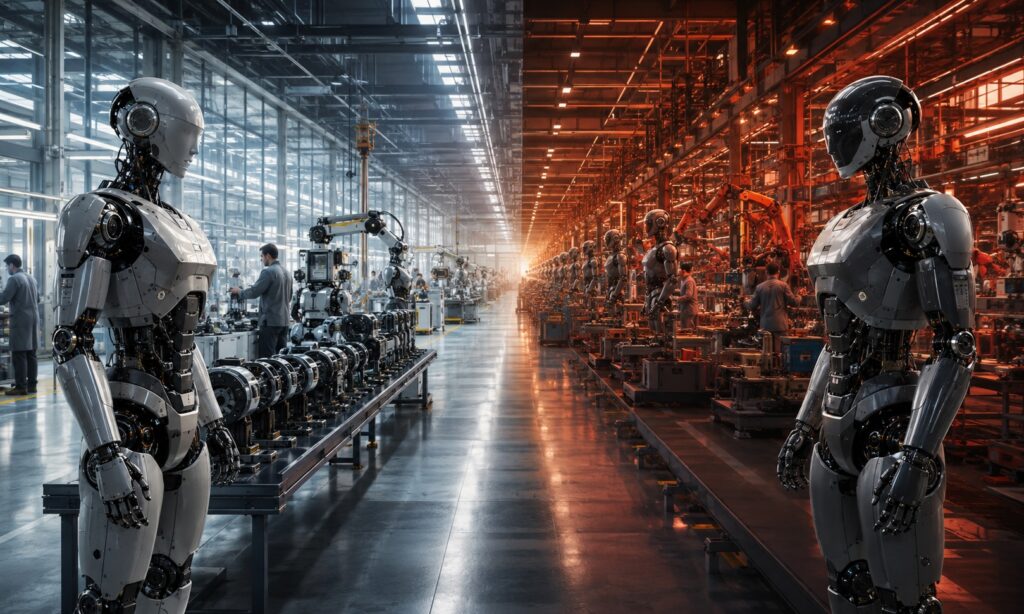
BERLIN, Germany – At the Hannover trade fair this spring, the future appeared close enough to touch. A humanoid robot raised its arm, turned toward a visitor and offered a hand. The gesture was smooth, controlled and undeniably impressive. It was also an apt symbol of Europe’s position in the emerging robotics race: world-class engineering was on display, while large-scale production was happening somewhere else.
That contrast has fueled an increasingly anxious argument in Germany. China, the argument goes, is already shipping thousands of humanoid robots while Europe is still polishing prototypes. The concern is justified. But the most widely repeated figures collapse several different markets into one — research machines, entertainment robots, wheeled systems, industrial pilots and genuinely autonomous factory workers — and then treat every shipment as proof of productive use.
The more accurate picture is less theatrical and more consequential. China has established a formidable lead in price, volume, supply chains and the speed at which machines can be placed in the world to collect data. Germany retains advantages in industrial integration, precision components, safety engineering and access to demanding manufacturing customers. The race is real, but it will not be decided by a viral video or by a single annual shipment chart.
The Numbers Behind the Alarm
Omdia estimated that roughly 13,000 humanoid robots were shipped worldwide in 2025. Nearly 90 percent were made by Chinese companies. That means China did not itself sell all 13,000, as some social-media posts have claimed; its share was closer to 11,500 to 12,000. The distinction hardly erases the lead. It merely makes the comparison accurate.
Unitree later said it had sold and delivered more than 5,500 pure humanoid robots in 2025. AgiBot reported 5,168 shipments, or 39 percent of the global total measured by Omdia. By comparison, Figure AI, Agility Robotics and Tesla each shipped roughly 150 units, according to the same market reporting. The top of the table was overwhelmingly Chinese.
A more relevant industrial benchmark comes from UBTECH, the publicly listed maker of the Walker series. The company says it sold 1,079 full-size embodied humanoids in 2025 and that more than 80 percent went to automotive manufacturing, logistics, electronics, semiconductor and aerospace work or industrial data collection. Those are company-reported figures, but they show that China’s lead is not limited to inexpensive research platforms.
China’s Ministry of Industry and Information Technology has also counted more than 140 domestic humanoid manufacturers and more than 330 models released during 2025. Those figures capture the extraordinary breadth of the ecosystem. They also suggest overcrowding. Chinese officials have warned that the sector risks producing repetitive models faster than it develops durable commercial uses.
One of the most dramatic China stories, however, was simply wrong. Reports claimed that BYD already had about 150 humanoids working in factories and intended to deploy 20,000 by the end of 2026. BYD denied those figures. As late as July, the company was preparing the first public presentation of its humanoid robot for August. BYD may eventually become an important manufacturer, but the 20,000-unit claim is not evidence of current scale.
The word that matters is “shipped.” A robot sent to a university laboratory, a showroom, a government-backed training center or a rental company counts as a shipment. It does not necessarily perform an eight-hour production shift. Reuters reported that most of the roughly 12,000 humanoids sold in China in 2025 went to research, education and testing rather than full commercial or industrial deployment.
A Cheap Robot Is Not Yet a Factory Worker
The Unitree G1 is now advertised from $13,500, excluding tax and shipping. That price is a genuine manufacturing achievement, but it is not directly comparable with the cost of a fully integrated industrial system. The base G1 is a compact platform aimed largely at education, research and development. Unitree itself cautions buyers that the global humanoid industry remains in an early stage and that users should understand the machines’ limitations.
Tesla’s often-cited $20,000 to $30,000 figure for Optimus is not a retail price. It is a long-term target for a robot that is not yet publicly orderable. NEURA Robotics, by contrast, lists an estimated price of €98,000 for one to 19 units of its full-size 4NE1 Gen 3.5 and €60,000 per unit for orders of 20 or more, excluding tax and shipping. Deliveries are expected to begin at the end of 2026.
The real economic comparison will therefore be measured not by sticker price but by the cost of a successful, unattended hour of work. Factories will care about intervention rates, cycle time, battery management, mean time between failures, integration costs, safety approvals and the availability of technicians and spare parts. On those measures, almost every humanoid vendor still has more to prove than its promotional videos suggest.
NEURA’s Billion-Dollar Wager
NEURA Robotics, founded in 2019 in Metzingen, has become Europe’s most visible answer to the American and Chinese humanoid boom. In June, the company announced a Series C financing of up to $1.4 billion. The Financial Times reported a valuation of roughly $7 billion. Backers include Nvidia, Amazon, Qualcomm, Tether, Bosch, Schaeffler, the European Investment Bank and other industrial and financial investors.
The wording is important. The round is worth “up to” $1.4 billion, and NEURA described it as the largest financing round for a full-stack robotics company — not the largest fundraising by any German company. Its published figure of more than $1 billion also combines an order book with a strategic deployment pipeline, which is broader than a backlog of firm, near-term purchase orders.
Still, NEURA is more than a single humanoid prototype. It already offers collaborative robot arms, cognitive industrial robots and autonomous mobile transport systems. Its strategy is to connect these machines through the Neuraverse, a software and data platform, and to train them in so-called NEURA Gyms using both real-world and simulated tasks. For European manufacturers, the promise includes local control of production data and a system designed around collaboration with human workers.
The 4NE1 humanoid is the centerpiece of that ambition. Schaeffler has said it intends to integrate a mid-four-digit number of NEURA humanoids into its global operations by 2035. But as of August 2026, NEURA has not publicly demonstrated a comparable record of large-scale humanoid deliveries. Its plan to produce several million robots by 2030 should be read as a stretch target, not a forecast.
That leaves NEURA in an unusual position: exceptionally well financed, connected to some of Europe’s strongest industrial groups and technically credible, but still approaching the point at which customers can test the product in sustained production. Its next milestone is not another demonstration. It is the first repeat order from a customer whose initial robots have completed useful shifts at an acceptable total cost.
Germany Has More Than One Robotics Unicorn
By the strict venture-capital definition — a privately held company valued at more than $1 billion — Germany has two clear names in industrial robotics. NEURA is now the larger on paper. Agile Robots, based in Munich, crossed the threshold in 2021 after a $220 million financing round led by SoftBank Vision Fund 2.
Agile Robots is a different kind of contender. Its business includes robot arms, automated systems and factory integration, while its humanoid work remains in early pilots. The Wall Street Journal reported that the company generated about €300 million in revenue in 2025 and expected to double that figure in 2026. Its acquisitions, including automation businesses with established factory customers, give it something many humanoid start-ups lack: revenue, integration experience and installed industrial relationships.
If the definition expands beyond factory robotics to autonomous machines, Quantum Systems also belongs on the list. The German drone and autonomous-systems company raised $1.2 billion at a valuation of roughly $8 billion in July 2026. It is not a humanoid competitor, but its growth demonstrates that European investors and industrial partners can fund complex hardware when demand is clear.
RobCo, a Munich company building modular robotic arms and software for smaller manufacturers, is another company to watch, though it does not yet qualify as a unicorn. Its focus is a reminder that the greatest near-term gains from physical artificial intelligence may come from flexible, nonhumanoid automation rather than machines designed to resemble people.
Europe’s Smaller, More Specialized Field
The European field extends beyond Germany, though it remains thinner and less heavily financed than China’s. In France, Wandercraft has transferred technology from medical exoskeletons to Calvin-40, an industrial humanoid developed with Renault. The company says first series deliveries are expected in the first half of 2027, and Renault has committed to a fleet of 350 robots by that year.
Spain’s PAL Robotics has more than two decades of experience in humanoid and service robots and a large European research network. Italy’s Oversonic Robotics is developing RoBee for industrial, logistics and health-care environments. These companies have valuable specialist knowledge, but neither currently matches NEURA’s financing or the shipment scale of Unitree and AgiBot.
Norway’s 1X is often included in European comparisons, although it is outside the European Union and now describes itself as based in Palo Alto. Its NEO robot is aimed primarily at the home. Britain also has well-funded humanoid ventures, but post-Brexit they are not EU companies. Europe’s competitive landscape is therefore less a single bloc than a collection of national clusters with different products, investors and routes to market.
That fragmentation is a weakness in mass production but can be an advantage in specialization. European companies are developing robots around medical rehabilitation, industrial safety, logistics, service work and data-sensitive manufacturing. They may not need to beat China in total unit volume if they can own high-value applications where certification, process knowledge and long-term support matter more than the lowest initial price.
The Parts May Matter More Than the Brand
Germany’s most defensible position may lie partly inside the robot. Schaeffler won the 2026 Hermes Award for a compact, highly integrated actuator platform designed for humanoid joints. The company says the system reduces installation space by about 20 percent and addresses one of the largest cost categories in a humanoid robot. It planned to begin series production of components in 2026.
Schaeffler is working not only with NEURA but with several robot manufacturers and intends to deploy humanoids from more than one supplier in its own factories. That gives it a “picks and shovels” position: it can sell joints, bearings, drives and related systems regardless of which robot brand ultimately leads.
This is a familiar German industrial model. The country does not always own the consumer-facing brand, but it often captures value through precision components, production equipment, engineering services and integration. In humanoids, however, that strategy carries a risk. If control software, data and learning platforms become the most valuable layers, supplying excellent hardware alone may not be enough.
China Versus Germany Is Not One Race
China’s advantage is strongest where cost, iteration speed and hardware availability dominate. Its dense supply chains allow companies to revise motors, reducers, batteries, sensors and hands quickly. Thousands of shipped robots create a data flywheel: more machines generate more failures, demonstrations, teleoperation sessions and task data, which can be used to improve the next software release.
Germany’s advantage is strongest inside existing industrial systems. German and European plants contain decades of specialized machinery, safety procedures, enterprise software and worker knowledge. A robot that can be connected reliably to those systems, serviced locally and trusted with proprietary production data may justify a higher purchase price.
The likely market will therefore split. Chinese companies should continue to lead the global volume and price curves. European suppliers can remain competitive in regulated, safety-sensitive and intellectual-property-intensive settings. Some factories will use Chinese hardware with European integration and components. Others will pay a premium for a European stack. Many will decide that a conventional robot arm, mobile platform or customized machine remains faster and more reliable than a humanoid.
The Hardest Forecast in Manufacturing
It is reasonable to expect many more humanoids on factory floors by 2028. Early tasks will be narrow and structured: moving containers, feeding machines, sorting parts, conducting visual inspections and handling repetitive work at stations designed for people. These are precisely the jobs where the human form may avoid an expensive factory redesign.
It is much harder to predict when humanoids will become general-purpose workers. Dexterous manipulation, recovery from unexpected events, battery life and reliable reasoning in changing environments remain unresolved at commercial scale. A machine that succeeds 95 percent of the time can be impressive in a laboratory and disruptive in a production line if the remaining 5 percent requires a technician.
The base case for the next several years is not a sudden replacement of factory labor. It is a gradual expansion of paid pilots, followed by fleet purchases only where the economics work. The strongest vendors will publish operational evidence: hours worked without intervention, task-success rates, deployment time, service costs and repeat orders. Shipment totals will matter, but productive hours will matter more.
For NEURA, 2027 and 2028 are likely to be decisive. If 4NE1 moves from first deliveries to repeatable customer installations, the company could become the preferred European premium provider for manufacturers concerned about safety, data and local support. If the ramp slips or the economics remain unattractive, NEURA may still build a valuable business in cognitive arms, mobile robots, software and components without matching China’s humanoid volumes.
Germany may never lead the world in the number of humanoid bodies shipped. It can still capture a large share of the value — if its robotics start-ups, component suppliers and manufacturers turn industrial depth into products before China’s lead in volume becomes an unassailable lead in data. The handshake at the trade fair was a beginning. The contest will be decided by what the robot can do after the visitor lets go. (AT/hz)
Reporting Notes and Sources
Company figures are identified as company-reported where relevant. Market totals vary with definitions of humanoid, embodied and wheeled robots. Sources accessed August 11, 2026.
Sources: AgiBot / Omdia, Unitree, UBTECH, China State Council Information Office, Reuters, NEURA Robotics, Financial Times, Agile Robots, WSJ, Wandercraft, PAL Robotics, Oversonic Robotics, BYD