
President Steinmeier Links Maritime Risks in Asia to Lessons From the Strait of Hormuz
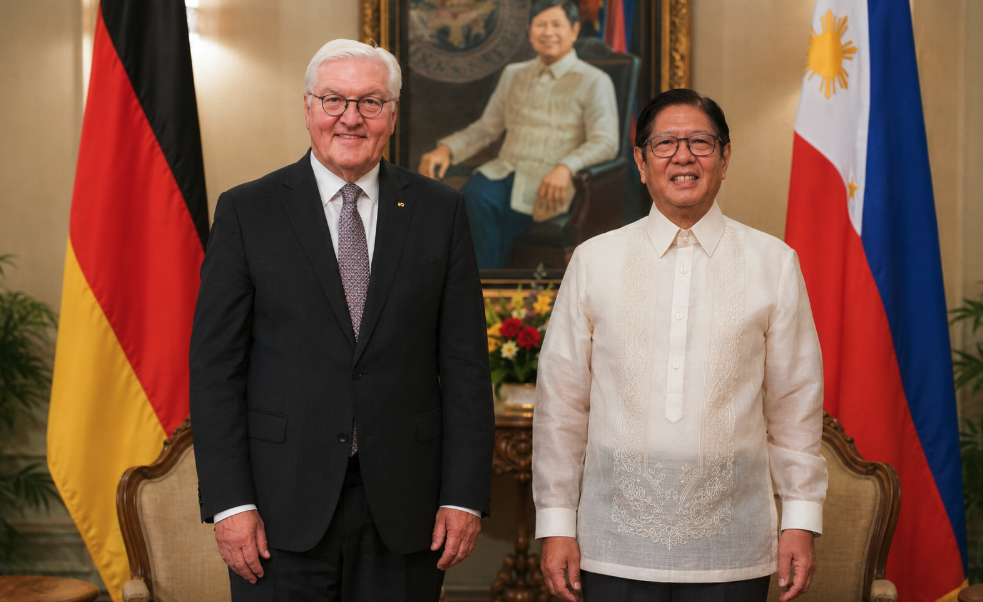
MANILA, Philippines — German President Frank-Walter Steinmeier has warned that escalating tensions in the South China Sea pose growing risks not only to regional stability but also to the global economy, drawing direct parallels with the recent disruption of shipping through the Strait of Hormuz. During a state visit to Manila, Steinmeier said Europe is increasingly concerned that confrontations in one of the world’s most important maritime corridors could undermine international trade, energy security and freedom of navigation.
Appearing alongside Philippine President Ferdinand Marcos Jr., Steinmeier emphasized that Southeast Asia remains one of the most economically dynamic regions in the world and that any disruption to maritime commerce would have consequences far beyond Asia. He noted that the recent closure of the Strait of Hormuz—an event that triggered spikes in global fuel and fertilizer prices—demonstrated how quickly regional conflicts can generate worldwide economic shocks.
Germany Expands Its Indo-Pacific Security Role
The visit reflects Germany’s steadily expanding engagement in the Indo-Pacific, a region increasingly viewed by European policymakers as central to global economic and strategic stability. Berlin has strengthened defense and security ties with Manila in recent years, including agreements on defense cooperation, maritime security, logistics and cybersecurity. Germany has also deployed naval assets to the Indo-Pacific and repeatedly affirmed its support for freedom of navigation and adherence to international maritime law.
Steinmeier reaffirmed Germany’s commitment to assisting the Philippine Coast Guard, which has become a focal point in recurring maritime incidents involving Chinese and Philippine vessels in disputed waters. His remarks align with previous statements by German officials expressing concern over actions that could raise the risk of miscalculation or confrontation in the region.
The South China Sea Remains a Strategic Flashpoint
The South China Sea is among the world’s most important maritime trade routes, carrying an estimated one-third of global shipping traffic. The dispute involves overlapping claims by the Philippines, China, Vietnam, Malaysia, Brunei and Taiwan. While the United States claims no territory in the region, Washington has repeatedly stated that its mutual defense treaty obligations apply if Philippine forces, vessels or aircraft come under armed attack.
China continues to assert expansive claims over much of the South China Sea and rejects international criticism of its activities. Beijing has consistently opposed external involvement in the dispute and maintains that disagreements should be resolved through direct negotiations among the parties concerned. At the same time, China has dismissed the landmark 2016 arbitration ruling initiated by the Philippines, arguing that the tribunal lacked jurisdiction and that the decision is legally invalid.
Renewed Focus on the 2016 Arbitration Ruling
A central theme of the Manila discussions was continued international support for the 2016 arbitral award issued under the United Nations Convention on the Law of the Sea (UNCLOS). The ruling concluded that China’s “nine-dash line” claims had no legal basis under international law and affirmed the maritime rights of the Philippines within its exclusive economic zone. China has never accepted the decision and continues to reject its findings.
President Marcos thanked Germany for consistently supporting the rule of law and calling for compliance with the arbitral award. International backing for the ruling has gradually expanded in recent years, with a growing number of countries publicly reaffirming its legal significance amid broader concerns about maintaining a rules-based international order.
ASEAN, Europe and the Search for Stability
Steinmeier also voiced support for efforts by the Association of Southeast Asian Nations (ASEAN) to finalize a long-negotiated Code of Conduct for the South China Sea, a framework intended to reduce tensions and prevent maritime incidents. Analysts view progress on the code as increasingly important as regional military activity intensifies and geopolitical competition between China and the United States continues to shape security dynamics across the Indo-Pacific.
Security experts note that Europe’s growing attention to the South China Sea reflects a broader strategic shift. The war in Ukraine, disruptions to global supply chains and recent instability in Middle Eastern shipping lanes have reinforced the view among European governments that distant maritime chokepoints can have immediate economic consequences at home. As a result, European nations are becoming more active supporters of international maritime law, freedom of navigation and multilateral security cooperation in Asia.
Outlook
Steinmeier’s visit underscores the increasingly international nature of the South China Sea dispute. What was once viewed primarily as a regional territorial conflict is now seen by many governments as a test of the international maritime order and the resilience of global trade networks. As tensions persist between China and the Philippines, and as external powers deepen their involvement, the challenge for regional leaders will be preventing localized confrontations from evolving into a broader crisis with worldwide economic consequences.
Source: AP