
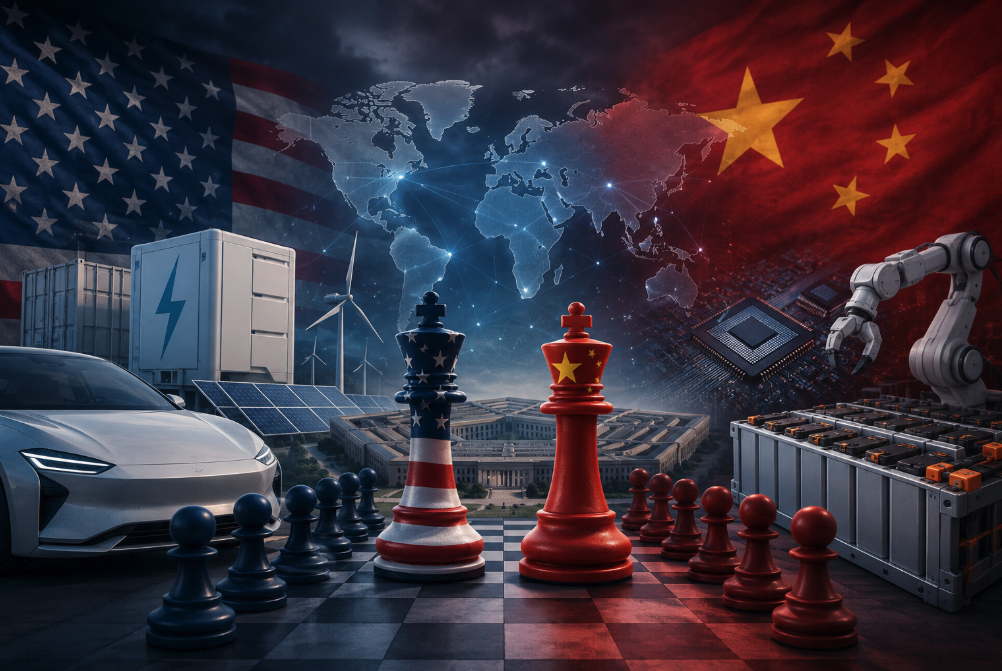
New U.S. Designations Deepen Technology and Supply Chain Tensions Between Washington and Beijing
BEIJING, China – The United States has expanded its list of companies designated as Chinese military-linked entities, adding major electric vehicle, battery and technology firms including BYD, Nio, EVE Energy, Alibaba and Baidu in a move that underscores the intensifying strategic competition between Washington and Beijing over advanced technologies, energy security and industrial leadership.
The additions were published by the U.S. Department of Defense under Section 1260H of the National Defense Authorization Act (NDAA), which identifies companies deemed to be Chinese military companies operating in the United States. The updated list, published in the Federal Register on June 10, adds 65 new entities spanning electric vehicles, batteries, semiconductors, artificial intelligence, robotics, telecommunications and renewable energy sectors.
Battery and EV Champions Draw Increased Scrutiny
Among the most notable additions are BYD, one of the world’s largest electric vehicle and energy storage manufacturers; Nio, a leading Chinese EV producer; and EVE Energy, a major supplier of lithium-ion batteries to global automotive and energy storage markets. The Pentagon alleges that these companies have affiliations with Chinese state industrial bodies and contribute to China’s military-civil fusion strategy, a national policy aimed at integrating civilian technological innovation with defense development.
The designation does not automatically trigger sanctions or prohibit commercial activity. However, legal experts note that inclusion on the Section 1260H list can increase regulatory scrutiny, complicate partnerships with U.S. entities and potentially affect future government procurement opportunities. Recent U.S. legislation has also begun linking Section 1260H designations to more substantive restrictions that are expected to take effect over the coming years.
Chinese Companies Reject Allegations
Several companies named on the list have strongly denied the Pentagon’s assertions.
Baidu stated that it is neither a Chinese military company nor a contributor to China’s defense industrial base and argued that there was no justification for its inclusion. The company added that any procurement-related restrictions associated with the designation would not materially affect its business operations. Similar objections have been voiced by other Chinese firms, which characterize the allegations as politically motivated and lacking factual basis.
The latest designations arrive amid a broader pattern of escalating U.S. efforts to reduce dependence on Chinese technology supply chains, particularly in strategic sectors such as batteries, electric vehicles, semiconductors and artificial intelligence.
Implications for Global Battery and Energy Storage Markets
For the global battery industry, the move highlights the increasingly geopolitical nature of clean-energy supply chains.
Chinese manufacturers currently dominate much of the world’s lithium battery ecosystem, accounting for a significant share of battery cell production, energy storage deployments and critical materials processing. Companies such as BYD and EVE Energy have become major suppliers not only within China but also across Europe, North America, the Middle East and emerging markets.
Industry analysts say the designations are unlikely to immediately disrupt commercial battery sales or energy storage deployments. Nevertheless, they could influence procurement decisions by government agencies, utilities and institutional investors that are increasingly required to evaluate geopolitical and supply-chain risks alongside technical and financial considerations.
The development is particularly noteworthy for BYD, which has rapidly expanded its global footprint in both electric vehicles and utility-scale energy storage. The company recently highlighted the performance of a 100MW/400MWh battery energy storage project in California that achieved leading reliability and availability metrics among standalone storage projects in the state. EVE Energy, meanwhile, opened its U.S. regional headquarters in California in 2024 as part of its broader international expansion strategy.
A New Phase in U.S.-China Technology Competition
The expanded Section 1260H list reflects a broader shift in U.S. policy from focusing primarily on traditional defense sectors toward emerging technologies viewed as strategically important for economic competitiveness and national security.
By targeting companies involved in batteries, electric vehicles, artificial intelligence, robotics and renewable energy infrastructure, Washington is signaling that future geopolitical competition will increasingly be shaped by control of advanced industrial technologies and clean-energy supply chains.
For global investors, manufacturers and energy developers, the latest designations represent another reminder that the transition to a low-carbon economy is unfolding alongside an increasingly complex geopolitical landscape—one in which technological leadership, industrial policy and national security are becoming ever more closely intertwined.