
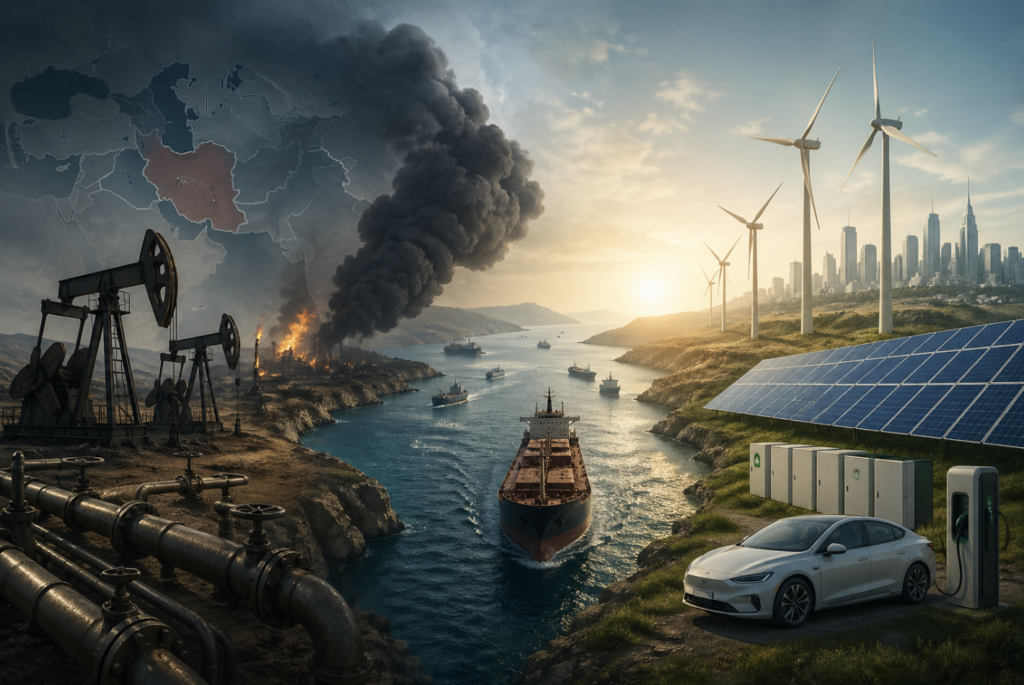
SINGAPORE – A sudden escalation of conflict involving Iran has triggered one of the most significant energy supply shocks in recent years, forcing oil-dependent economies to scramble for alternatives and accelerating a global pivot toward renewable energy.
Following late-February airstrikes by the United States and Israel, Iran moved to restrict access through the Strait of Hormuz, a vital artery for roughly 20 percent of global oil and gas flows. The disruption has fueled sharp volatility in energy markets, stalled diplomatic negotiations and heightened concerns about prolonged supply instability.
Oil-dependent Asian economies race to conserve fuel
In response, governments across Asia and beyond have enacted emergency measures, from energy rationing to reduced working hours, while simultaneously fast-tracking investments in renewable infrastructure. Analysts say the crisis is reinforcing a broader structural shift already underway: a move away from fossil fuel dependence toward electrification and clean energy systems.
China’s clean-energy exports surge to record highs
At the center of this transition is China.
According to a recent report by Ember, China’s exports of solar panels, batteries and electric vehicles — collectively known domestically as the “new three” industries — surged to record levels in March. Solar exports alone reached 68 gigawatts, a 50 percent increase over the previous high, with more than 50 countries setting new import records.
Solar power becomes a hedge against fossil-fuel volatility
Emerging economies in Asia and Africa, particularly those hardest hit by rising fuel costs, accounted for much of the growth. These markets are increasingly turning to Chinese technology as a cost-effective and scalable solution to energy shortages.
“Fossil shocks are boosting the solar surge,” said Euan Graham, an analyst at Ember, noting that volatile oil prices are accelerating adoption of renewables worldwide.
Batteries and electric vehicles join China’s “new three” export boom
China’s broader clean energy exports rose 70 percent year-on-year in March, supported by strong demand in the European Union, India and Australia. Battery exports alone reached approximately $10 billion, underscoring the sector’s growing role as a pillar of China’s economic expansion, replacing traditional export drivers like textiles and appliances.
Energy security is being redefined around renewables
The geopolitical implications are significant.
China’s dominance in renewable manufacturing — spanning solar panels, wind turbines and electric vehicles — is not only strengthening its domestic energy security but also expanding its influence in global energy markets. Nations seeking to insulate themselves from fossil fuel disruptions are increasingly viewing China not just as a low-cost supplier, but as a strategic partner in long-term energy transitions.
“Energy security is being redefined,” said Ed Miliband in a recent statement. “The era of fossil fuel security is over. Clean energy must now take its place.”
Emerging markets turn to Chinese technology
The shift is already yielding measurable effects. Countries that moved early to diversify their energy mix are now seeing tangible benefits. Pakistan, for instance, has significantly reduced its exposure to oil price shocks through large-scale imports of Chinese solar panels, saving billions annually in fuel costs.
Electric vehicles begin to cut into global oil demand
Analysts estimate that global adoption of electric vehicles reduced oil consumption by roughly 1.7 million barrels per day last year. As oil prices climbed in the wake of the Middle East conflict, Chinese automakers reported a surge in overseas demand, further accelerating the trend.
A temporary shock may become a lasting energy transition
Although Washington and Tehran have agreed to a tentative ceasefire, tensions in the Strait of Hormuz persist, with continued naval confrontations disrupting shipping routes. Energy analysts warn that prolonged instability could further reshape global trade patterns and deepen the shift toward renewables.
What is increasingly clear is that the latest fossil fuel shock is not merely a temporary disruption — it is acting as a catalyst for a deeper transformation of the global energy system, one increasingly defined by electrification, resilience and the rising influence of China. (hz)