
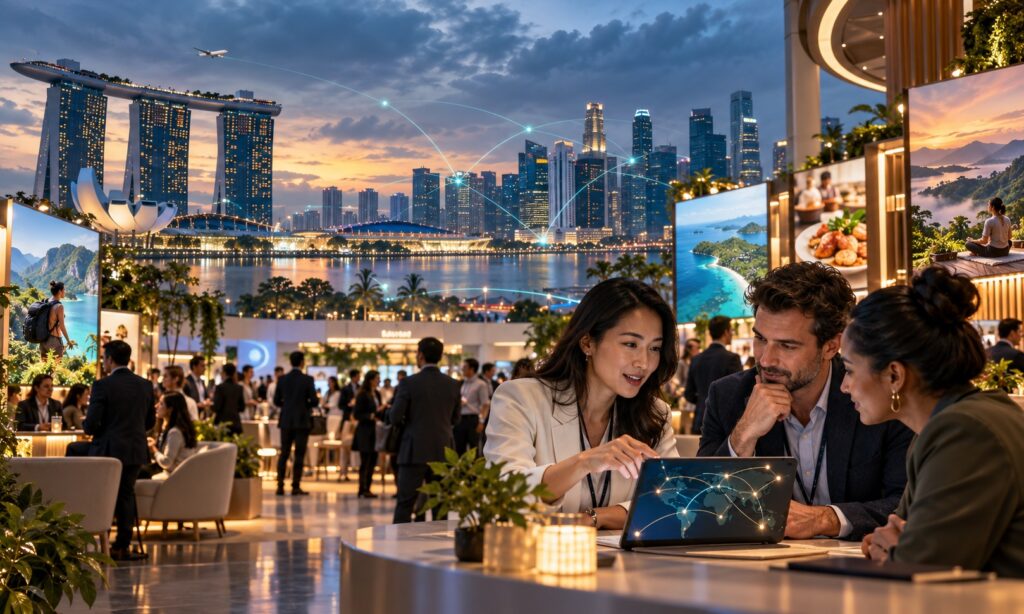
SINGAPORE — ITB Asia returns to Marina Bay Sands from October 21 to 23 with a proposition that carries growing commercial urgency: travel companies must offer customers stronger reasons to spend. Organizer Messe Berlin Asia Pacific expects more than 18,000 participants and over 1,000 exhibitors at the three-day event, which brings together leisure tourism, business events and travel technology. Those figures remain advance projections.
The fair’s emphasis on distinctive experiences and smarter services comes as international tourism loses momentum. Together, the program and the latest industry figures suggest a shift in priorities: attracting more visitors remains important, but extracting sustainable business value from each trip is becoming a more pressing challenge.
A More Difficult Market
UN Tourism’s September assessment offers a restrained backdrop to the exhibition’s optimism. International arrivals increased just 0.4 per cent in the first half of 2026, to an estimated 690 million, while Asia-Pacific recorded growth of 1 per cent. The agency lowered its full-year global forecast to 1–2 per cent, from the 3–4 per cent anticipated in January, citing geopolitical volatility, the Middle East conflict and pressure from oil prices and inflation.
Demand has not disappeared. UN Tourism’s expert panel remained cautiously positive about September through December. But high transport and accommodation costs were among its principal concerns. The implication for exhibitors is that innovation must deliver a convincing benefit to customers whose budgets are already under pressure.
Singapore Focuses on Visitor Spending
Singapore illustrates how spending can outpace visitor growth. Tourism receipts rose 5.8 per cent to S$8.6 billion in the first quarter, while arrivals increased 2.9 per cent, according to Singapore Tourism Board figures reported by The Business Times. The gains were uneven: sightseeing, entertainment and gaming spending increased sharply, while accommodation and food-and-beverage receipts declined slightly.
That divergence supports Singapore’s emphasis on higher-value tourism, though it does not establish that every part of the industry is benefiting. STB chief executive Melissa Ow has acknowledged softer arrivals from some markets and said the board was working with partners to stimulate demand.
The government has backed its longer-term ambitions with funding. In May, Grace Fu, the minister in charge of trade relations, announced S$740 million in fresh funding over five years for the Tourism Development Fund. STB has also introduced an AI playbook and technology support initiatives intended to improve business productivity and visitor experiences.
Experiences and AI Face a Commercial Test
ITB Asia’s response will be visible on the exhibition floor. New zones will focus on gastronomy, wellness and adventure tourism, alongside an Experience Pavilion powered by Tripadvisor. Guided exhibition tours will connect buyers with relevant suppliers. These additions reflect the organizer’s effort to turn interest in specialized travel into concrete business appointments.
The conference will examine the same challenge through AI, personalization, Chinese outbound tourism, sustainability and cruise travel. Announced participants include leaders from Agoda, Trip.com, WebBeds and Disney Cruise Line.
Yet smarter technology also threatens established business models. A recent Wall Street Journal analysis argued that AI agents’ ability to compare hotel prices could weaken booking intermediaries, while platforms offering exclusive accommodation might retain an advantage. For travel companies, this raises a strategic question about who will control customer relationships as automated tools increasingly influence purchasing decisions.
Business events face a parallel demand for demonstrable value. The organizer reports an 83.2 per cent expansion in exhibition space at MICE Show Asia, held alongside ITB Asia. Darren Seah, Messe Berlin Asia Pacific’s executive director, says buyers increasingly expect measurable outcomes from meetings and events.
That provides a useful standard for judging the fair itself. Its commercial significance will emerge in the partnerships and bookings that follow—and in whether the experiences and technologies on display can produce durable returns in a slower market.