
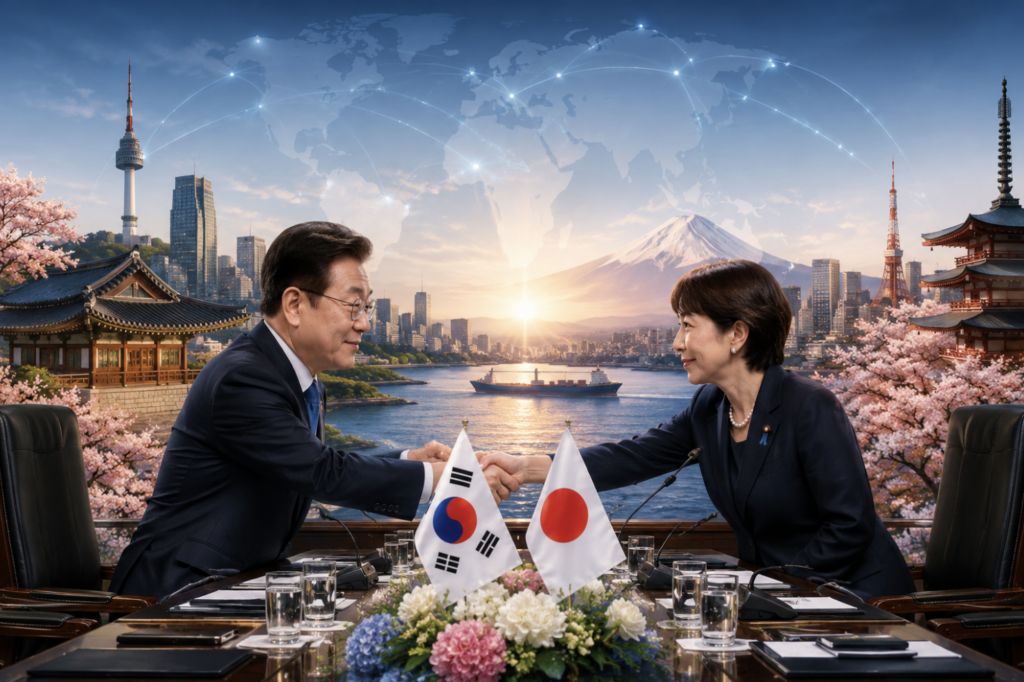
SEOUL, South Korea — Japanese Prime Minister Sanae Takaichi is set to travel to Andong, the hometown of South Korean President Lee Jae Myung, for a two-day summit beginning May 19, in what officials describe as the latest step in an increasingly strategic — and unusually personal — rapprochement between the two U.S.-allied nations.
The meeting follows Lee’s January visit to Nara, Takaichi’s home region in Japan, extending what both governments now call “shuttle diplomacy” — a deliberate effort to normalize high-frequency leadership exchanges after years of political mistrust and historical grievances.
South Korea’s presidential office said the summit would include bilateral talks, a joint press conference, an official dinner and cultural events aimed at emphasizing “future-oriented relations” between the two countries. Officials indicated the agenda would stretch beyond symbolism into economic security, regional stability and global geopolitical crises.
From Historical Friction to Strategic Necessity
For decades, relations between Japan and South Korea were constrained by unresolved tensions tied to Japan’s colonial occupation of the Korean Peninsula from 1910 to 1945. Disputes over wartime labor, territorial claims and nationalist politics repeatedly disrupted diplomatic cooperation.
Yet the strategic environment in Asia has shifted dramatically.
North Korea’s expanding missile arsenal, intensifying U.S.-China rivalry, supply-chain vulnerabilities and instability in the Middle East have pushed Tokyo and Seoul toward closer coordination. Japanese officials now openly frame bilateral ties as essential to broader trilateral cooperation with the United States.
Analysts say the current rapprochement reflects less a resolution of historical disputes than a recognition that both governments face mounting geopolitical pressure.
“The relationship is increasingly being driven by strategic realism rather than emotional reconciliation,” several regional analysts noted in commentary surrounding the summit preparations.
Economy, Technology and Security at the Center
Officials from both governments indicated the leaders are expected to discuss:
- semiconductor cooperation,
- battery and critical mineral supply chains,
- artificial intelligence,
- economic security,
- tourism and public safety,
- and maritime stability linked to the Strait of Hormuz crisis.
The talks come at a moment of broader global uncertainty following the recent escalation surrounding Iran and renewed volatility in energy markets. South Korean and Japanese policymakers are increasingly concerned about disruptions to shipping lanes and critical imports.
Both countries are also attempting to reduce strategic dependence on Chinese-controlled supply chains while avoiding a direct economic rupture with Beijing.
That balancing act has become more delicate as Washington intensifies pressure on allies to align more closely with U.S. trade and technology restrictions on China.
China Looms Over the Summit
The Andong summit takes place against the backdrop of rapidly evolving regional diplomacy, including the high-profile Beijing meeting this week between U.S. President Donald Trump and Chinese President Xi Jinping.
Foreign-policy observers say Seoul and Tokyo are both recalibrating their positions as China seeks to project itself as a stabilizing force in global trade and energy security amid tensions in the Middle East.
While Japan under Takaichi has adopted a more openly hawkish posture toward Beijing, South Korea under Lee has attempted to preserve working relations with both China and the United States — a diplomatic balancing strategy that analysts say could define the next phase of Northeast Asian politics.
A Carefully Choreographed Political Message
The reciprocal hometown visits carry unusual political symbolism in East Asia, where personal gestures between leaders often serve as signals of deeper strategic intent.
South Korean officials described the Andong meeting as the first exchange of hometown visits between incumbent leaders of the two nations.
Beyond policy discussions, the summit appears designed to convey durability — an effort to reassure investors, allies and regional partners that the fragile improvement in Japan–South Korea relations is becoming institutional rather than temporary.
Whether that momentum can survive future domestic political pressures remains uncertain. But for now, Tokyo and Seoul appear increasingly united by a shared conclusion: the geopolitical risks surrounding them have become too large to manage alone.