
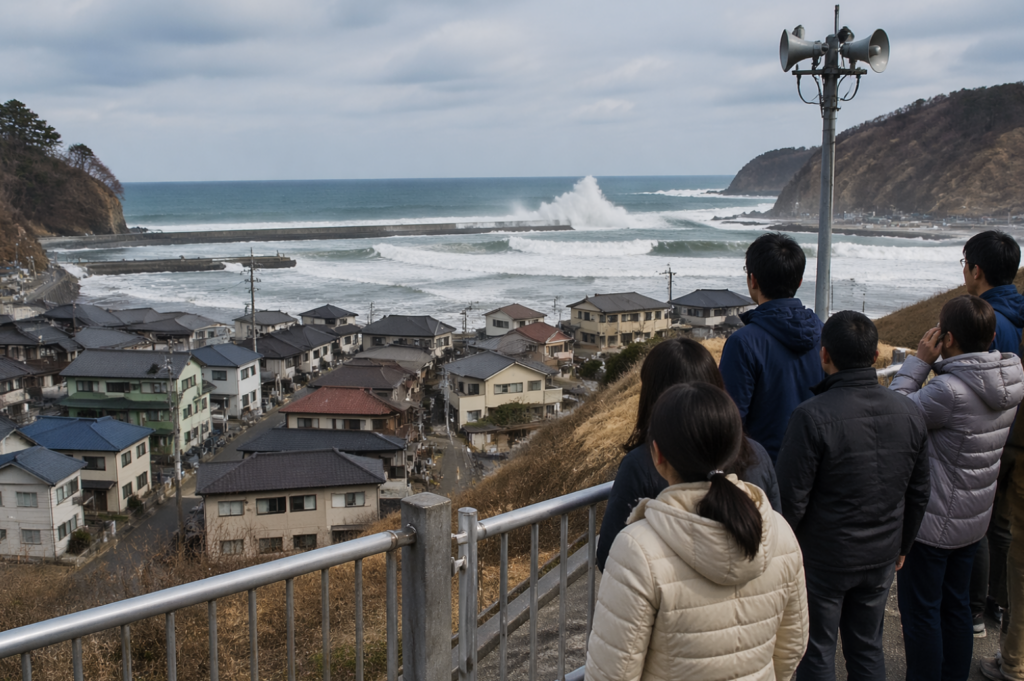
TOKYO, Japan — A powerful offshore earthquake rattled northeastern Japan on Monday, prompting widespread evacuations, a brief tsunami warning and renewed concern about the country’s seismic vulnerability, though early assessments suggested limited damage and few injuries.
The earthquake, measured at magnitude 7.4 by the United States Geological Survey and later revised higher by the Japan Meteorological Agency, struck off the east coast of Honshu, shaking buildings as far away as Tokyo for several minutes. Residents described prolonged tremors, with one report noting buildings swaying for nearly seven minutes in the capital.
Tsunami Fears Ease, but Evacuations Spread
Immediately after the quake, Japanese authorities issued a three-meter tsunami warning for parts of Iwate Prefecture and coastal areas of Aomori and Hokkaido. The warning was later downgraded to an advisory and ultimately lifted after observed waves fell well below projected levels.
Tsunami activity remained modest: waves of 0.8 meters were recorded at Kuji Port and 0.4 meters at Miyako Port, according to official monitoring data. Even so, the initial alert triggered precautionary evacuations, with more than 180,000 residents ordered to move to higher ground.

Limited Damage, Rapid Government Response
Officials reported only minor injuries—two people hurt in falls—and no immediate structural damage to homes, though assessments were ongoing. Approximately 200 power outages were reported across affected regions, with restoration efforts underway.
Prime Minister Sanae Takaichi said the government had established an emergency task force and was mobilizing disaster response teams. “The government will do our utmost in case of an emergency,” she said, emphasizing rapid damage assessment and public communication.
Heightened Alert Across Northeast
In the quake’s aftermath, authorities urged heightened vigilance across 182 municipalities in seven prefectures. Residents were advised to review evacuation routes and prepare for potential aftershocks, according to NHK.
Seismologists noted that Japan’s dense network of early warning systems and strict building codes once again appeared to mitigate the worst outcomes, a point frequently underscored in international disaster-response analysis following recent earthquakes in seismically active regions.
A Familiar Pattern, Closely Watched
The advisory issued this week follows a similar notice after a magnitude 7.5 earthquake in December 2025, which did not precede a larger seismic event. Still, the recurrence of such alerts reflects ongoing concern about stress accumulation along Japan’s offshore fault lines, particularly near deep-sea trenches in the Pacific.
International analysts, including those cited by the Associated Press, note that while Japan’s preparedness remains among the world’s most advanced, even moderate quakes can raise short-term probabilities of more severe events.
Slightly Elevated Risk of a Larger Quake
Officials from Japan’s Cabinet Office and the Japan Meteorological Agency said there is now a roughly 1 percent chance of a magnitude 8 or stronger earthquake occurring along nearby trenches within the next week—an increase from the typical 0.1 percent baseline risk.
The so-called megaquake advisory is not a prediction, authorities stressed, but a precaution based on statistical modeling following significant seismic activity. Still, the warning underscores the persistent threat facing Japan, where major earthquakes can strike with little notice, and where even a slight rise in probability prompts widespread readiness measures.
Graphic: JMA