
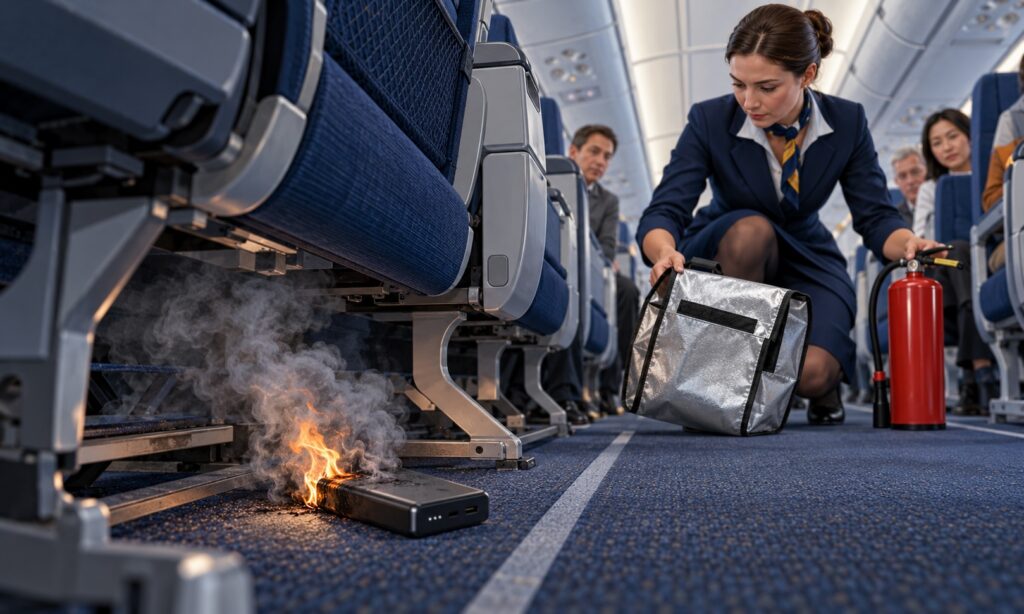
FRANKFURT, Germany – A passenger’s power bank caught fire aboard a Lufthansa aircraft on September 26, forcing the crew to contain the burning device and make an unscheduled landing in Lyon. The incident underscores the danger that an everyday electronic accessory can present inside an aircraft — and the importance of detecting overheating before it develops into a larger emergency.
Flight LH1170, an Airbus A321-200 traveling from Frankfurt to Lisbon, was carrying 198 passengers and six crew members. Lufthansa said cabin crew secured the device in a specialized lithium-battery containment bag after it ignited near a seat. The pilots declared an emergency to obtain priority landing. No injuries were reported, and passengers were accommodated overnight and rebooked to continue their journeys.
The airline statements reviewed do not establish what caused the battery to ignite or whether it was being charged. The fire therefore raises questions about battery safety without establishing that the passenger breached airline rules.
A Small Device With Serious Consequences
Lithium batteries can enter “thermal runaway,” a chain reaction in which overheating produces further heat, potentially releasing gas and causing a fire. Damage, overcharging and exposure to excessive heat can trigger the process, according to the European Union Aviation Safety Agency. Its passenger guidance emphasizes keeping power banks where they can be monitored and using aircraft seat power, where permitted, to charge personal devices.
Lufthansa already prohibits passengers from using or recharging power banks aboard its aircraft, except for use with approved medical equipment. Passengers may carry a maximum of two in the cabin, but cannot place them in overhead lockers. Units above 100 watt-hours and up to 160 Wh require airline approval; damaged or recalled batteries are prohibited.
The safety rationale extends beyond preventing a fire. Accessible storage helps passengers and crew notice a developing problem and respond quickly.
Asian Airlines Tighten Cabin Rules
Several major Asian airlines now apply similar restrictions, combining limits on the number of power banks with bans on onboard use and requirements for accessible storage.
| Airline | Key published requirements |
|---|---|
| Singapore Airlines | Maximum two power banks; cabin baggage only; no use or recharging during the flight; no overhead storage. Units above 100 Wh and up to 160 Wh require advance approval and supporting documentation. |
| Cathay Pacific | Maximum two; no onboard use or recharging. Power banks must be stored in cabin baggage under the seat ahead, with checked baggage and overhead compartments prohibited. |
| Korean Air | Maximum two under its April 2026 notice; no onboard use or charging. Passengers must carry them personally or place them in the seat pocket and protect them against short circuits. |
| Japan Airlines | Maximum two under its current published rules; cabin baggage only; no onboard use or recharging. Passengers are asked to avoid overhead storage. |
Sources: the airlines’ published baggage policies and passenger notices. Capacity limits and approval requirements should be checked for each itinerary.
These measures form part of a broader international response. Effective March 27, 2026, the International Civil Aviation Organization limited personal power banks to two per passenger and prohibited recharging them during flights. The airlines listed above also prohibit using them to charge other devices — a separate restriction that travelers should distinguish from the international recharging ban.
China imposes an additional requirement on mainland domestic flights. Since June 28, 2025, passengers have been barred from carrying power banks without a clear China Compulsory Certification mark, commonly called CCC or 3C, or from recalled models or batches. Travelers connecting from an international service to a domestic flight must account for that requirement.
Taken together, the policies show how battery precautions now cover the entire journey, from product certification and airport screening to storage and use inside the cabin.
What Travelers Need to Know
Passengers should check the rules of every operating airline on their itinerary and carry power banks and spare lithium batteries in cabin baggage. If a cabin bag is taken at the gate for transport in the hold, those items must be removed. Each battery should be protected against damage and short circuits, using an individual protective pouch or appropriate terminal insulation.
Capacity also matters. The relevant measurement is watt-hours, calculated by multiplying ampere-hours by nominal voltage. A 20,000 mAh power bank rated at 3.7 volts contains 74 Wh. Clear labeling is essential: a device whose rating cannot be verified may be refused carriage.
Permission to carry a power bank does not automatically include permission to use it. On Lufthansa and the Asian carriers listed above, passengers must observe the onboard charging and use restrictions even when the device has passed airport security.