
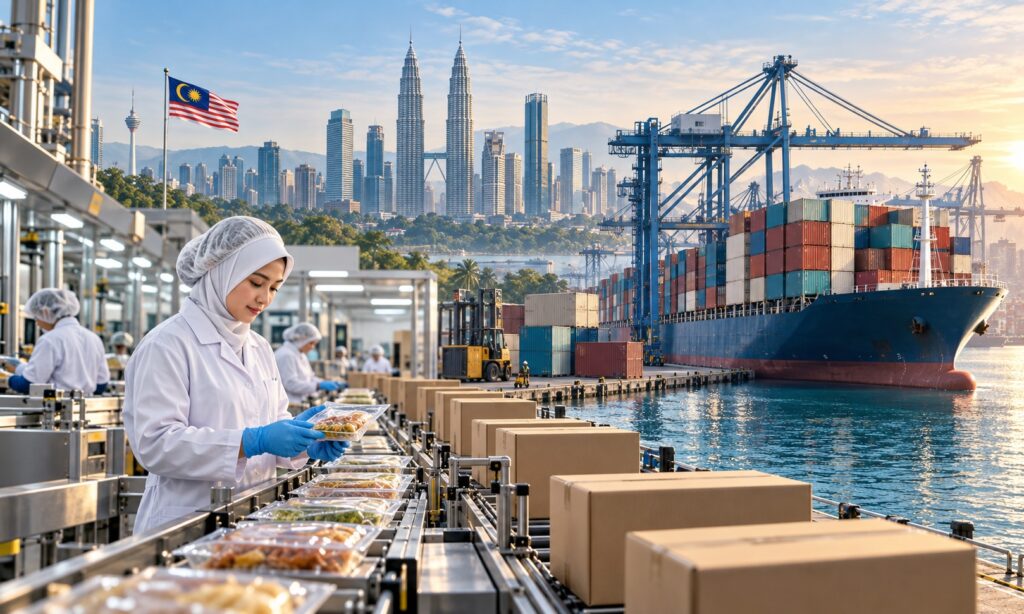
KUALA LUMPUR, Malaysia — Malaysia is setting a tougher test for its halal industry: whether its reputation for religious certification can produce more internationally competitive businesses.
At the World Halal Business Conference, Religious Affairs Minister Zulkifli Hasan urged companies to become “halal-competitive,” linking Malaysia’s standing in the Islamic economy to exports, investment and industrial growth. His remarks, detailed in a September 25 statement, mark a shift in emphasis toward the commercial results that certification enables.
Malaysia enters that effort from a strong position. It retained first place in the Global Islamic Economy Indicator for a 12th consecutive year, while halal exports rose 10.9 percent to 68.52 billion ringgit in 2025. Yet the ranking measures the strength of the national ecosystem; it does not establish dominance in global sales.
The Gap Between Certification and Exporting
The domestic challenge became clearer on September 25, when Deputy Prime Minister Ahmad Zahid Hamidi said only about 14.7 percent of Malaysia’s halal-certified companies were exporters. Businesses needed working capital, dependable production, suitable packaging and reliable logistics to compete abroad, he said.
New government initiatives address that gap. The Malaysia Halal Global Nexus, announced the same day, brings together the certification and governance expertise of the Department of Islamic Development Malaysia, known as JAKIM, and the trade promotion capabilities of MATRADE. Separately, Entrepreneur Development Minister Steven Sim outlined partnerships supporting digital marketing and production automation among smaller businesses.
Taken together, these measures suggest that the next phase of policy will depend on how effectively certification connects companies to buyers, finance and manufacturing capacity.
The market already extends well beyond Muslim-majority countries. China was Malaysia’s largest halal export destination in 2025, followed by Singapore, the United States and Japan — evidence of a commercially diverse customer base.
Regional Cooperation Meets International Competition
Malaysia’s proposed ASEAN Halal Council remains a regional ambition. A more immediate development came on September 25 with the announcement of a separate Malaysia–Indonesia Halal Council, whose first meeting is scheduled for October. Its stated purpose is to address differing requirements and repeated procedures that complicate bilateral trade.
That distinction matters: a bilateral mechanism offers a practical testing ground for cooperation, but does not yet constitute an integrated ASEAN halal market.
International business interest supports Malaysia’s ambitions while underscoring the competition it faces. Fernanda Baltazar of the Arab Brazilian Chamber of Commerce told Bernama that Brazilian companies viewed Malaysia as a gateway to Asia and wanted to expand beyond meat into a broader range of food products. Malaysia’s opportunity, that suggests, includes processing and distribution partnerships alongside exports of its own brands.
The agreement between Malaysia’s Tradewinds and Saudi Arabia’s Tanmiah Food Company illustrates that approach. The companies will explore poultry imports, processing and possible investment in Malaysian facilities. But the timetable remains preliminary: Tradewinds executive Farhan Hafetz told RTM that initial results could emerge toward late 2027, with a factory potentially three to four years away. These are prospective projects, rather than completed investments.
HDC also signed an agreement with King’s Park Development covering technical advice and capacity building, reinforcing the conference’s emphasis on developing the infrastructure around halal businesses.
A Large Opportunity, With Different Measures
The conference statement’s $5 trillion projection requires qualification: it specifies neither a target year nor a detailed market definition.
Dinar Standard’s latest State of the Global Islamic Economy report offers a more clearly bounded measure, estimating Muslim consumer spending across six sectors at $2.60 trillion in 2024 and projecting $3.56 trillion by 2029. Islamic financial assets are measured separately and should not be treated as equivalent to annual consumer spending.
For Malaysia, the decisive numbers will be closer to the factory floor: companies fulfilling repeat overseas orders, investment becoming productive capacity, and more value retained domestically. The government has articulated that ambition. The next test is delivery.