
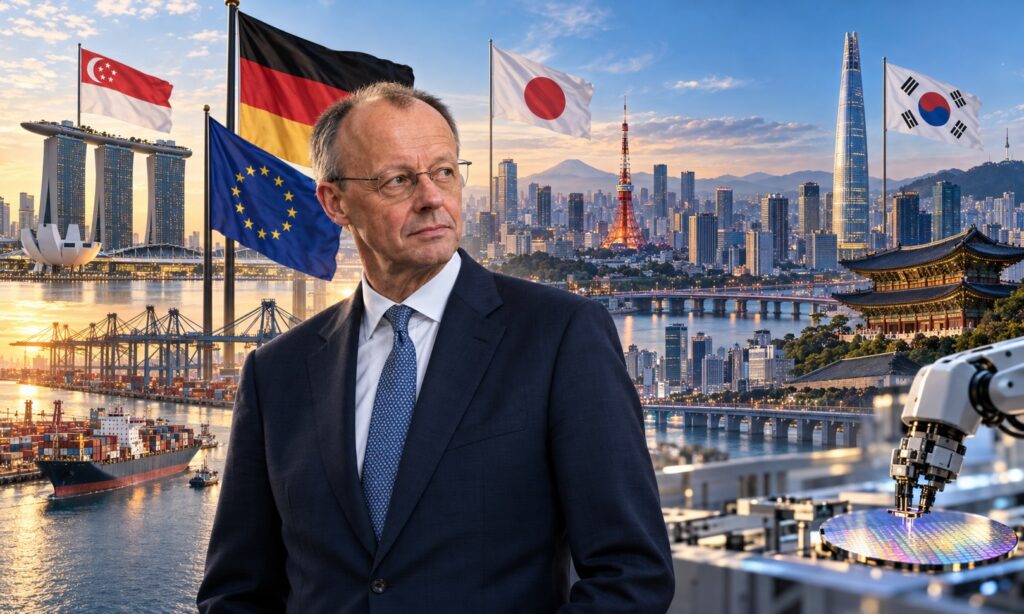
SINGAPORE – German Chancellor Friedrich Merz is pursuing closer cooperation with three major partners in the Asia-Pacific region. His five-day visit to Singapore, Japan and South Korea combines trade initiatives with agreements on technology and security. The central goal is to diversify Germany’s economic relationships while working with reliable partners to strengthen an open, rules-based international order.
Singapore: An Agenda for Closer Trade
In Singapore, the first stop on his tour, Merz outlined the strategic ambition behind the visit on Tuesday. In a keynote address at the ISEAS research institute, he called for stronger links between Europe and the Indo-Pacific. With great-power rivalry intensifying and the international order weakening, he argued that economically influential countries must coordinate more closely to defend their interests. Trade, technological cooperation and security policy were interconnected.
Merz proposed aligning existing bilateral trade agreements more closely and pursuing a comprehensive agreement between the European Union and members of the Comprehensive and Progressive Agreement for Trans-Pacific Partnership, or CPTPP. A free-trade agreement with the Association of Southeast Asian Nations, ASEAN, remains a longer-term objective. Singapore’s prime minister, Lawrence Wong, supported stronger connections between these economic blocs while acknowledging the complexity of negotiating an EU-ASEAN agreement. The proposals therefore set out a trade agenda that will take time to deliver.
Germany and Singapore also intend to deepen bilateral cooperation. Their discussions covered industrial applications of artificial intelligence, cybersecurity and the protection of critical undersea infrastructure. For both export-oriented economies, technological competitiveness is closely tied to the security of international connections. Singapore also provides German companies with an important gateway to Southeast Asian markets.
Japan: Technology and Economic Security
In Japan, the second stop, Wednesday’s talks produced joint declarations on advanced technology and economic security. Merz and Prime Minister Sanae Takaichi agreed to strengthen cooperation on securing supply chains, diversifying sources of critical minerals and protecting key technologies. A new high-level dialogue on artificial intelligence will support those efforts, while both countries also plan to advance specific projects in hydrogen and nuclear fusion.
Security cooperation also featured prominently in Tokyo. Germany and Japan intend to deepen their defence ties, including cooperation between their defence industries. Both governments opposed economic coercion through arbitrary export restrictions and practices that contribute to industrial overcapacity. Their discussions underscored the growing role of the partnership in safeguarding economic autonomy.
South Korea: Business Partnerships and Regional Security
South Korea is the final destination on the tour. The visit, scheduled to begin on Thursday, includes talks with President Lee Jae-myung and a visit to the demilitarised zone along the border with North Korea. On Friday, Merz is due to open the 19th Asia-Pacific Conference of German Business in Seoul. The gathering offers an opportunity to connect the political initiatives with companies’ investment and cooperation plans.
For German industry, the trip addresses an important priority. Wolfgang Niedermark, a senior representative of the Federation of German Industries, told German broadcaster ARD that Germany needed to spread its economic risks more widely and expand cooperation with other Asian industrial partners. The practical test will be whether the political agreements generate additional market opportunities, joint technology projects and more reliable supply relationships.
China: A Cooperative Signal Without New Concessions
China, meanwhile, struck a notably cooperative tone towards the German government on Wednesday in response to Merz’s tour. Foreign Ministry spokesperson Guo Jiakun said Beijing wanted to work with all parties to maintain stable and secure global industrial and supply chains. Germany and the EU should remain “objective and rational” and resolve disagreements through dialogue, he said. Guo also emphasized the close integration of their industries and the mutual benefits of economic cooperation.
The statement contained no specific new concessions on market access. It can be read as an attempt to influence Europe’s diversification strategy while keeping economic dialogue intact. Beijing is signalling an interest in stable relations at a time when Berlin is deliberately broadening its partnerships across Asia.
Photo: AI Generated