
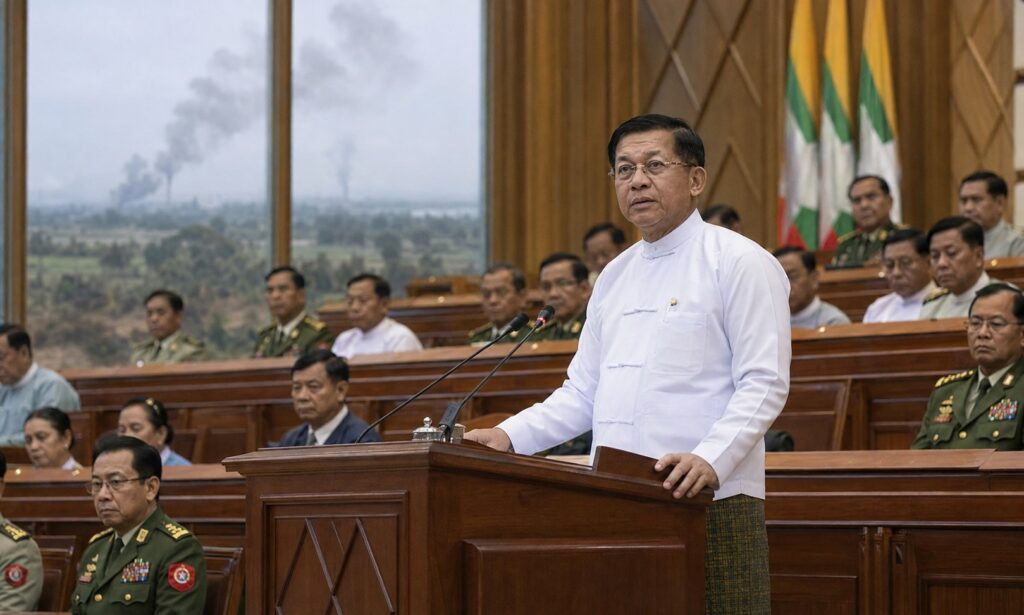
NAYPYITAW, Myanmar – President Min Aung Hlaing marked his government’s first 100 days in office with an expansive defense of military-backed rule, promising elections in conflict-stricken districts, vast energy projects and a modern federal democracy even as fighting, displacement and political repression continue across Myanmar.
Addressing more than 900 lawmakers, government officials and military representatives in the capital, Naypyitaw, on Friday, Mr. Min Aung Hlaing said his administration had established “important foundations” by pursuing stability and economic development.
His five-year program calls for two years of accelerated preparations followed by three years of intensive development. But the speech offered few measurable benchmarks, funding details or concessions to the armed resistance challenging the government’s authority.
Mr. Min Aung Hlaing led the military’s 2021 overthrow of Myanmar’s elected government. He retired as commander in chief and was sworn in as president in April after an election widely criticized as a military-managed process that excluded major opposition forces, including Aung San Suu Kyi’s National League for Democracy. The International Crisis Group has described the new administration as a consolidation of military control rather than a democratic transition.
Elections Promised Where Voting Was Impossible
Mr. Min Aung Hlaing said special elections would be held in 2027 for constituencies in 102 townships where voting could not take place during last year’s three-stage election because of armed conflict.
The announcement underscored the limits of the earlier vote: large portions of the country were too insecure—or outside effective government control—to participate. Courts have meanwhile imposed lengthy prison sentences on activists accused of campaigning against the election, reinforcing opposition claims that the political process was conducted under coercion.
The president said his government was building a nation “based on democracy and a federal system.” Yet he also pledged to continue enforcing conscription and strengthening the armed forces and police as they battle pro-democracy resistance groups and ethnic minority armies.
Myanmar’s military activated compulsory service in 2024 as it struggled with manpower shortages and battlefield reversals. The policy has been widely associated with young people leaving the country or moving into territory beyond military control.
Nan Lin, a spokesman for the General Strike Coordination Body, said the address showed that the authorities intended to preserve their power rather than negotiate a political settlement.
“No meaningful change can be expected from the junta,” he said, warning that conscription would be used to control young people through fear.
Independent domestic analysis had already questioned the substance of the government’s 100-day program. The Institute for Strategy and Policy–Myanmar called its proposals overly general and said they lacked crucial measures for economic recovery.
A Peace Offer Without the Main Resistance
Mr. Min Aung Hlaing said his administration had encouraged armed opponents to surrender and had conducted discussions with 13 ethnic armed organizations. But he did not announce negotiations with the principal pro-democracy resistance coalition or other forces demanding an end to military rule.
That omission is central to the government’s peace strategy: surrender talks with selected groups are not the inclusive national dialogue sought by Myanmar’s opposition or international mediators.
The humanitarian toll continues to mount. United Nations data showed that nearly four million people were internally displaced as of July 20, with more than 1.3 million in the Sagaing region alone.
A recent conflict-monitoring assessment also found that attacks on civilians intensified during the first half of 2026, despite the military leadership’s transition to a nominally civilian administration.
A Direct Challenge to ASEAN
Mr. Min Aung Hlaing sharply criticized the five-point peace consensus adopted by the Association of Southeast Asian Nations after the 2021 coup. He argued that it had been issued without full agreement among member states and accused the regional organization of discriminating against Myanmar.
ASEAN’s plan calls for an immediate reduction in violence, humanitarian assistance and dialogue among all parties facilitated by a special envoy. The bloc has restricted Myanmar’s representation at high-level meetings because of the military authorities’ failure to carry out those commitments.
The president’s challenge came only days after ASEAN again expressed deep concern about Myanmar’s conflicts and reaffirmed that the five-point consensus remained its principal framework for addressing the crisis.
His remarks suggest that relations may remain adversarial despite recent diplomatic contacts. ASEAN has welcomed limited measures—including prisoner releases—but continues to insist that meaningful political progress requires an end to violence and an inclusive dialogue.
Ambitious Energy Plans Amid a Fragile Economy
The president also announced plans to proceed with 10 electricity-generation projects, including the Myitsone hydropower dam, a large Chinese-backed project suspended in 2011 after widespread protests over environmental damage and the displacement of local communities.
Reviving the dam could strengthen economic relations with China, but it risks reopening one of Myanmar’s most politically sensitive environmental disputes. Mr. Min Aung Hlaing also reiterated plans to develop nuclear power, without providing a timetable, financing structure or details about international safeguards.
The government’s infrastructure ambitions confront a weak economic base. The World Bank projects growth of only 2 percent in the 2026-27 fiscal year, citing continuing conflict, disrupted trade, fragile logistics and volatile energy costs.
Mr. Min Aung Hlaing acknowledged that the departure of young workers was harming development, but did not connect the exodus to conscription, political repression or the continuing war.
He also highlighted campaigns against money laundering, narcotics and online fraud, saying that more than 72,000 foreigners linked to scam operations had been returned to 58 countries. Such operations have become a regional security concern, although United Nations reporting says armed conflict, organized crime, drug trafficking and scam networks remain deeply interconnected.
The speech presented a government focused on order, infrastructure and institutional continuity. But its central contradiction remained unresolved: Mr. Min Aung Hlaing promised peace and federal democracy while expanding the security forces, enforcing conscription and excluding his most consequential opponents from political negotiations.
Sources: UN Human Rights Council, World Bank, AP, Reuters