
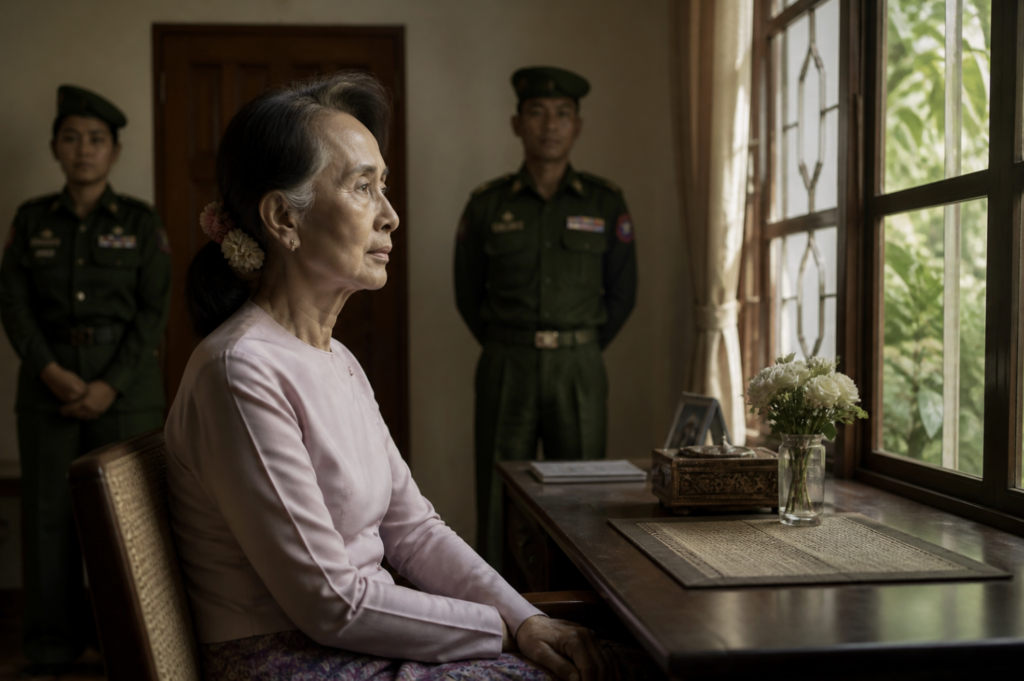
YANGON, Myanmar – Myanmar’s military government has announced that the detained former leader Aung San Suu Kyi has been transferred from prison to house arrest, a move that analysts say may reflect a calculated attempt by the junta to ease international pressure and reframe its global image.
The 80-year-old Nobel Peace Prize laureate has been held incommunicado since the 2021 coup led by Senior General Min Aung Hlaing, which ousted her democratically elected government and plunged the country into prolonged conflict. In a brief statement, the junta chief said her remaining sentence would be “served at the designated residence,” offering no independent verification of her condition or whereabouts.
Skepticism remains widespread. Her son, Kim Aris, dismissed the announcement as unproven, noting that the only image released by state media appeared to be outdated. “Until there is independent confirmation, I cannot accept this as fact,” he said in interviews.
A Strategic Gesture Amid Global Scrutiny
The reported transfer comes as Myanmar’s military leadership seeks to reduce diplomatic isolation following years of sanctions and condemnation. Observers point to recent efforts by the junta to stage elections and promote a semblance of civilian governance, even as real power remains firmly in military hands.
According to Sean Turnell, the move fits into a broader “public relations offensive” aimed at legitimizing the regime. “They are trying to convince the world that they are a credible government,” he said, while cautioning that doubts persist about the authenticity and permanence of the decision.
International reactions have been measured but cautious. Western governments and human rights organizations have repeatedly called for Suu Kyi’s unconditional release, along with that of thousands of political prisoners. Regional actors within ASEAN have also intensified quiet diplomacy, urging de-escalation and inclusive dialogue.
Opaque Conditions and Humanitarian Concerns
Little is known about Suu Kyi’s health or living conditions during her detention. Her lawyers have not had access to her in years, and her family has been cut off from communication. Former detainees, including Turnell, have described prison conditions as harsh and inadequate, raising concerns given her age.
The secrecy surrounding her detention has been a central criticism of the junta, reinforcing doubts about its latest claims. Legal representatives told international media they had received no official notification regarding her transfer.
A Political Figure Still Revered at Home
Despite years out of public view, Suu Kyi remains a potent symbol within Myanmar. Once celebrated globally for her nonviolent resistance—recognized with the Nobel Peace Prize in 1991—her reputation abroad was later damaged by her defense of the military at the International Court of Justice over allegations of atrocities against the Rohingya minority.
Yet domestically, analysts say her influence endures. “Her connection with the people is almost spiritual,” Turnell noted, suggesting that her political relevance inside Myanmar has not diminished.
Uncertain Path Ahead
The junta’s decision to publicize her apparent relocation has fueled speculation that further concessions—possibly a broader release or political recalibration—could follow. Others warn it may simply be a symbolic gesture without substantive change.
With Myanmar still embroiled in armed संघर्ष between the military and pro-democracy resistance forces, Suu Kyi’s fate remains intertwined with the country’s uncertain political future. For now, the announcement offers more questions than answers—about her condition, her freedom, and the intentions of those who continue to hold power.