
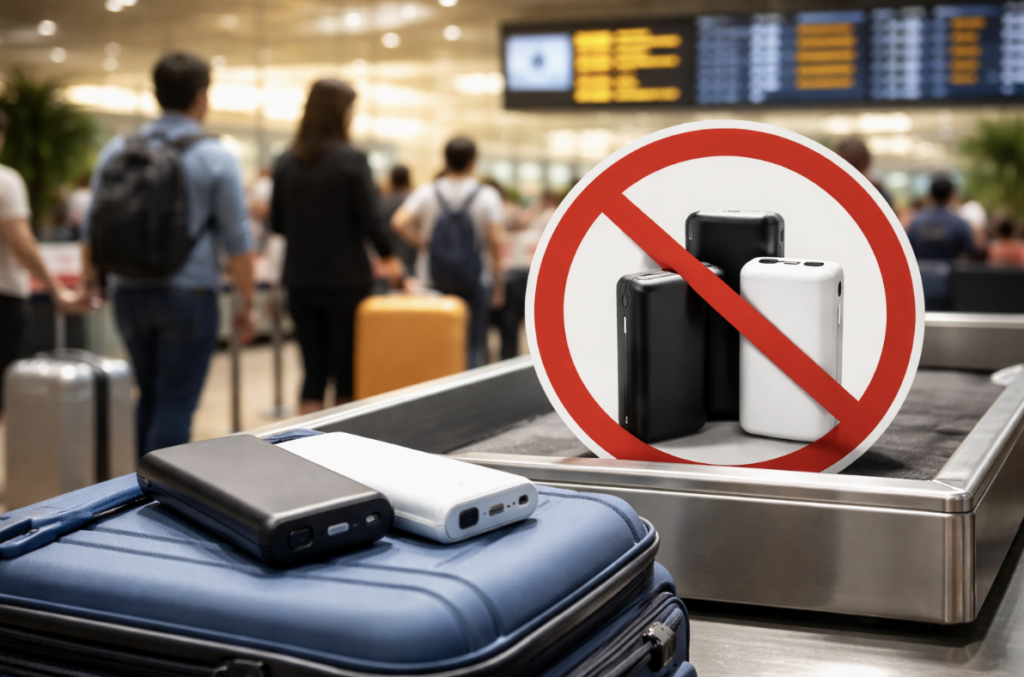
SINGAPORE — Travelers departing Singapore will soon face stricter limits on portable battery packs, as regulators move to address mounting concerns over in-flight fire risks tied to lithium-ion devices.
Beginning April 15, passengers will be allowed to carry no more than two power banks on board, according to the Civil Aviation Authority of Singapore. Devices exceeding the limit must be surrendered before boarding, and all power banks will be prohibited from being used or charged during flights.
The directive follows updated global safety guidance issued on April 2 by the International Civil Aviation Organization, which introduced tighter rules on the carriage and use of lithium battery devices in aircraft cabins.
A Global Push to Reduce Lithium Battery Risks
The new policy reflects increasing alarm among aviation authorities worldwide over lithium battery incidents. Power banks, which rely on lithium-ion cells, have been linked to overheating and short-circuiting events that can escalate into fires—particularly dangerous in the confined environment of an aircraft cabin.
“The revised standards are designed to reduce fire risk while maintaining practical travel needs,” CAAS said, noting alignment with ICAO’s recommendation of a two-device limit per passenger.
Industry guidelines from the International Air Transport Association already classify power banks as dangerous goods, subject to strict handling requirements, including bans in checked baggage and mandates for short-circuit protection.
Airlines have begun acting ahead of regulators. Singapore Airlines and its low-cost subsidiary Scoot implemented bans in April 2025 on using or charging power banks during flights, citing safety compliance.
Southeast Asia: Patchwork Adoption, Growing Momentum
Across Southeast Asia, similar policies are emerging, though implementation remains uneven:
- Malaysia: The Civil Aviation Authority of Malaysia has signaled alignment with ICAO standards but has not yet mandated a strict two-device cap as of early 2026. Airlines such as Malaysia Airlines enforce usage restrictions onboard.
- Thailand: The Civil Aviation Authority of Thailand continues to follow existing ICAO lithium battery transport rules, with discussions underway on tighter limits, though no formal adoption timeline has been announced.
- Indonesia: Regulators under the Directorate General of Civil Aviation Indonesia maintain restrictions on capacity and checked baggage but have not introduced a numerical cap on power banks.
- Vietnam and Philippines: Authorities are reviewing ICAO’s latest recommendations; airlines in both countries already enforce strict onboard usage bans, suggesting regulatory convergence may follow.
Aviation analysts say Singapore’s move could accelerate regional harmonization. “Singapore often sets the regulatory tone in Southeast Asia,” said a regional aviation safety consultant. “We expect other major hubs like Kuala Lumpur and Bangkok to adopt similar caps within the next 6 to 12 months.”
Implementation and Passenger Impact
CAAS said it is coordinating with airlines and airport operators to ensure a smooth rollout. Notices will be displayed across terminals, and passengers are being urged to verify airline-specific rules before travel, which may be stricter than baseline regulations.
Existing requirements remain unchanged: power banks are still banned from checked luggage, subject to capacity limits, and must be individually protected against short circuits.
The shift underscores a broader recalibration in aviation safety as personal electronics proliferate. With passengers increasingly reliant on portable power, regulators face the challenge of balancing convenience with risk mitigation.
For now, Singapore’s message is clear: fewer batteries, safer skies.