
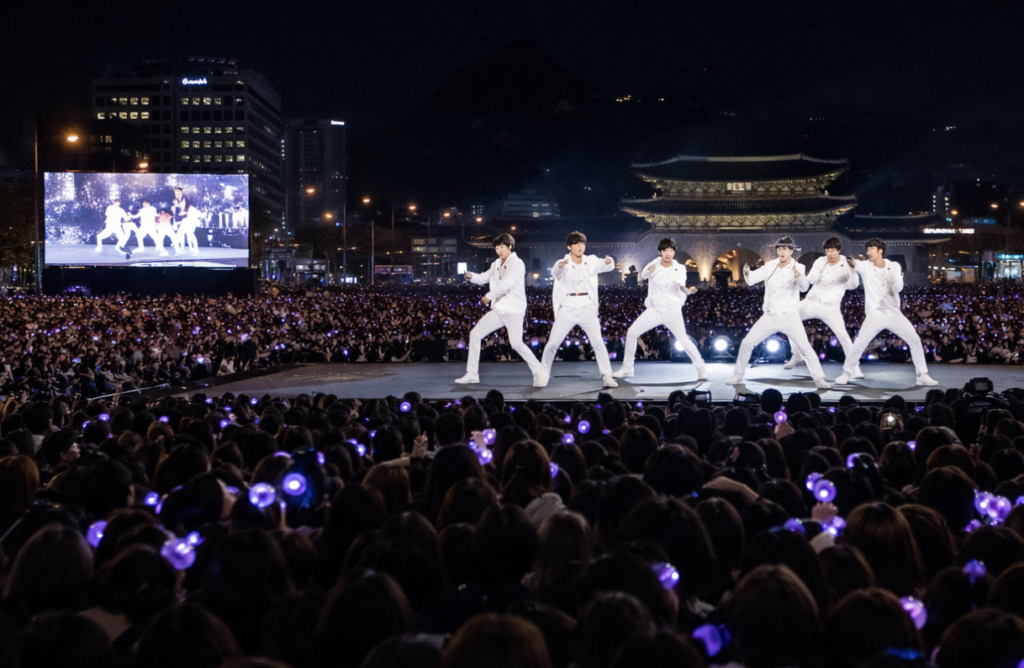
SEOUL, South Korea— BTS, the South Korean pop group whose hiatus reshaped the economics of K-pop, returned to the stage the past weekend with a free concert in central Seoul that drew 18.4 million global viewers on Netflix, according to the streaming platform, in a comeback that was both a cultural spectacle and a financial stress test. Reuters reported that the livestream reached viewers in more than 190 countries, entered Netflix’s weekly Top 10 in 80 markets and ranked No. 1 in 24.
The one-hour performance, held on March 21 at Gwanghwamun Square, was the first time all seven members — Jin, Suga, J-Hope, RM, Jimin, V and Jung Kook — had performed together in public since 2022, when the group suspended full-group activities for mandatory military service. The concert also served as the public launch of ARIRANG, the group’s first studio album in nearly four years, a release that several outlets described as central to BTS’s effort to reconnect its global fame with Korean cultural identity.
In Seoul, the event carried unusual symbolic weight. Gwanghwamun Square is not simply a concert venue but one of the country’s most politically and historically resonant public spaces. Hybe, the group’s parent company, said about 104,000 people attended across the area, though only roughly 22,000 ticket holders were allowed into the main viewing zone. Authorities had initially prepared for a significantly larger crowd, and the lower turnout quickly became part of the story, with domestic coverage focusing on whether extensive security measures dampened attendance and altered the spirit of what was billed as a civic-scale celebration.
Security was exceptionally tight. Yonhap and other Korean outlets reported that police established crowd-control zones and capped density around the site, while local officials defended what they described as an intentionally heavy response. Korea JoongAng Daily reported that the Seoul police chief said public safety required an “excessive” posture, citing broader security concerns and the risks associated with an event of this scale.
The domestic financial response was more anxious than celebratory. Reuters reported that Hybe shares fell 14.5 percent on March 23 after the concert, while The Korea Times put the closing decline at 15.55 percent, reflecting investor concern that the physical turnout had failed to match the feverish expectations surrounding BTS’s reunion. Yet that sell-off was not universally accepted as a verdict on the group’s commercial power. Korea JoongAng Daily described the market reaction as “baffling,” citing analysts who argued that one free, security-restricted event should not outweigh the group’s broader earnings potential.
That broader case remains formidable. Billboard had previously estimated that BTS’s reunion cycle — including touring, merchandise, licensing, album sales and streaming — could generate more than $1 billion. Chosun and other Korean business coverage this week echoed that optimism, with forecasts that Hybe’s profit could surge sharply on the strength of BTS-related activity. The Korea Herald, meanwhile, framed the comeback as a possible turning point not just for one company but for the wider K-pop market, which has been searching for renewed momentum after a softer period in physical album sales.
Internationally, the reaction was more straightforward: the concert was treated as evidence that BTS remains one of the few music acts capable of fusing fan devotion, national symbolism and platform-scale distribution into a single event. The Associated Press described the reunion as a reaffirmation of the group’s global influence, while Reuters tied the broadcast to Netflix’s broader push into live programming in South Korea and beyond. Netflix executives said before the show that they saw growing opportunity in live events tied to Korean entertainment, suggesting that BTS’s return was not only a pop milestone but also a strategic test for the platform’s ambitions in real-time global broadcasting.
Seen from abroad, the homecoming looked triumphant. Seen from Seoul, it also exposed the pressures that now surround BTS: heightened expectations from investors, logistical scrutiny from officials and a shifting entertainment market in which even the industry’s biggest act is measured not only by cultural impact, but by crowd flow, stock charts and platform metrics. Even so, the underlying conclusion of the weekend was difficult to miss. After nearly four years apart, BTS returned not as a nostalgia act, but as a central force in global pop — one still large enough to move markets, public institutions and the strategy of a streaming giant all at once.
Sources used: Reuters, Associated Press, Netflix, Yonhap, Korea Herald, Korea JoongAng Daily, The Korea Times, Billboard.