
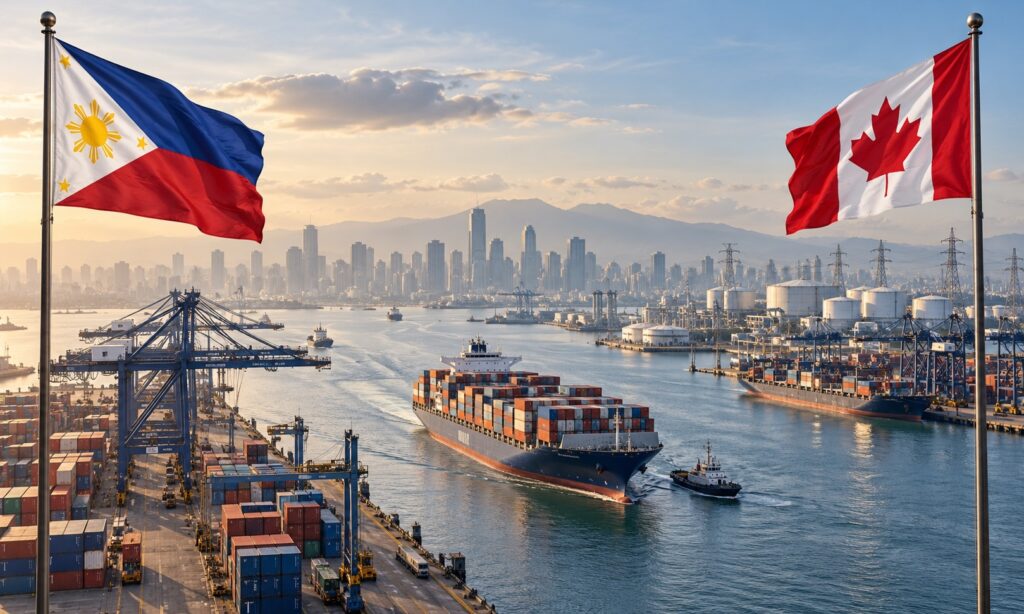
MANILA, Philippines – The Philippines is pressing to complete trade agreements with Canada, seeking to turn a shared commitment to economic diversification into new export markets, investment and more dependable energy supplies.
Speaking at an economic symposium in Ottawa on October 13, Philippine Ambassador Jose Victor Chan-Gonzaga urged progress on both the bilateral Philippines-Canada agreement and the broader ASEAN-Canada pact, according to the Philippine Embassy account. He identified agriculture, manufacturing, electronics and services as potential beneficiaries, while emphasizing clearer trade requirements and assistance for smaller businesses.
The appeal comes as negotiations approach a politically significant deadline. Canadian Trade Minister Maninder Sidhu said in September that both tracks were more than 90 percent complete, with Ottawa seeking to have agreements ready for Prime Minister Mark Carney’s November visit to Manila. That assessment signals momentum, but does not establish that the remaining differences have been resolved.
A November Target, With Implementation Further Away
The regional timetable is more qualified than the diplomatic optimism might suggest. In their September 22 joint statement, ASEAN and Canadian economic ministers called for negotiations to conclude by November’s ASEAN summit, while identifying 2027 as the planned signing date. Negotiating completion, signature and entry into force remain distinct milestones.
For the Philippines, ASEAN’s 2026 chair, an agreement would offer a visible demonstration of its support for predictable, rules-based commerce. For Canada, the negotiations form part of a wider effort to expand overseas business: Sidhu has explicitly linked closer Southeast Asian ties to Ottawa’s ambition to double non-U.S. exports over the next decade.
There is already a commercial base to build upon. Canadian figures put bilateral merchandise trade at C$3.4 billion in 2025, including C$2.3 billion in imports from the Philippines. The prospective agreement would deepen an existing relationship rather than create one from scratch.
Market Access Must Work for Smaller Exporters
Chan-Gonzaga’s emphasis on practical trade facilitation points to the central domestic challenge: preferential access has limited value if businesses cannot navigate documentation, standards and customs procedures.
The implication is that the agreement’s Philippine impact will depend partly on implementation at home. Smaller exporters will need understandable requirements and technical support to translate tariff preferences into orders. Canada’s September announcement of C$280,000 for regional small-business development and economic diplomacy training acknowledges that broader capacity-building need.
Energy Opportunities Bring Questions About Safeguards
Energy adds a strategic dimension. The ambassador highlighted supply diversification and possible nuclear cooperation, alongside commercially viable projects and competitive electricity prices. Canada also identifies nuclear energy, clean technology and infrastructure among its commercial priorities in the Philippines.
Business support is accompanied by scrutiny. The September ministerial statement recorded the Canada-ASEAN Business Council’s backing for the regional pact and cooperation in energy and agriculture. Separately, a May briefing from the Transnational Institute warned that investor-state dispute provisions could constrain environmental regulation and community protections. That warning concerns the agreement’s potential design; it is not evidence of a finalized provision or a response to the October symposium.
The decisive test will therefore extend beyond announcing a deal. For Manila, success would mean more firms reaching Canadian customers and investment delivering reliable, affordable infrastructure. For both governments, the challenge is to make those gains compatible with the regulatory protections that give economic cooperation lasting public support.