
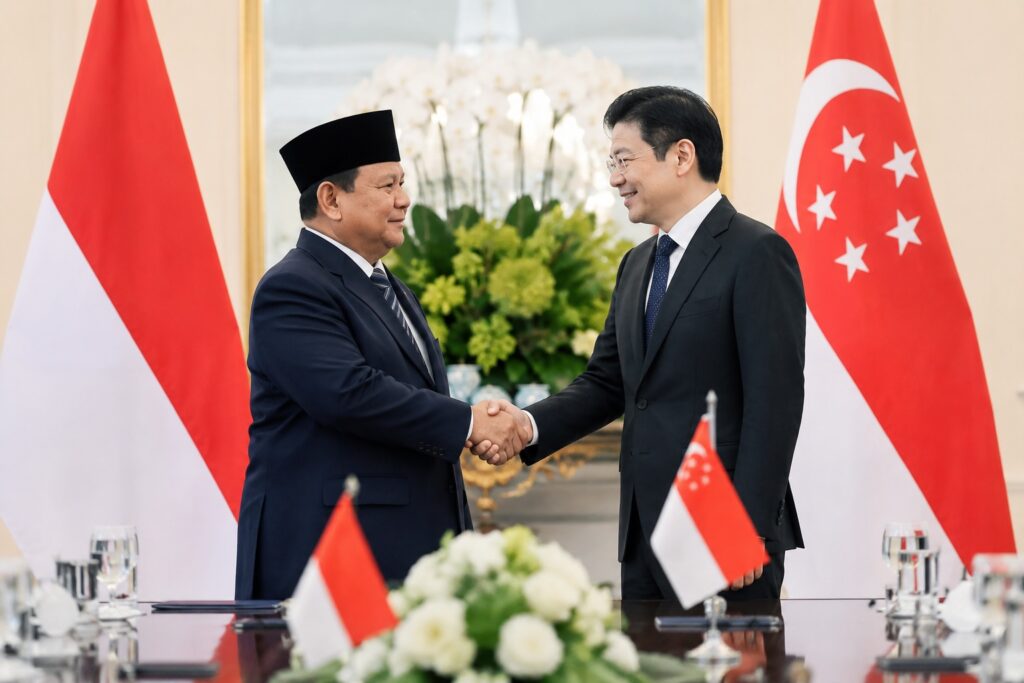
JAKARTA, Indonesia — Indonesian President Prabowo Subianto and Singaporean Prime Minister Lawrence Wong reaffirmed a shared commitment to resolving international disputes through dialogue and diplomacy, underscoring ASEAN’s longstanding preference for consensus at a time of heightened geopolitical uncertainty.
Speaking after the annual Indonesia–Singapore Leaders’ Retreat at Jakarta’s Merdeka Palace on Monday, President Prabowo said ASEAN members remain united in the belief that disagreements should be settled peacefully rather than through confrontation.
“Every dispute must be resolved peacefully through dialogue and diplomacy—not only in our region, but in all regions,” Prabowo said, adding that any misunderstandings between Indonesia and Singapore would be addressed openly and transparently.
The remarks came as the two leaders reviewed regional security developments, broader global challenges and their implications for Southeast Asia, while emphasizing that sustained communication remains essential to preserving regional stability. Both leaders described their discussions as candid, forward-looking and focused on strengthening cooperation in the years ahead.
A Partnership Looking Beyond Present Challenges
Beyond regional diplomacy, the meeting reinforced the strategic importance of one of Southeast Asia’s closest bilateral relationships. Prabowo said the discussions were designed not only to address current challenges but also to prepare Indonesia and Singapore for future economic, technological and security cooperation.
The two governments also marked progress across a broad range of collaborative initiatives. During the Leaders’ Retreat, Indonesia and Singapore concluded 26 cooperation agreements spanning areas including environmental cooperation, digital development, carbon-credit collaboration, energy connectivity and cross-border electricity trade, highlighting the increasingly comprehensive nature of bilateral ties.
Prabowo noted that the two countries will celebrate the 60th anniversary of diplomatic relations next year, describing the milestone as an opportunity to ensure the partnership remains resilient for decades to come.
ASEAN’s Consensus-Based Diplomacy Under Renewed Focus
The leaders’ statements reflect ASEAN’s traditional diplomatic approach, which prioritizes consensus, dialogue and respect for sovereignty over bloc politics or military confrontation. Analysts say that position has become increasingly significant as Southeast Asian governments navigate intensifying competition among major powers while seeking to preserve regional neutrality.
Singapore is scheduled to assume the ASEAN chairmanship next year, and Prime Minister Wong said his government would work closely with Indonesia in shaping the organization’s agenda, reinforcing ASEAN centrality amid a rapidly evolving strategic landscape.
While ASEAN’s consensus model is sometimes criticized for moving cautiously during international crises, supporters argue that its emphasis on diplomacy has helped maintain regional stability for decades despite the diverse political systems and strategic interests of its member states.
The meeting in Jakarta therefore carried significance beyond bilateral relations, signaling a renewed commitment by Southeast Asia’s two largest economic partners to uphold diplomacy as the primary mechanism for managing regional and international disputes.