
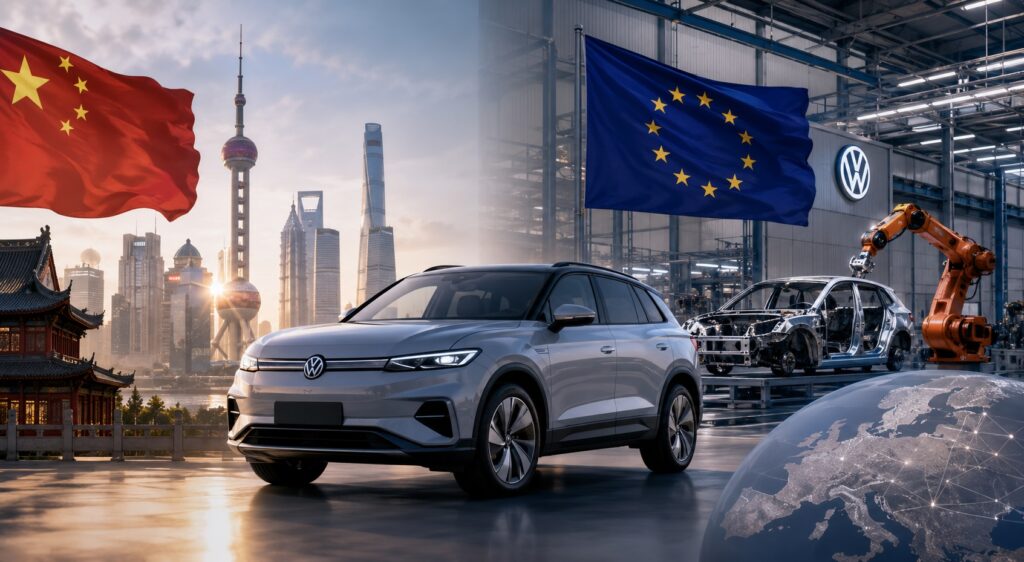
WOLFSBURG, Germany — Volkswagen is evaluating one of the most significant strategic shifts in its modern history: bringing vehicles designed and engineered in China to European consumers, with the possibility of eventually producing those models—or key components—at European factories.
According to multiple company insiders cited by German business daily Handelsblatt, Volkswagen has launched an internal feasibility study examining both the import of China-developed Volkswagen vehicles and their future assembly in Europe. Among the factories reportedly under consideration is Volkswagen’s underutilized plant in Zwickau, Germany, although executives caution that the project remains exploratory and could still be abandoned.
A Fundamental Break From Volkswagen’s Traditional Model
For decades, Volkswagen’s global operating model followed a straightforward principle: vehicles were developed in Germany, produced primarily in Europe, and exported worldwide.
That strategy is now being reconsidered.
CEO Oliver Blume has repeatedly argued that Volkswagen’s historical business model no longer delivers sufficient returns in today’s automotive market, where Chinese manufacturers have become global technology leaders in electric mobility.
Instead of treating China solely as a manufacturing base for local customers, Volkswagen is increasingly viewing its Chinese operations as a global innovation center capable of supplying products to Europe and other regions. This represents a profound organizational shift for Europe’s largest automaker.
China Has Become Volkswagen’s Fastest Innovation Hub
The proposed strategy reflects the rapid transformation of Volkswagen’s Chinese business.
Over the past several years, the company has invested heavily in its research and development operations in Hefei through the Volkswagen China Technology Company (VCTC). Executives say vehicles can now be developed approximately 30% faster while reducing material costs by as much as 50%, with engineering costs substantially below European levels.
Volkswagen plans to launch roughly 30–40 new models in China by 2027, many built on dedicated Chinese platforms designed specifically for local consumer preferences, including advanced intelligent cockpits, AI-powered software, connected services and autonomous driving technologies.
Two SUVs Lead the Internal Discussion
Management is reportedly considering two possible candidates for Europe.
The first is the ID.Era 9X, a large range-extender SUV jointly developed with Chinese partner SAIC Motor. Priced in China from roughly €45,000, it offers dimensions exceeding those of the outgoing Touareg while costing dramatically less than the European flagship SUV, whose starting prices typically approach €75,000–€80,000.
The second—and increasingly favored—option is an upcoming SUV based on Volkswagen’s proprietary China Scalable Platform (CSP), expected to debut in China next year. Because Volkswagen fully controls the platform’s underlying technology, executives believe it would simplify adaptation for European markets. However, exports would likely not begin before late 2027.
European Production Could Ease Factory Pressure
The proposal could simultaneously address several structural challenges facing Volkswagen.
European factories—including Zwickau, Emden and Hanover—have struggled with underutilization amid slowing electric vehicle demand. Producing China-developed models locally could increase factory utilization, preserve employment and reduce exposure to European tariffs on Chinese-built vehicles.
Recent comments from Lower Saxony officials and supervisory board members have also highlighted domestic production as a possible way to stabilize German manufacturing capacity while preserving technological expertise.
Software and Regulation Remain Major Obstacles
Significant engineering work would still be required before Chinese-developed vehicles could enter Europe.
Volkswagen is evaluating whether software developed for Chinese customers—including driver-assistance systems, infotainment architecture and connected services—can be modified to comply with European safety regulations, cybersecurity requirements and consumer expectations.
Materials, homologation standards and regulatory compliance would also require substantial redesign before commercialization.
A Company Under Intensifying Pressure
The initiative comes as Volkswagen faces one of the deepest restructuring efforts in its history.
Weak profitability, excess production capacity, slowing demand in China, rising competition from Chinese manufacturers and ongoing geopolitical trade tensions have all weighed heavily on earnings.
Reuters reported earlier this year that Volkswagen has already acknowledged existing cost-cutting measures are insufficient. More than 28,000 employee departure agreements have already been reached in Germany, while management continues reviewing additional structural reforms and production optimization.
According to Handelsblatt, additional workforce reductions are also under discussion as part of a broader restructuring package expected to be reviewed by Volkswagen’s supervisory board.
Internal Debate Reflects Strategic Uncertainty
The proposal has generated differing opinions within Volkswagen.
Supporters argue that leveraging China’s lower development costs and advanced technologies could restore competitiveness while helping fill unused European factories.
Others remain skeptical.
Chief Financial Officer Arno Antlitz has previously cautioned against building vehicles originating from outside Volkswagen’s traditional engineering ecosystem and selling them under Volkswagen’s long-established quality reputation—a position many inside the company interpret as a warning against overreliance on Chinese-developed products.
Meanwhile, German labor representatives have signaled cautious openness, provided any new production complements existing commitments and does not result in factory closures or weaken previously negotiated employment guarantees.
European Industrial Policy Could Complicate the Plan
Even if the business case proves attractive, political obstacles remain.
The European Commission continues strengthening industrial policies aimed at reducing dependence on Chinese technology, while additional tariffs remain in place on many China-built electric vehicles.
Volkswagen already exports the Cupra Tavascan from China to Europe under a special pricing and quota arrangement because it is largely based on European-developed technology. Fully China-developed Volkswagen models would likely face greater regulatory and political scrutiny.
Market Analysis
Industry analysts increasingly view Volkswagen’s deliberations as recognition that China’s automotive industry has evolved from a manufacturing base into the world’s leading center for electric vehicle innovation.
Chinese manufacturers—including BYD, Geely, Chery and Tesla’s Shanghai operations—have demonstrated that vehicles designed and manufactured in China can compete successfully in international markets.
For Volkswagen, importing or producing China-developed models in Europe would represent more than a sourcing decision. It would acknowledge that technological leadership within the global automotive industry has shifted eastward, requiring Europe’s largest automaker to rethink assumptions that defined its business for generations.
Whether the company proceeds with the initiative will likely depend on regulatory developments, labor negotiations, tariff economics and the outcome of ongoing internal strategy reviews later this year.