
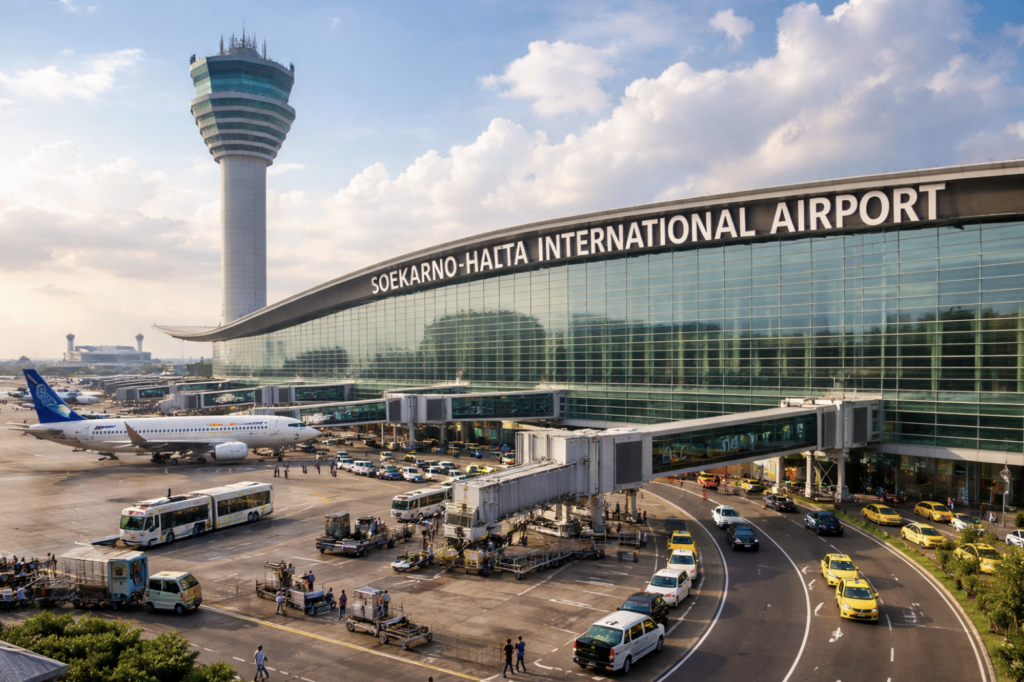
JAKARTA, Indonesia – A section of the roof at Terminal 3 of Jakarta’s Soekarno-Hatta International Airport collapsed Tuesday afternoon after days of intense rainfall, sending passengers fleeing as water and debris crashed onto the terminal floor.
Witnesses described a rapid escalation: what began as a minor ceiling leak quickly turned into a torrent. Within moments, panels gave way, and water streamed into the concourse near Gate 7, forcing passengers to run for safety. Videos circulating online captured the chaos, with luggage abandoned and crowds dispersing in alarm.
The incident occurred around 1:40 p.m. local time, during a peak period of passenger movement. Despite the dramatic scene, authorities reported no serious injuries.
Heavy Rainfall and Structural Strain
Preliminary assessments suggest that prolonged rainfall in Jakarta — part of a broader pattern of intensifying tropical weather — played a central role. Water accumulation within the roof structure is believed to have increased the load on roofing materials, ultimately leading to failure.
Infrastructure experts note that such incidents are increasingly tied to climate variability. “Airports are engineered for resilience, but cumulative stress from sustained rainfall can expose vulnerabilities, particularly in drainage and roof design,” said one Southeast Asia–based civil engineer.
Recent international analyses echo this concern. Studies by global climate and infrastructure bodies have warned that airports across Asia — especially in coastal megacities — face growing risks from extreme precipitation, flooding, and temperature fluctuations. Similar disruptions have been reported in parts of India, China, and the Middle East over the past two years.
Rapid Response Limits Disruption
Airport authorities acted swiftly, cordoning off the affected zone within minutes. Cleanup crews were deployed immediately to remove debris and drain water, while access to the impacted area was restricted as a precaution.
According to airport officials, operations were stabilized within approximately five minutes. Flights continued with minimal interruption, and continuous monitoring of other terminal sections was initiated.
Yudistiawan, a communications official, said that safety inspections were intensified following the incident. “Any area showing signs of structural stress has been cleared and secured,” he noted.
Broader Concerns Over Airport Preparedness
While the immediate danger was contained, the incident has renewed scrutiny of infrastructure readiness in the face of increasingly volatile weather patterns.
Globally, aviation authorities — including the International Civil Aviation Organization (ICAO) and regional regulators — have been urging airports to strengthen climate resilience strategies. These include enhanced drainage systems, more frequent structural inspections, and adaptive design standards capable of handling extreme rainfall events.
In Indonesia, where seasonal monsoons regularly test urban systems, the collapse highlights the intersection of rapid infrastructure expansion and environmental pressure.
For passengers, the episode was a brief but unsettling reminder of how quickly routine travel can be disrupted. For policymakers and engineers, it underscores a more enduring challenge: ensuring that critical transport hubs remain safe and functional in an era of intensifying climate extremes.
No Injuries, but a Warning Signal
Officials emphasized that the absence of casualties was a fortunate outcome. Yet analysts suggest the incident should be viewed less as an anomaly and more as a warning.
As climate patterns shift and urban density increases, even modern, high-capacity facilities may face unexpected stress points. The Jakarta collapse, though contained, may prompt broader reviews — not only in Indonesia but across global aviation networks — of how infrastructure is designed, maintained, and future-proofed.