
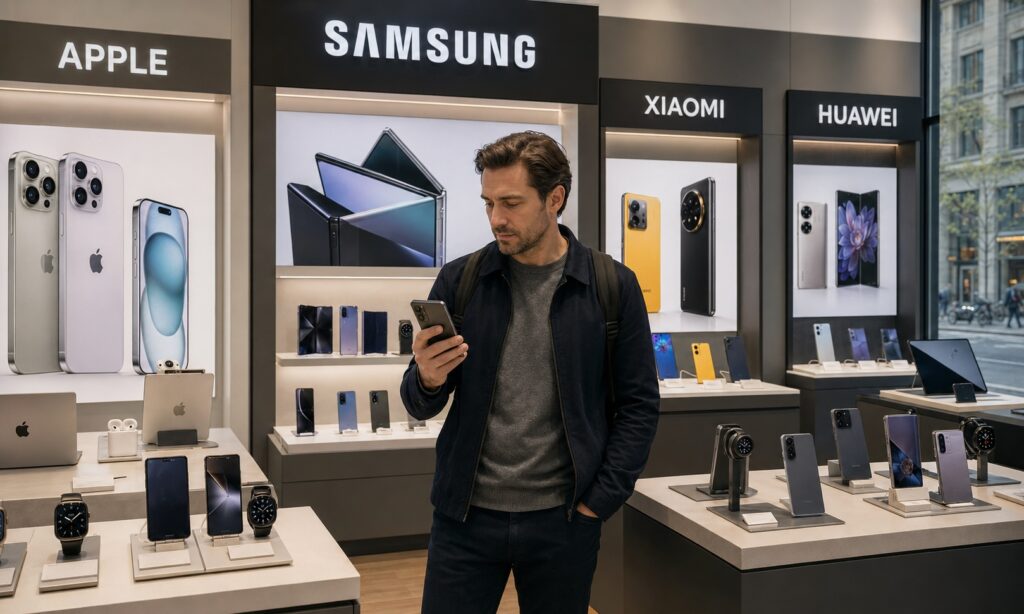
HONGKONG, China — For more than a decade, Samsung occupied an enviable position in the smartphone business. It challenged Apple at the expensive end of the market while selling millions of more affordable Android devices around the world.
That strategy has not collapsed. But it has become increasingly difficult to sustain.
Apple is drawing more consumers into a tightly controlled ecosystem of devices and services. Xiaomi is using Redmi and Poco phones to compete on price while pushing its main brand into premium territory. Huawei, meanwhile, has staged a forceful comeback in China by building its own chips, software and connected-device ecosystem.
Samsung is therefore under pressure from several directions. Yet the claim that it has been “crushed” between Apple and Chinese competitors is not supported by current market data.
Apple captured about 20 percent of worldwide smartphone shipments in 2025, narrowly ahead of Samsung at 19 percent. Xiaomi ranked third with approximately 13 percent. Samsung’s shipments still increased by about 5 percent during the year, according to Counterpoint Research.
The central question is no longer whether Samsung will remain a major smartphone company. It almost certainly will. The more consequential question is whether it can protect its profits and build a distinctive ecosystem while competing across nearly every price category.
Apple Moves Further Upmarket
Apple’s advantage is not simply the popularity of the iPhone. It is the company’s ability to sell a connected system of phones, computers, watches, headphones, applications and subscription services.
The iPhone 17 generation extended that strategy. In the United States, the standard model started at $799, the unusually thin iPhone Air at $999, the iPhone 17 Pro at $1,099 and the Pro Max at $1,199. The Air created an additional premium tier based as much on design as on technical performance.
Apple also upgraded the cameras and processors in its Pro models, reinforcing their position as tools for photography, video and content production. The iPhone 17 Pro series uses the A19 Pro processor and three 48-megapixel rear cameras, according to Apple’s product announcement.
Apple remains less convincing in some visible generative artificial-intelligence applications. But that weakness has not yet seriously undermined iPhone demand. Consumers are also paying for long software support, strong resale values and the inconvenience of leaving Apple’s ecosystem.
Apple is likely to continue raising the value of each sale rather than chasing the widest possible range of buyers. If the company closes its perceived gap in artificial intelligence, the pressure on Samsung’s Galaxy S series will intensify.
Samsung’s Breadth Is Both Its Strength and Its Problem
Samsung offers something no other major manufacturer currently matches: a globally distributed portfolio spanning inexpensive Galaxy A devices, premium Galaxy S phones and foldable Galaxy Z models.
Its latest flagship pricing, however, places it directly against Apple. In the United States, the Galaxy S26 started at about $900, the S26+ at $1,100 and the S26 Ultra at $1,300.
Samsung is emphasizing artificial intelligence, cameras, performance and privacy features. Early demand was concentrated heavily at the top: the company said the S26 Ultra accounted for more than 70 percent of initial preorders.Ich nutze die Bildgenerierung, um daraus ein journalistisches Querformat-Motiv im 6:10-Verhältnis zu erstellen – ohne schwer lesbare Textblöcke im Bild. Samsung’s announcement described the S26 family as its third generation of Galaxy AI devices.
But Samsung’s pricing carries a contradiction. Its official flagship prices resemble Apple’s, while trade-in offers, preorder bonuses and retailer discounts often reduce the effective price soon after release. These promotions support shipments but can teach consumers to wait, weakening resale values and the perception of exclusivity.
Further down the range, Galaxy A phones face Chinese rivals offering larger batteries, faster charging and aggressive specifications. Samsung’s advantages — software support, security, retail availability and service networks — are less dramatic on a product comparison page.
In Europe, Samsung nevertheless remains far stronger than Xiaomi in the installed-device base. Statcounter’s usage data for June 2026 placed Apple at roughly 39 percent, Samsung at 29 percent and Xiaomi below 10 percent. These figures measure active web usage rather than quarterly sales, but they show that Samsung has not been displaced in one of its most important regions.
Samsung will probably simplify and more clearly separate its product families. The Galaxy S and Z lines are likely to concentrate on AI, premium materials and new form factors, while the A series will compete through reliability and longer ownership rather than specifications alone.
Xiaomi Is No Longer Just the Cheaper Alternative
Xiaomi is pursuing a two-level strategy. Redmi and Poco continue to attract price-conscious buyers, while Xiaomi-branded flagships are moving toward the highest end of the market.
The Xiaomi 17 reportedly entered Europe at about €999, while the Xiaomi 17 Ultra reached approximately €1,499. With Leica-branded camera systems, powerful processors, large batteries and rapid charging, Xiaomi is seeking to compete with the Galaxy Ultra and iPhone Pro Max rather than merely undercut them.
That transition poses a challenge. Xiaomi built its reputation by offering unusually strong hardware for less money. At €1,000 or more, buyers also expect refined software, dependable updates, convenient repairs, privacy assurances and high resale values.
Xiaomi will probably continue using Redmi and Poco to defend shipment volumes while turning its main brand into a more profitable premium business. But increasing component prices could force difficult choices. If prices rise too far, Xiaomi risks weakening the value proposition that made it successful. If they remain too low, margins will suffer.
Huawei’s Revival Is Powerful but Mostly Chinese
Huawei’s recovery is real, but it is frequently misinterpreted as a global resurgence.
In China, Huawei led the market with a 22.6 percent share in the second quarter of 2026, according to IDC data reported by Reuters. Its shipments rose 19.4 percent even as the Chinese market declined. Xiaomi’s shipments in China fell 21.7 percent during the same period.
Huawei has benefited from strong domestic loyalty, renewed access to advanced Chinese-made processors and an expanding HarmonyOS ecosystem encompassing phones, computers, wearables and automotive technology. Within China, it increasingly resembles a self-contained alternative to Apple.
Its international prospects are more limited. The absence of preinstalled Google services remains a major obstacle in Europe and other markets. Advanced cameras and foldable designs have maintained Huawei’s visibility, but they have not restored its former global scale.
Unless trade restrictions ease or Huawei develops a broadly accepted international application ecosystem, its growth will probably remain concentrated in China and selected overseas markets.
Rising Costs Favor Expensive Phones
The competition is unfolding as the wider industry contracts. Global smartphone shipments fell sharply in the second quarter of 2026 amid higher memory and component costs. Apple still increased shipments and reached a record 20 percent share for the quarter, according to preliminary Counterpoint figures reported by Reuters.
Higher component costs disproportionately hurt inexpensive smartphones. Adding $20 or $30 in manufacturing costs is easier to absorb on a $1,200 flagship than on a $200 entry-level device. Manufacturers may respond by raising prices, reducing storage or cameras, or discontinuing their least profitable models.
That trend favors Apple and Samsung’s premium business. It is more dangerous for Xiaomi and other companies that depend heavily on price-to-performance appeal.
A Market Divided by Strategy
The smartphone industry is not moving toward a simple victory by one manufacturer. Instead, its largest companies are becoming more distinct:
- Apple is strengthening a high-margin ecosystem built around customer loyalty.
- Samsung is trying to remain the only truly global Android competitor across premium, foldable and mass-market categories.
- Xiaomi is preserving volume through Redmi and Poco while taking its main brand upmarket.
- Huawei is building an increasingly independent technology ecosystem centered on China.
Samsung has not been crushed between Apple and Xiaomi. Its predicament is subtler: it can no longer be the obvious Apple alternative, the dominant Android brand and the best-value manufacturer at the same time.
Its future will depend on whether it can transform a broad collection of Galaxy devices into a coherent ecosystem — and persuade buyers that its phones retain their value for years, not merely until the next discount arrives.