
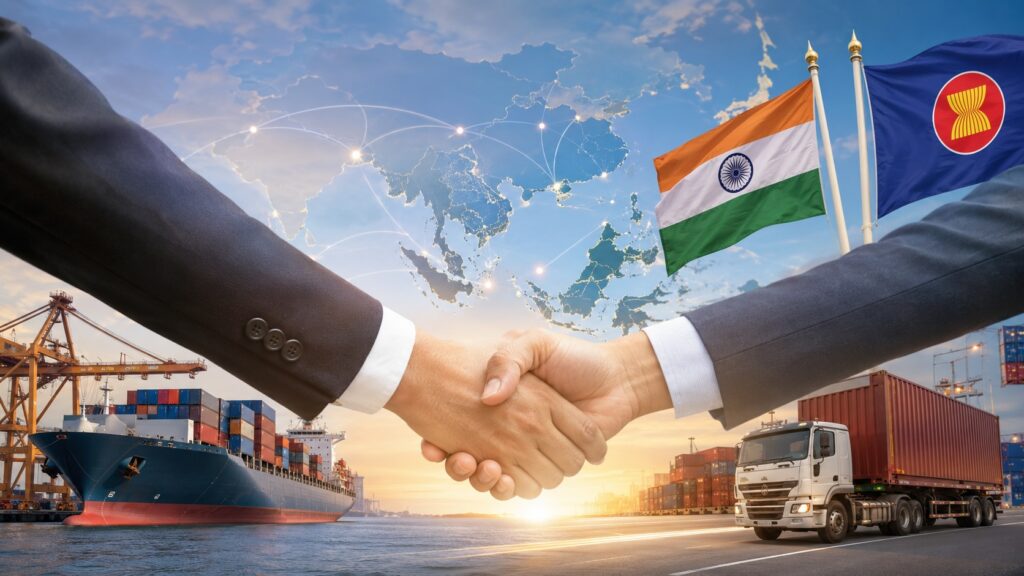
NEW DELHI, India — India and the Association of Southeast Asian Nations (ASEAN) are accelerating efforts to modernize their trade relationship after bilateral commerce reached US$128 billion in fiscal year 2025–26, underscoring the bloc’s growing importance as one of India’s largest economic partners even as New Delhi seeks to address longstanding concerns over trade imbalances.
ASEAN accounts for approximately 11 percent of India’s global trade, making the 10-member regional bloc a central pillar of India’s “Act East” strategy and broader Indo-Pacific economic engagement. Against a backdrop of slowing global trade growth and shifting supply chains, officials from both sides convened in New Delhi this week for the 13th ASEAN-India Trade in Goods Agreement (AITIGA) Joint Committee Meeting, aimed at advancing the long-awaited review of the 2009 free trade agreement.
Pressure Builds to Modernize a 15-Year-Old Trade Agreement
Running from July 6 to July 10, the negotiations focus on updating provisions that governments and businesses increasingly view as outdated for today’s regional trading environment.
The Joint Committee instructed its specialized negotiating groups to accelerate work on unresolved chapters of the agreement, assigning time-bound objectives to maintain momentum after previous deadlines slipped. Officials emphasized that faster progress would help produce tangible outcomes and strengthen commercial certainty for businesses operating across the region.
Three technical working groups met alongside the main negotiations, covering:
- Customs Procedures and Trade Facilitation
- National Treatment and Market Access
- Rules of Origin
These areas are widely regarded as among the most commercially significant because they directly affect market access, customs efficiency and the ability of companies to qualify for preferential tariff treatment.
Economic Opportunity Meets Domestic Political Reality
While officials describe ASEAN as an indispensable economic partner, the review also reflects India’s desire to make the agreement more balanced.
Indian policymakers have increasingly argued that the existing pact has not fully benefited domestic manufacturers, with concerns that complex supply chains and transshipment practices have contributed to a widening trade deficit. Particular attention has focused on strengthening Rules of Origin, which determine where products are genuinely manufactured and help prevent goods from third countries from entering India through ASEAN members to obtain preferential tariff treatment.
The modernization effort therefore seeks to achieve two objectives simultaneously: expanding trade and investment while providing stronger safeguards for domestic industries.
Strategic Importance Beyond Trade
Analysts say the AITIGA review carries significance beyond tariffs.
As multinational companies diversify supply chains and governments seek greater economic resilience, closer India-ASEAN integration could reinforce regional manufacturing networks in sectors including electronics, automotive components, renewable energy, digital trade and advanced manufacturing.
A modernized agreement could also complement India’s broader efforts to strengthen economic partnerships across the Indo-Pacific while enhancing connectivity with one of the world’s fastest-growing consumer markets.
Outlook
Although negotiators have yet to finalize the revised agreement, the latest round of talks signals renewed political commitment to completing the review after earlier delays.
With bilateral trade now reaching US$128 billion, both India and ASEAN appear determined to preserve one of Asia’s most important economic partnerships while adapting it to new commercial realities, stronger supply-chain security requirements and evolving regional competition. The pace at which negotiators resolve outstanding chapters—particularly on market access, customs procedures and rules of origin—will likely determine whether the updated agreement can unlock a new phase of trade and investment growth.