
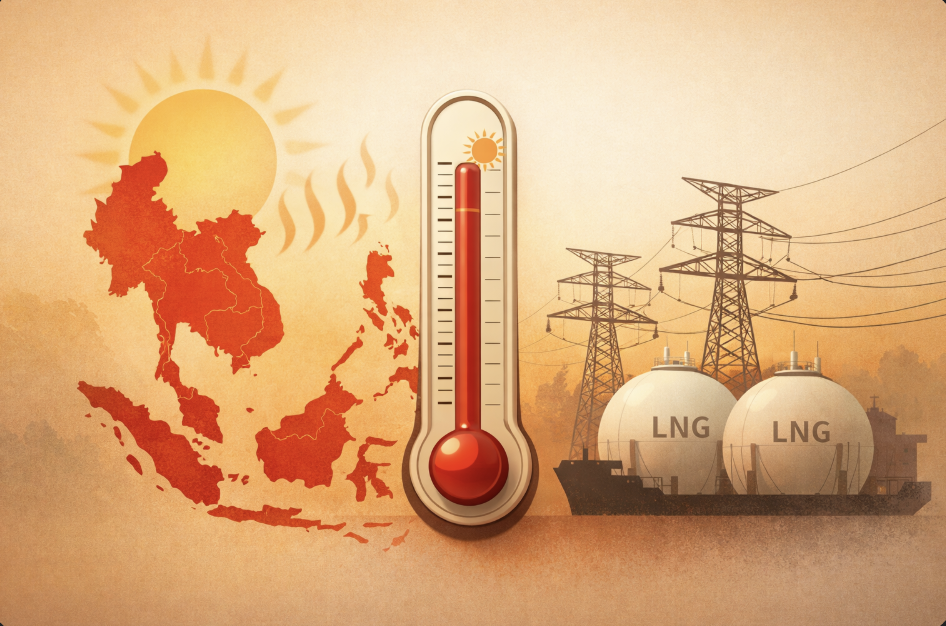
SINGAPORE — Much of Southeast Asia is expected to endure an unusually warm early-summer season in the coming months, according to new regional climate forecasts, raising concerns about surging electricity demand at a time of heightened volatility in global energy markets.
The latest seasonal outlook from the ASEAN Specialised Meteorological Centre (ASMC) indicates that temperatures across large parts of the region will likely exceed historical averages between March and May, the period that typically marks Southeast Asia’s hottest months. The warming trend is expected to affect both the mainland and island nations of the region, home to more than 500 million people.
Widespread Probability of Above-Average Temperatures
The highest likelihood of above-normal temperatures is forecast for Indonesia and Malaysia, where the probability ranges from 80 to 100 percent. Meteorologists say the heat is expected to emerge first across parts of the maritime Southeast Asian archipelago before spreading gradually across mainland areas over the coming weeks.
Significant warming is also projected in Thailand and northern Vietnam, regions that already experience intense seasonal heat before the onset of the southwest monsoon.
Only limited pockets of the region—including southeastern Vietnam, Cambodia and parts of the Philippines—are expected to see temperatures closer to long-term averages, according to the forecast.
Seasonal climate models also suggest that lingering atmospheric patterns linked to the fading La Niña phase may influence regional weather conditions, even as the Pacific climate system gradually transitions toward neutral conditions during the spring.
Rising Energy Demand Amid Global Market Uncertainty
The prospect of persistent heat has raised concerns among policymakers and utilities that electricity consumption—particularly for air-conditioning and cooling—could rise sharply during April and May, historically the region’s peak temperature months.
Energy analysts note that extreme weather has become a key driver of natural-gas demand in Asia in recent years, as power systems rely increasingly on gas-fired generation to meet spikes in electricity consumption during heatwaves.
This year’s seasonal outlook arrives amid renewed volatility in international energy markets. Disruptions to Middle Eastern energy routes linked to conflict involving Iran have tightened global oil and natural-gas supplies, pushing prices higher and raising concerns about fuel availability across Asia.
The Strait of Hormuz, a critical shipping corridor for energy exports, has become a particular focus of concern for Asian importers that depend heavily on Middle Eastern crude and liquefied natural gas.
Governments Seek Additional LNG Supplies
Against this backdrop, several Southeast Asian governments and utilities have begun seeking additional liquefied natural gas cargoes to ensure adequate fuel supplies for power generation.
Energy traders say Vietnam and Thailand are currently looking to secure additional LNG shipments for delivery in March and April, while Thailand has adjusted its procurement strategy to include at least three additional spot cargoes during the same period.
Thailand’s reliance on imported LNG has grown steadily in recent years as domestic gas production declines, with the fuel accounting for a rising share of the country’s energy mix.
The tightening market has also been compounded by supply disruptions, including temporary shutdowns at major export facilities in the Gulf region—an important source of LNG for Asian buyers.
Climate and Energy Risks Converge
For Southeast Asia, the convergence of hotter weather and uncertain energy supplies highlights the region’s growing vulnerability to both climate variability and global geopolitical shocks.
Analysts say the combination could test regional power systems during the coming months, particularly in countries where electricity demand is rising rapidly alongside economic growth.
While the expected heat is not unusual for the time of year, meteorologists warn that sustained above-average temperatures could amplify pressure on electricity grids and fuel markets across one of the world’s fastest-growing energy-consuming regions.