
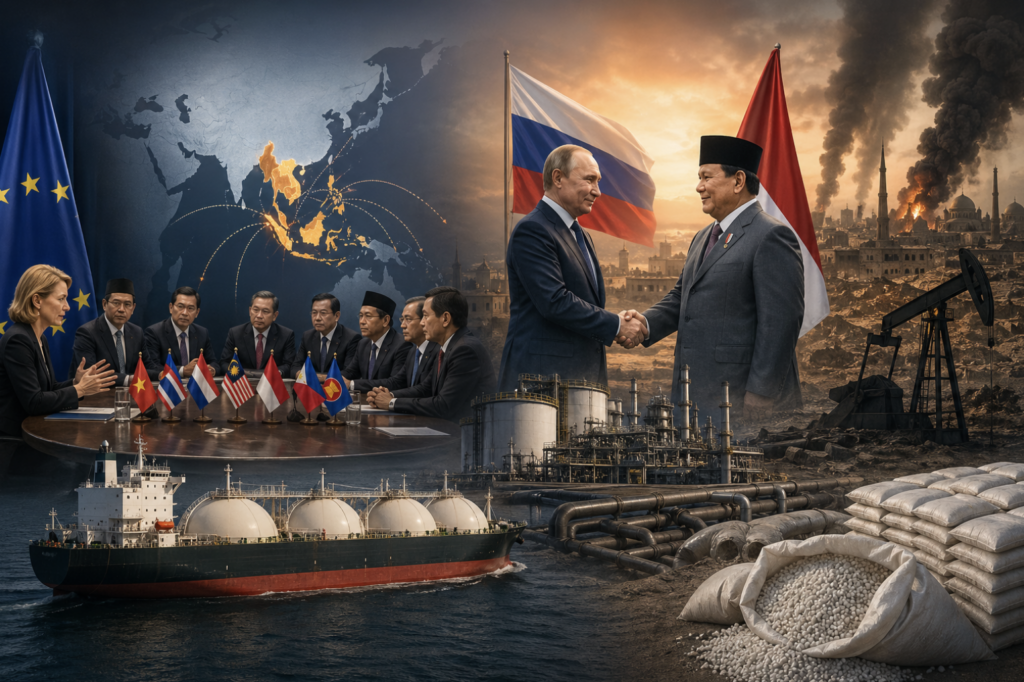
JAKARTA, Indonesia – As conflict in the Middle East disrupts global energy flows, countries across Southeast Asia are racing to secure alternative supplies—turning increasingly to Russia despite mounting pressure from Western governments.
At a recent meeting with the Association of Southeast Asian Nations in Brunei, Kaja Kallas urged regional leaders to avoid purchasing Russian oil, warning that such deals would help sustain Moscow’s war in Ukraine. Her appeal reflected growing concern in Europe that geopolitical fractures are accelerating as energy shortages intensify.
Yet across the region, those warnings have had limited effect. Governments facing acute fuel and fertilizer gaps—long dependent on Middle Eastern supplies—are prioritizing economic stability over geopolitical alignment.
Indonesia, Southeast Asia’s largest economy, recently signaled plans to import up to 150 million barrels of Russian crude following talks between President Prabowo Subianto and Vladimir Putin in Moscow. The Philippines has resumed Russian oil imports for the first time in five years, while Thailand is exploring fertilizer purchases. Vietnam, meanwhile, is accelerating cooperation with Russia on a long-delayed nuclear power project.
Energy Shortages Reshape Alliances
The shift underscores a broader recalibration underway in Southeast Asia. The Middle East conflict has disrupted not only oil shipments but also fertilizer exports critical to the region’s agricultural economies, forcing governments to diversify supply chains with urgency.
Recent international analysis from organizations such as the International Energy Agency and the World Bank indicates that global energy markets remain volatile, with Asian import-dependent economies among the most exposed. Spot crude prices have surged intermittently in 2026, while fertilizer costs remain elevated compared to pre-crisis levels.
A temporary easing of U.S. sanctions enforcement—allowing limited maritime purchases of Russian oil—has further opened the door. The policy, introduced by Washington in March and extended under pressure from Asian partners, has provided short-term relief to tight markets while complicating Western efforts to isolate Moscow.
Russia Finds Opportunity—But Faces Constraints
For Russia, the crisis has delivered both economic gains and diplomatic openings. Elevated energy prices and new buyers in Asia have helped offset lost European markets, reinforcing Kremlin claims that sanctions have failed to fully isolate its economy.
Public sentiment in parts of Southeast Asia has also proved receptive. Surveys by the Pew Research Center and other institutions show relatively favorable views of Russia in countries such as Indonesia and Vietnam—reflecting perceptions of Moscow as a counterweight to Western influence.
Analysts say this dynamic has enabled Russia to deepen ties not only in hydrocarbons but also in strategic sectors such as nuclear energy. Russian firms have expanded agreements with Vietnam and Myanmar, positioning themselves as long-term partners in energy infrastructure.
Still, Moscow’s reach remains constrained. Compared with the United States and China, Russia lacks the economic scale and investment capacity to dominate the region. Its growing dependence on Beijing also raises concerns among Southeast Asian nations wary of China’s influence, particularly in contested maritime areas.
Strategic Balancing in a Fragmented World
For Southeast Asian governments, the turn toward Russia reflects less an ideological shift than a continuation of longstanding non-alignment strategies.
“Energy security is now inseparable from foreign policy,” regional analysts note, pointing to efforts by countries like Indonesia to balance relations among major powers while safeguarding domestic stability. Engagement with Russia offers both practical benefits—such as discounted oil—and symbolic leverage in signaling independence from Western pressure.
At the same time, competition for influence is intensifying. Alongside Russia, countries including the United States, China, South Korea and Japan are vying for roles in Southeast Asia’s evolving energy landscape, particularly in renewables and nuclear power.
A Test for Global Order
The unfolding dynamic highlights a deeper shift in the international system. As supply shocks reshape priorities, countries are increasingly willing to sidestep geopolitical divides in favor of immediate economic needs.
A planned Russia-ASEAN summit later this year is expected to underscore that reality. Even if concrete agreements remain limited, the gathering will signal Moscow’s continued engagement in a region central to global growth.
For Western policymakers, the challenge is becoming clearer: in a world defined by overlapping crises, influence may hinge less on persuasion—and more on who can reliably deliver energy, food and stability when it matters most.