
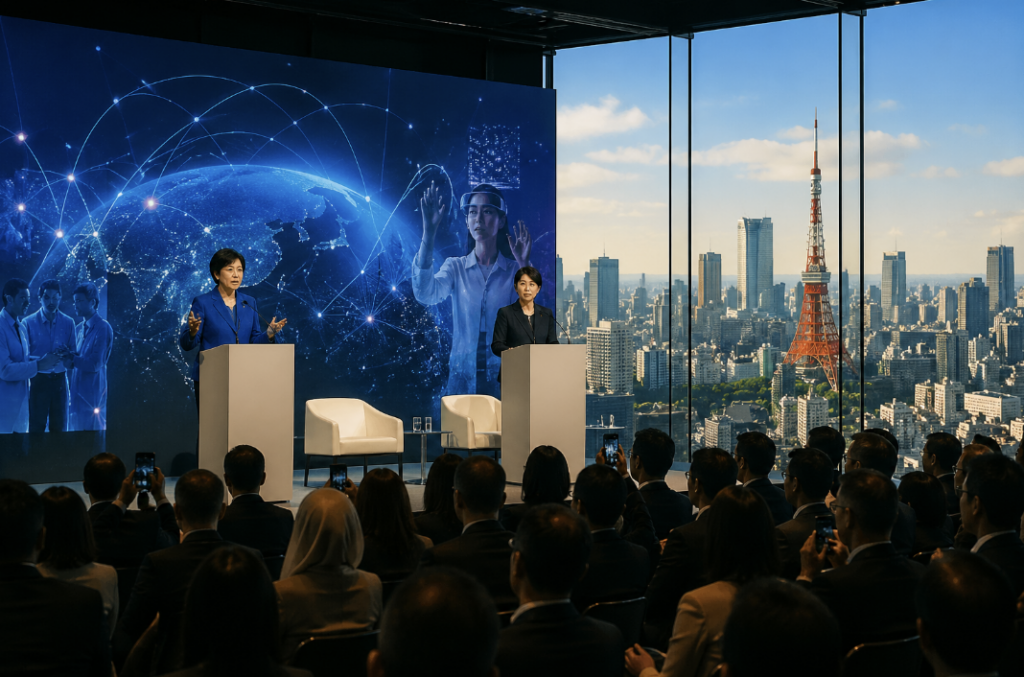
TOKYO, Japan — With a blend of policy ambition and global outreach, the SusHi Tech Tokyo 2026 conference opened Monday at Tokyo Big Sight, drawing thousands of startups, investors and policymakers as Japan seeks to position its capital among the world’s leading innovation hubs.
Organizers described the event as one of Asia’s largest startup gatherings, with a focus on sustainability, artificial intelligence and cross-border investment. The Tokyo Metropolitan Government has set an ambitious target of facilitating roughly 10,000 business negotiations during the multi-day conference, underscoring its economic and diplomatic stakes.
Koike Unveils Expansion Strategy for Tokyo’s Startup Ecosystem
Governor Announces Globalization Push and Billion-Dollar Investment Framework
In her opening keynote, Tokyo Governor Yuriko Koike framed the conference as a cornerstone of the city’s long-term economic transformation. She reiterated her goal of making Tokyo “a global hub for startup incubation,” while unveiling new policy instruments aimed at accelerating that shift.
Among the headline initiatives:
- A “SusHi Tech Global” program to support Japanese startups expanding overseas
- A Tokyo Startup Database to map and visualize the city’s innovation ecosystem
- Plans for a $1 billion investment framework and “10×10×10” growth targets
Koike also emphasized the broader vision of “sustainable cities through high technology,” aligning Tokyo’s economic strategy with climate and urban resilience priorities.
Internationally, analysts noted that her agenda reflects intensifying competition among global cities—particularly in Asia—to attract venture capital, talent and emerging technologies. The convening of leaders from roughly 50 global cities alongside the conference reinforced Tokyo’s intent to shape transnational innovation networks.

Prime Minister Signals National Backing for Innovation Agenda
Takaichi Positions Technology as Central to Japan’s Growth Strategy
Prime Minister Sanae Takaichi delivered a special keynote reinforcing the national government’s alignment with Tokyo’s ambitions, presenting innovation as central to Japan’s economic renewal and geopolitical positioning.
While full transcripts were not immediately released, government messaging surrounding the event highlighted priorities consistent with Takaichi’s broader agenda: increased investment in advanced technologies, support for startups, and the expansion of international collaboration. These themes echo her administration’s plan to significantly boost science and technology spending through 2030.
Domestic coverage portrayed the Prime Minister’s appearance as a signal of unified national-local coordination, particularly as Japan seeks to counter demographic decline with productivity gains driven by innovation.
International Reaction: Tokyo’s Strategic Repositioning
Analysts See Event as Test of Japan’s Global Competitiveness
Early international reporting has framed SusHi Tech Tokyo 2026 as both a showcase and a test.
- Economic observers view the conference as part of a broader push to reassert Tokyo’s relevance amid competition from Singapore, Seoul and Silicon Valley.
- Investors are watching whether policy pledges—especially funding mechanisms—translate into scalable startup growth.
- Urban policy experts highlight Tokyo’s emphasis on sustainability and “smart city” frameworks as a differentiating strategy.
The Japan Times noted that organizers hope the event will generate substantial deal-making and deepen ties between startups and large corporations, a long-standing challenge in Japan’s innovation ecosystem.
Domestic Perspective: Momentum, but Structural Questions Remain
Japanese Media Highlight Scale While Questioning Execution
Japanese coverage has emphasized the scale and ambition of the conference, portraying it as a symbol of Tokyo’s growing startup ecosystem. At the same time, analysts have pointed to structural hurdles:
- Historically limited risk capital compared with global peers
- Cultural barriers to entrepreneurship
- The need for deeper integration with global markets
The success of newly announced initiatives—particularly international expansion programs and investment frameworks—will likely determine whether the conference marks a turning point or remains largely symbolic.
A City’s Ambition on Display
As SusHi Tech Tokyo 2026 unfolds, it presents a carefully choreographed image of a city—and a country—seeking to redefine its place in the global technology economy.
Whether Tokyo can translate vision into sustained innovation, analysts say, will depend less on the scale of its conferences than on the durability of its reforms and its ability to attract the world’s most competitive talent and capital.