
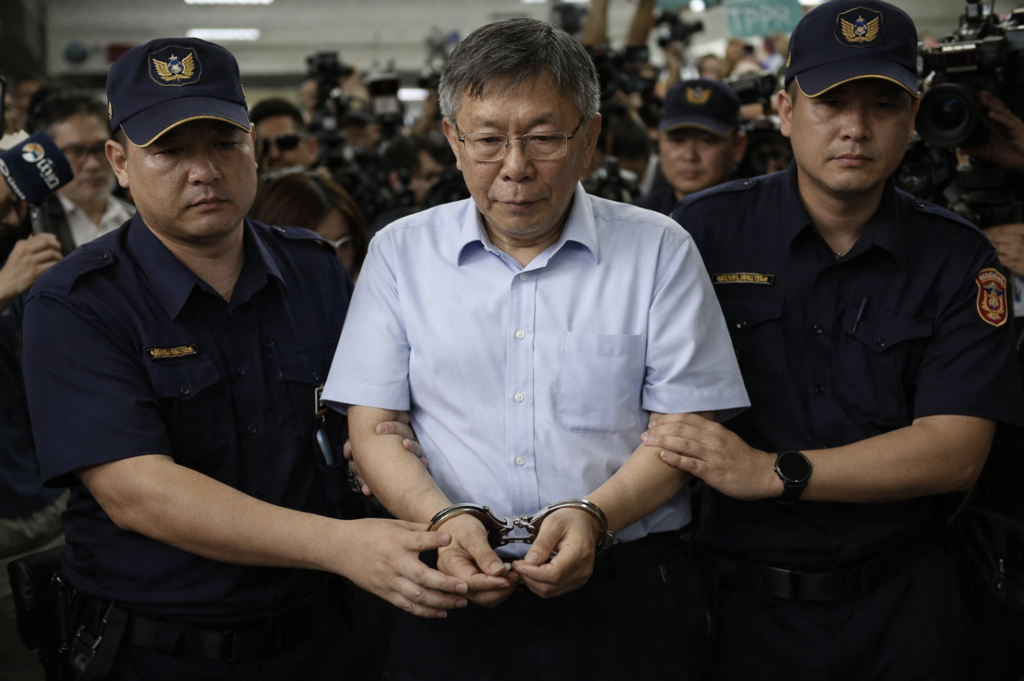
TAIPEI, Taiwan — A Taipei court has sentenced former Taipei mayor and former presidential candidate Ko Wen-je to 17 years in prison after finding him guilty in a corruption case tied to a real-estate development and to the misuse of political donations, in a judgment that also suspends his civil rights for six years and could effectively remove him from the next presidential contest unless the ruling is overturned on appeal. Ko, 66, has denied wrongdoing and says the case is politically motivated.
Prosecutors had accused Mr. Ko of accepting NT$17.1 million in bribes connected to a major development project approved during his tenure as Taipei mayor, while also alleging the improper handling of tens of millions of Taiwan dollars in campaign funds. Prosecutors had originally sought a sentence of more than 28 years. The court’s ruling marks one of the most consequential convictions of a major Taiwanese opposition figure in recent years.
For Taiwan’s domestic politics, the sentence lands far beyond one politician’s legal fate. Mr. Ko, a former surgeon who built his appeal on impatience with the island’s two dominant parties, finished third in the 2024 presidential election with 3,690,466 votes, or 26.46 percent, while Lai Ching-te won with 40.05 percent. That result established the Taiwan People’s Party, or TPP, as a durable “third force” in national politics, especially among younger and urban voters frustrated by high housing costs, partisan stalemate and the narrowing space between the ruling Democratic Progressive Party and the Kuomintang.
The immediate political effect is likely to be destabilizing but not necessarily terminal for the opposition camp. The TPP holds eight seats and has often voted with the Kuomintang, helping form a parliamentary bloc strong enough to frustrate the Lai administration on budgets, oversight and national priorities. Analysts have described Taiwan’s post-2024 system as one of entrenched divided government, meaning Mr. Ko’s downfall weakens the symbolic center of the third-party movement even as the opposition’s legislative leverage remains intact.
That tension explains the sharply polarized response. Huang Kuo-chang, the TPP chairman, has continued to back Mr. Ko and previously cast the prosecution as politically driven, while supporters gathered outside court and, according to Taiwanese media, clashes broke out between his backers and critics after the verdict. For Mr. Ko’s allies, the case feeds a broader narrative that Taiwan’s governing establishment is using the judiciary to hobble a disruptive rival; for his opponents, it is evidence that Taiwan’s courts are willing to pursue high-profile corruption cases even against nationally prominent figures.
Internationally, the case is being read less as a turning point in cross-strait policy than as a test of Taiwan’s democratic resilience under conditions of extreme polarization. Foreign analysts have spent the past year focusing on Taiwan’s fractured government, rising partisan conflict and the pressure created by Chinese military and political coercion. In that context, Mr. Ko’s conviction matters because he had positioned himself as an alternative to both the DPP’s harder-edged framing of Beijing and the KMT’s emphasis on restoring dialogue. His removal from frontline politics could narrow the field of centrist or anti-establishment options just as Taiwan heads toward local elections and, eventually, the 2028 race.
The larger question now is whether the TPP can survive as an institution without the man who personified it. Recent commentary in Taiwan and abroad has suggested that the party’s future depends on whether it can evolve from a leader-centered vehicle into a more durable organization with a broader bench and clearer identity. If it cannot, Taiwan’s opposition politics may consolidate further around the Kuomintang; if it can, Mr. Ko’s conviction may end his candidacy without ending the political demand he helped uncover.
Sources: Reuters; Taiwan Central Election Commission; Taipei Times; Focus Taiwan; Brookings; CSIS.