
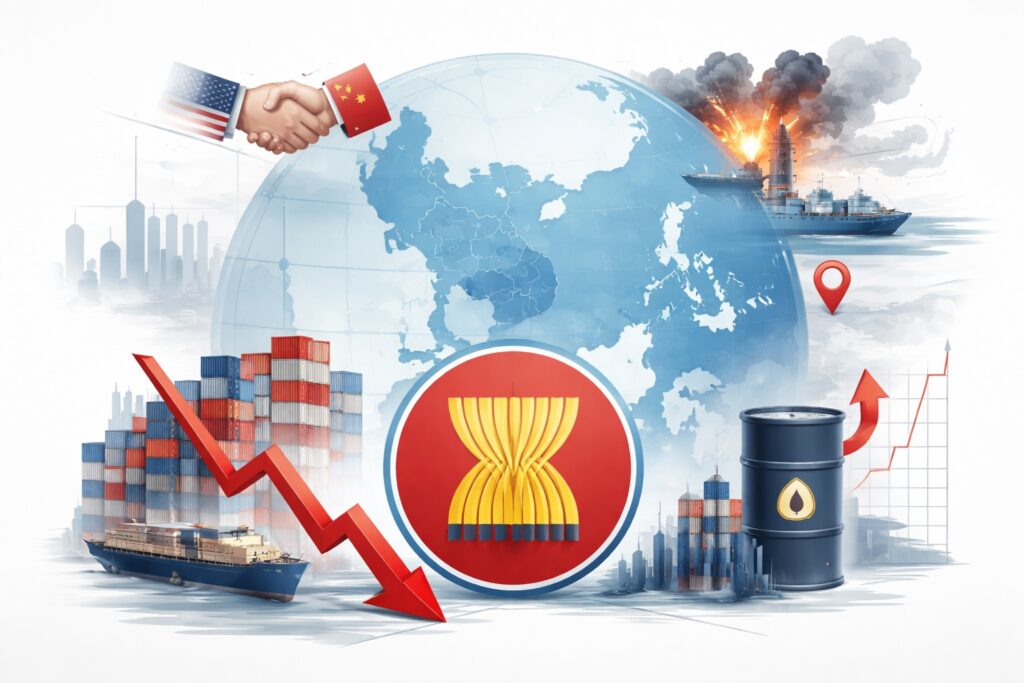
PHNOM PENH, Cambodia — Leaders and business executives from Southeast Asia warned this week that escalating geopolitical tensions and renewed trade protectionism are threatening the economic momentum of the Association of Southeast Asian Nations, the regional bloc that has been one of the world’s fastest-growing economic areas.
Speaking at the Cambodia-ASEAN Business Summit in Phnom Penh, Cambodia’s prime minister, Hun Manet, said the global economy is entering a period of mounting uncertainty shaped by supply-chain disruptions, climate pressures, and intensifying political conflicts — particularly in the Middle East.
“The world is facing overlapping challenges that threaten both regional and global stability,” Mr. Hun Manet said, urging Southeast Asian nations to strengthen cooperation and economic resilience.
Trade Fragmentation and Rising Tariffs
Business leaders said unilateral tariff actions — primarily associated with shifting trade policies in the United States and retaliatory responses by other countries — are accelerating a broader shift away from the rules-based global trading system.
Kith Meng, president of the Cambodia Chamber of Commerce, warned that these measures risk deepening economic fragmentation and geopolitical polarization.
He said recent tariff disputes and industrial policy subsidies among major economies are making global commerce more “transactional and interest-driven,” undermining the predictability on which export-oriented economies in Southeast Asia rely.
Economists from institutions including the International Monetary Fund and the World Bank have similarly cautioned that a fragmentation of global trade into competing blocs could reduce global output in the coming decade, with export-dependent regions such as Southeast Asia particularly exposed.
Middle East Conflict Sends Energy Risks Through Asia
At the same time, renewed tensions involving the United States, Israel and Iran have heightened fears of disruptions to global energy markets. Analysts say any instability affecting the Strait of Hormuz — through which roughly one-fifth of the world’s oil supply passes — could send fuel prices sharply higher.
Higher oil prices are already rippling across Asia. Southeast Asia’s economies are mostly net energy importers, making them vulnerable to price shocks.
Thong Mengdavid, a researcher at the China-ASEAN Studies Center, said energy volatility could raise transportation and manufacturing costs across the region while weakening consumer purchasing power.
“With higher oil and gas prices, inflationary pressures could spread through supply chains,” he said. “That would affect industries ranging from manufacturing to agriculture.”
Cambodia and Regional Economies Feel the Pressure
For Cambodia, analysts say the impact will likely be indirect but significant. Rising fuel prices increase logistics costs for export sectors such as garments and agricultural goods, which remain central to the country’s economy.
Imported inflation and financial market volatility could also weigh on household spending and investor sentiment, economists said.
The concerns come as Southeast Asia seeks to maintain growth momentum after several years of global economic shocks following the pandemic.
ASEAN Looks to Integration and Neutrality
Regional leaders emphasized that ASEAN’s strategy will focus on economic integration rather than geopolitical alignment.
“Asean’s strength lies not in choosing sides,” Mr. Kith Meng said, “but in preserving openness, neutrality and regional centrality.”
Officials pointed to the Regional Comprehensive Economic Partnership — the world’s largest free-trade agreement, linking ASEAN with major partners including China, Japan and South Korea — as a key framework for expanding intra-regional trade and strengthening supply chains.
Policy analysts say deeper regional cooperation on energy security, infrastructure connectivity and digital trade could help buffer the bloc against global shocks.
For now, however, Southeast Asia’s growth trajectory appears increasingly tied to forces far beyond its borders: geopolitical rivalry, fragile supply chains and volatile energy markets.