
Aging Population, Border Instability and Economic Pressures Push Bangkok to Accelerate Regional Labor Agreements
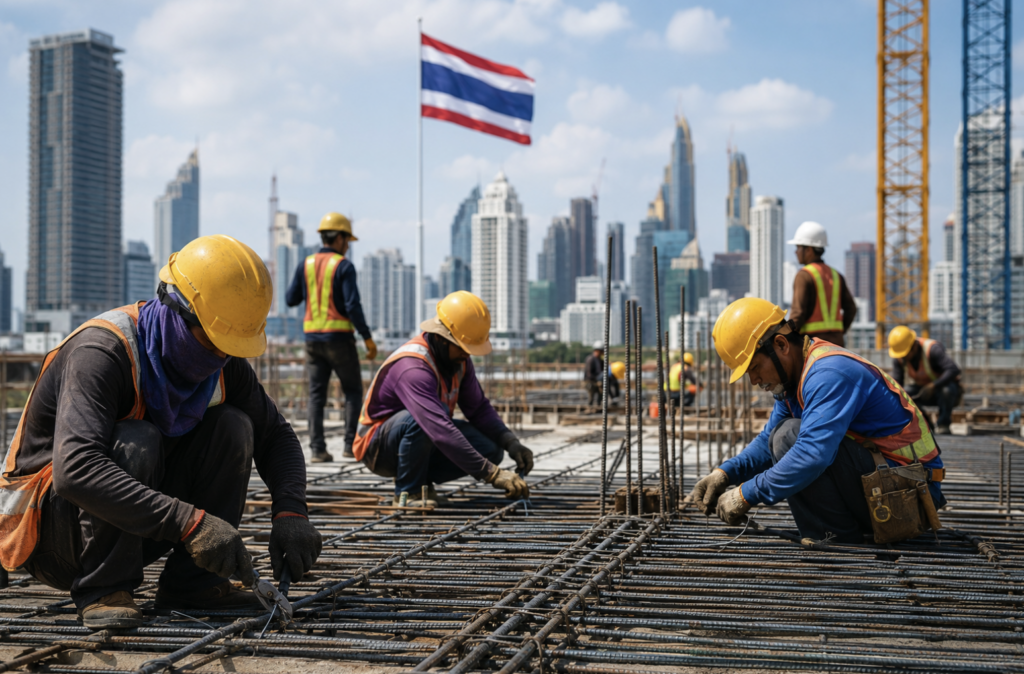
BANGKOK, Thailand – Thailand is moving urgently to stabilize its labor force as worker shortages increasingly threaten sectors central to the country’s economy, from construction and manufacturing to tourism and agriculture. Government officials acknowledged in May 2026 that labor scarcity has become a structural challenge rather than a temporary post-pandemic disruption, prompting Bangkok to accelerate labor agreements with neighboring countries including Myanmar, Laos, Cambodia and Vietnam.
The effort reflects a broader reality confronting Southeast Asia’s second-largest economy: Thailand’s workforce is shrinking while demand for low- and mid-skilled labor continues to rise. Demographic trends, slower domestic population growth and the reluctance of many Thai workers to take physically demanding jobs have left industries increasingly dependent on migrant labor. Analysts now view foreign workers as essential to sustaining Thailand’s long-term economic model.
Government officials have recently extended work permits and residency arrangements for hundreds of thousands of workers from Laos, Myanmar, Vietnam and Cambodia in an attempt to prevent labor disruptions. Thai authorities warned that allowing large numbers of migrants to fall out of the legal system could damage economic momentum and intensify labor shortages already affecting businesses nationwide.
Thailand’s Economic Recovery Depends Increasingly on Migrant Labor
The labor issue has become more urgent as Thailand attempts to sustain tourism recovery, industrial exports and infrastructure development amid slowing regional growth. According to Thai economic outlook assessments for 2026–2028, the country is already expected to grow below its historical average due to trade pressures, political uncertainty and weak domestic productivity growth.
Migrant workers now form a substantial part of Thailand’s workforce in key sectors. Data from labor and migration groups indicate that the number of registered migrant workers surpassed 3.6 million in 2025, with workers from Myanmar accounting for the largest share.
At the center of the current strategy is the expansion of the Memorandum of Understanding (MOU) system — bilateral agreements allowing Thailand to legally recruit workers from neighboring countries under regulated conditions. The system governs recruitment procedures, work permits, healthcare, insurance and labor protections.
Thai authorities have increasingly described the MOU framework as necessary not only for economic stability but also for national security and labor management. Officials argue that formalized recruitment reduces illegal migration, improves monitoring and limits exploitation risks.
Border Tensions and Myanmar Instability Disrupt Labor Supply
Recent geopolitical tensions have complicated the situation. Fighting and instability in Myanmar, combined with border disputes involving Cambodia, have disrupted traditional labor flows into Thailand. In some regions, Cambodian workers returned home amid rising tensions, leaving Thai employers struggling to fill vacancies.
Thai officials responded by accelerating replacement labor plans, including proposals to recruit workers not only from CLMV countries — Cambodia, Laos, Myanmar and Vietnam — but also from Sri Lanka, Nepal, Indonesia and the Philippines.
The shift signals a broader transformation underway in Thailand’s economy. Once viewed primarily as a temporary destination for regional migrant workers, Thailand is increasingly evolving into a labor-import-dependent economy similar to Singapore and Malaysia, where foreign workers have become embedded in long-term economic planning.
Rights Groups Warn of Risks Alongside Economic Benefits
Labor advocates and international observers caution that the expansion of migrant recruitment must be matched by stronger protections. Thailand has long faced scrutiny over labor exploitation, undocumented employment and human trafficking risks in sectors such as fishing, agriculture and construction.
Thai officials have responded by emphasizing social security access and legal protections for migrant workers within the CLMTV framework. Government representatives say the current reforms are intended to improve access to healthcare, legal employment and cross-border labor protections while reducing dependence on undocumented labor channels.
Still, economists note that the deeper issue extends beyond migration policy. Thailand’s aging society and declining birthrate are expected to continue shrinking the domestic workforce for decades. Some projections suggest the country’s working-age population could fall sharply by 2060, potentially limiting long-term economic growth unless productivity and automation improve significantly.
For now, however, Thailand’s immediate solution is clear: bring in more workers — and do so quickly enough to keep the country’s economic engine running.