
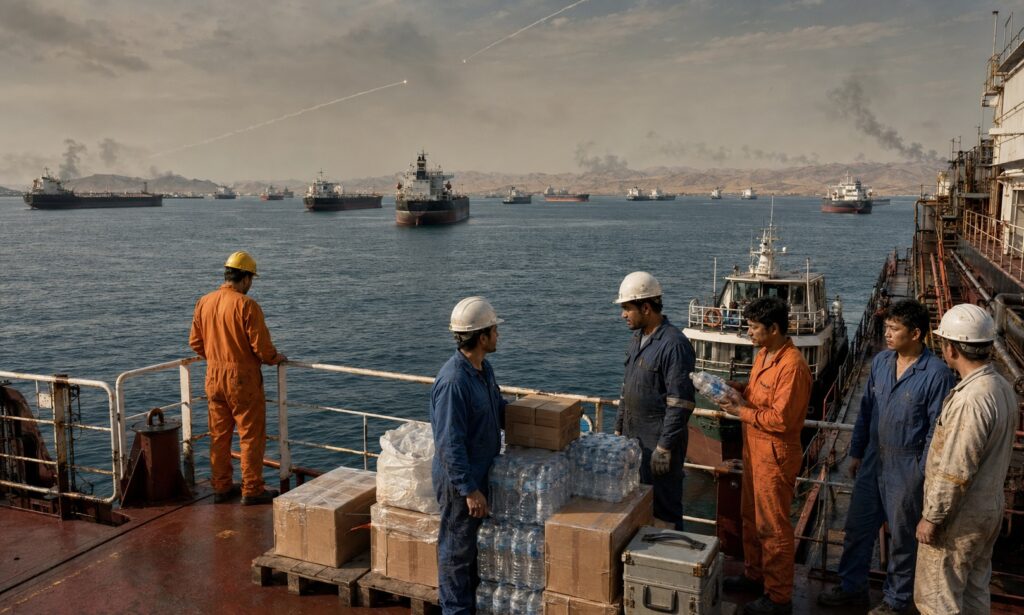
BERLIN, Germany – For the crews of hundreds of commercial ships caught inside the Persian Gulf, the Strait of Hormuz is no longer simply a passage between ports. It is the narrow boundary between confinement and escape.
Since the United States and Israel launched attacks against Iran on Feb. 28, commercial traffic through the strait has repeatedly fallen to a fraction of its normal volume. Iran asserted control over the waterway and restricted passage, while missiles, drones, naval mines and attacks on merchant vessels transformed one of the world’s busiest energy corridors into a war zone.
Before the conflict, approximately 120 to 140 ships crossed the strait each day. About half were oil tankers. In the months after the attacks began, traffic sometimes declined to single digits.
The ships caught inside include crude-oil tankers, liquefied-natural-gas carriers, container ships and bulk carriers. Many are registered, owned, operated or crewed through complicated corporate structures connecting them to India, China, Japan and Southeast Asian nations. Their cargoes—when ships can load and obtain permission to leave—are often destined for refineries and terminals across Asia.
But behind the statistics is a prolonged human emergency. Thousands of seafarers remain aboard vessels that were built to cross oceans, not to serve as indefinite places of confinement beneath a sky crossed by missiles.
The Floating Population of a Blockaded Gulf
Determining precisely how many people remain trapped is difficult. Estimates have changed as some vessels escaped, crews were repatriated and new fighting interrupted evacuation efforts.
By early May, the United States military estimated that approximately 1,500 vessels carrying 22,500 seafarers were trapped in the Gulf. By late June, maritime analysts estimated that 500 to 600 ships remained, with roughly 11,000 crew members aboard. More recent reporting suggests that the number of seafarers still caught in the broader Gulf crisis may have declined to around 6,000 by late July.
These numbers are not necessarily contradictory. They reflect different dates, geographic definitions and methods of counting vessels. They also show that evacuation has been partial rather than complete.
The International Maritime Organization, the United Nations agency responsible for shipping, established an emergency framework to facilitate the evacuation of vessels and crews. Initial crossings allowed some ships to leave, but attacks on merchant vessels forced the operation to pause and shipping traffic again slowed sharply.
For the sailors who remain, there is still no dependable date for departure.
Ships Bound for Asia, Crews Stranded Between Ports
The stranded fleet cannot be described by flag alone. Commercial ships often fly the flag of one country, are owned through a company registered in another, managed from a third and crewed by citizens of several more.
Liberia, the Marshall Islands, Panama and Malta—among the world’s largest open ship registries—appear frequently. Other affected vessels are registered in India, Hong Kong and Gulf countries.
Among the ships that eventually secured passage was the Malta-flagged Agios Fanourios I, carrying approximately two million barrels of Iraqi crude oil to Vietnam. It had been held up near Dubai after loading near Basra, Iraq. Its transit through Hormuz, normally a journey of several hours, became a two-day ordeal involving Iranian checkpoints, an inspection and periods in which its tracking signal disappeared.
After leaving Iranian-controlled waters, the vessel was stopped again—this time by the United States Navy enforcing its blockade. It was ultimately released and allowed to continue toward Vietnam.
The Liberia-flagged tanker Karolos loaded Iraqi crude at Basra before sailing toward Sikka, a major oil port in western India. The Panama-flagged gas carrier Danisa headed for China. The Indonesian-managed Pertamina Pride carried approximately two million barrels of Saudi crude. Other vessels have transported Kuwaiti oil to India, Qatari crude toward Asian markets and LNG from Qatar and the United Arab Emirates.
The pattern illustrates Asia’s dependence on the passage. China, India, Japan, South Korea and the ASEAN economies are among the principal destinations for Gulf oil, LNG, LPG, naphtha and refined petroleum products.
For the crews, however, the intended destination can become almost theoretical. A ship may be fully loaded and technically seaworthy yet remain unable to sail because its owner cannot obtain security guarantees, war-risk insurance or clearance from the authorities controlling the route.
How Long Can a Ship Feed Its Crew?
Large commercial ships are designed to remain at sea for weeks. Their storerooms generally contain frozen meat, rice, flour, canned food, cooking oil and other provisions sufficient for an extended voyage. Refrigerated rooms preserve vegetables, dairy products and other perishables.
But these reserves are not unlimited.
As confinement stretches from weeks into months, fresh produce disappears first. Variety declines. Frozen and dry provisions become increasingly important, and shortages may force cooks to ration ingredients or simplify meals.
Under the International Labour Organization’s Maritime Labour Convention, shipowners must provide food and drinking water of appropriate quantity, nutritional value and quality, without charging the crew. The obligation does not disappear because a ship has been delayed by war.
On responsibly managed vessels, local shipping agents can hire licensed ship chandlers to deliver vegetables, meat, bottled water, toiletries and other supplies. Small launches or supply boats carry the provisions to vessels at designated anchorages.
Yet those deliveries depend on money, permission and security. A supplier may refuse to approach an anchorage exposed to missiles or drones. Insurance may not cover the trip. A vessel may be too far offshore, near a mined channel or subject to sanctions. In the worst cases, an owner may stop paying altogether.
Making Water at Sea—Until the Machinery Fails
Freshwater is ordinarily less vulnerable than food because most large ships can produce it onboard.
Tankers and cargo ships generally have freshwater tanks as well as equipment that converts seawater into usable water through reverse osmosis or evaporation. This water is used for drinking after treatment, cooking, washing and sanitation. Emergency bottled-water reserves provide an additional safeguard.
But producing water requires functioning machinery, electricity, filters, chemicals and fuel for the ship’s generators. A mechanical failure that would be manageable during an ordinary port call can become dangerous when spare parts or technicians cannot reach the vessel.
Water quality can also become a concern when ships remain anchored close to industrial ports or contaminated coastal waters. If freshwater-making equipment fails, the crew becomes dependent on deliveries by barge or supply boat.
Gulf ports and anchorages ordinarily have networks capable of supplying freshwater, marine fuel and provisions. The war has not eliminated those services, but it has made them less predictable, more expensive and sometimes inaccessible.
A Medical Emergency Miles From Help
Commercial ships carry medicine and designated crew members trained to provide basic medical care. Captains can also obtain advice from shore-based doctors by radio or satellite communication.
Those arrangements are intended to stabilize a patient until the ship reaches port. They are not substitutes for a hospital.
Appendicitis, a heart attack, a serious infection, an industrial injury or an acute psychiatric crisis may require evacuation. Under normal conditions, a port agent, coast guard or maritime rescue coordination center can arrange for a launch boat or helicopter. In a conflict zone, every stage becomes more complicated.
Authorities must approve the movement. A receiving port must accept the patient. A rescue crew must be willing to approach. Mines, airstrikes and uncertain vessel identities can delay the response.
Iran has said it would provide stranded crews in its waters with fuel, medical assistance and technical support. But shipowners and captains must weigh that offer against sanctions, security concerns and the risk of entering Iranian-controlled waters.
For seafarers with chronic illnesses, even a non-emergency can become serious. Supplies of blood-pressure medication, insulin or other prescription drugs may have been packed for a defined voyage—not for an additional four or five months at anchor.
The Wages That Sustain Families Ashore
For many seafarers, particularly those recruited from India, the Philippines, Indonesia, China and other Asian countries, their earnings support entire households.
Mortgage payments, school fees, medical bills and everyday expenses continue even when the ship stops moving. The seafarer remains at work, responsible for watches, maintenance, fire safety, cargo systems and emergency readiness.
Under international maritime labor standards, wages must continue to be paid regularly and in full according to employment agreements. Seafarers are also entitled to monthly wage accounts and mechanisms that allow earnings to be transferred to their families.
A blockade does not suspend those obligations.
Nevertheless, prolonged maritime emergencies increase the danger of abandonment. A financially distressed owner may stop paying wages, provisioning the ship or arranging repatriation. International rules require ships to maintain financial security covering repatriation and certain unpaid entitlements, but recovering money can still involve flag states, insurers, unions and months of legal intervention.
For the worker at sea, an unpaid salary is not an accounting dispute. It may mean that a family thousands of miles away cannot pay rent or purchase medicine.
The Psychological Weight of an Indefinite Voyage
Perhaps the most difficult burden is the absence of an end date.
A normal voyage has a schedule: loading, departure, discharge and return. The stranded crews have watched those expectations collapse. Permission to transit may be announced and withdrawn. A ceasefire may be followed by another attack. A ship preparing to sail may turn around after another tanker is struck.
Crews remain responsible for maintaining potentially hazardous cargoes while monitoring alerts about missiles, drones, mines and attacks on nearby vessels. Some ships have switched off their tracking systems during crossings. Others have been ordered to stop or submit to inspections by armed forces.
The result is a combination of confinement, danger and powerlessness. Seafarers may struggle with insomnia, anxiety, depression and fear for their families. Internet connections allow contact with home, but they can also bring a continuous stream of distressing news and questions that the crew cannot answer.
Recent reporting indicates that seafarers’ organizations have received thousands of requests for assistance since the war began. Some sailors have said that the experience has made them unwilling to return to sea.
Unlike passengers awaiting a canceled flight, crews cannot simply leave. A tanker carrying two million barrels of crude cannot be abandoned at anchor. Minimum staffing must be maintained to operate machinery, prevent fire, monitor the cargo and respond to emergencies.
Even seafarers whose contracts have expired may therefore be unable to sign off until replacements arrive and authorities approve a crew change.
Rescue Exists, but Access Is Unequal
The International Maritime Organization, flag states, coastal governments, shipowners, insurers, unions and naval forces all possess pieces of the machinery needed to help.
Ship chandlers can deliver provisions. Bunker barges can supply fuel. Coastal states can authorize medical evacuations and crew changes. Flag administrations can pressure owners. Insurers can activate abandonment coverage. The International Transport Workers’ Federation can intervene over unpaid wages and unsafe conditions.
But no single institution controls the entire route through Hormuz.
A well-funded vessel operated by a major shipping company may continue receiving food, water, fuel, salaries and communications. A smaller ship owned through opaque companies and sailing under a distant flag may receive far less support.
That inequality is central to the crisis. Most crews are not starving, and many ships remain capable of producing water and obtaining periodic supplies. But the survival system depends on owners continuing to pay, suppliers continuing to sail and governments continuing to cooperate.
When any one of those links fails, a commercial delay can become a humanitarian emergency.
Waiting Without a Date for Home
The cargoes caught in the Gulf are measured in millions of barrels and billions of dollars. The people maintaining them are more easily overlooked.
They did not decide to begin the war. They do not control the strait, negotiate ceasefires or authorize naval corridors. Yet they live with the consequences—in engine rooms, on bridges and inside narrow cabins, maintaining ships that cannot complete their voyages.
Some will eventually carry Iraqi crude to Vietnam, Kuwaiti oil to India, Qatari gas to China or Saudi petroleum to Indonesia. Others may remain at anchor through another round of negotiations and fighting.
For their families, the essential questions are more immediate: Is there enough food? Is the drinking water safe? Has the salary arrived? Can a doctor reach the ship? And when will the person aboard finally come home?
For thousands of seafarers in the Persian Gulf, months after the war began, there is still no reliable answer to the last question. (AT/hz)