
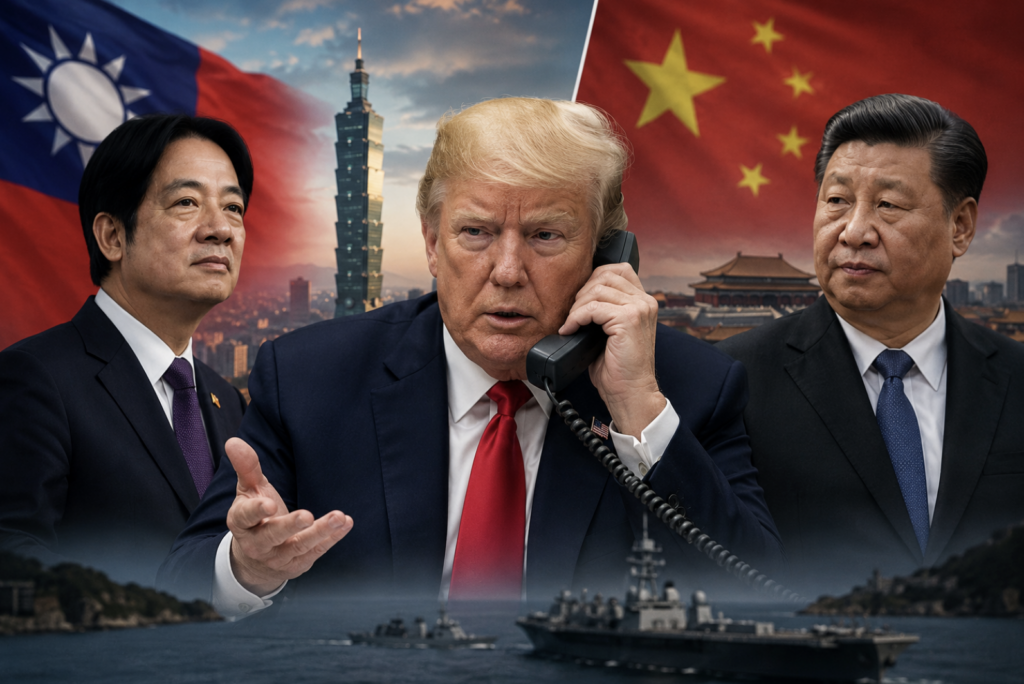
After Beijing Visit, U.S. President Suggests Direct Contact With Taipei
WASHINGTON, USA – In remarks likely to reverberate across Washington, Beijing, and Taipei, Donald Trump said he was open to speaking directly with Lai Ching-te, raising the prospect of the first direct conversation between sitting leaders of the United States and Taiwan since diplomatic relations were severed in 1979.
Speaking to reporters at Joint Base Andrews before boarding Air Force One, Trump dismissed concerns over protocol. “I speak to everybody,” he said, adding that the administration had “that situation very well in hand” and that “we’ll work on that Taiwan problem.”
The comments came only days after Trump’s closely watched visit to China, where Chinese leader Xi Jinping reportedly warned that mishandling Taiwan could become “a very dangerous situation.” Analysts in Washington and Asia viewed Trump’s remarks as a deliberate signal that his administration may pursue a more transactional and less convention-bound Taiwan policy than previous White Houses.
A Break With Four Decades of Diplomatic Practice
Since the United States formally switched diplomatic recognition from Taipei to Beijing in 1979, American presidents have avoided direct official contact with Taiwanese leaders in order to preserve the delicate framework underpinning U.S.-China relations.
Under the long-standing “One China” policy, Washington acknowledges Beijing’s position that Taiwan is part of China, while stopping short of formally recognizing Chinese sovereignty over the island. At the same time, the United States maintains extensive unofficial ties with Taiwan and remains legally obligated under the United States Congress-passed Taiwan Relations Act to assist the island in maintaining defensive capabilities.
Trump’s suggestion that he could personally speak with Lai therefore marks a potentially consequential shift in tone — one that could unsettle decades of carefully calibrated strategic ambiguity.
Diplomatic observers noted parallels to Trump’s 2016 transition-era phone call with former Taiwanese President Tsai Ing-wen, which broke precedent and triggered sharp protests from Beijing. But analysts say a direct leader-to-leader conversation while both are in office would carry substantially greater geopolitical weight.
Arms Sales at the Center of Strategic Tensions
The timing of Trump’s remarks is especially significant because the administration is weighing whether to finalize a Congress-approved $14 billion arms package for Taiwan.
According to Trump, arms sales were discussed “in great detail” during his meetings with Xi in Beijing. He indicated that a decision would come “over the next early short period of time,” suggesting the White House may link military support, trade considerations, and broader U.S.-China negotiations into a single strategic framework.
For Beijing, Taiwan arms sales remain among the most sensitive issues in bilateral relations. Chinese officials have repeatedly argued that American military support emboldens pro-independence forces in Taiwan and undermines regional stability. Taiwan, meanwhile, sees continued U.S. defense support as essential amid rising military pressure from the mainland, including near-daily Chinese military activity around the island.
Recent domestic debate in Taiwan has also intensified around defense preparedness, asymmetric warfare capabilities, and the reliability of long-term American security commitments. Lai’s administration has sought to deepen ties not only with Washington but also with regional partners such as Japan and European democracies increasingly concerned about Indo-Pacific security.
Global Reactions Reflect Deepening Strategic Polarization
International reaction to Trump’s comments was swift and divided.
Security hawks in Washington argued that direct engagement with Taiwan’s elected leadership reflects geopolitical reality and strengthens deterrence against Chinese coercion. Some Republican lawmakers have increasingly advocated abandoning older diplomatic constraints they see as outdated in light of China’s expanding military power.
Others, including former diplomats and Asia specialists, warned that symbolic gestures without a clearly defined strategic framework could heighten instability in the Taiwan Strait. European analysts and several Indo-Pacific governments have quietly expressed concern that abrupt changes to established diplomatic norms could trigger miscalculation during an already volatile period in U.S.-China relations.
In Beijing, state-affiliated commentators portrayed the remarks as another indication that Washington may be incrementally hollowing out the “One China” framework while publicly claiming to preserve it. Chinese officials have consistently stated that Taiwan remains the most sensitive and dangerous issue in relations between the world’s two largest powers.
Taiwan Emerges as Central Test of Trump’s Foreign Policy Doctrine
Trump’s comments underscore how Taiwan has evolved from a narrowly managed diplomatic issue into a central arena of strategic competition between the United States and China.
Unlike previous administrations that often separated diplomatic symbolism from defense policy, Trump appears increasingly willing to blend political messaging, economic leverage, and military negotiations into a single bargaining strategy. Whether that approach produces greater deterrence or deeper instability may depend on how Beijing interprets Washington’s next moves.
For now, no call between Trump and Lai has been officially scheduled. But even the suggestion of direct presidential contact has already intensified scrutiny across Asia and renewed questions about whether the decades-old architecture governing U.S.-China-Taiwan relations is entering a far more unpredictable phase.