
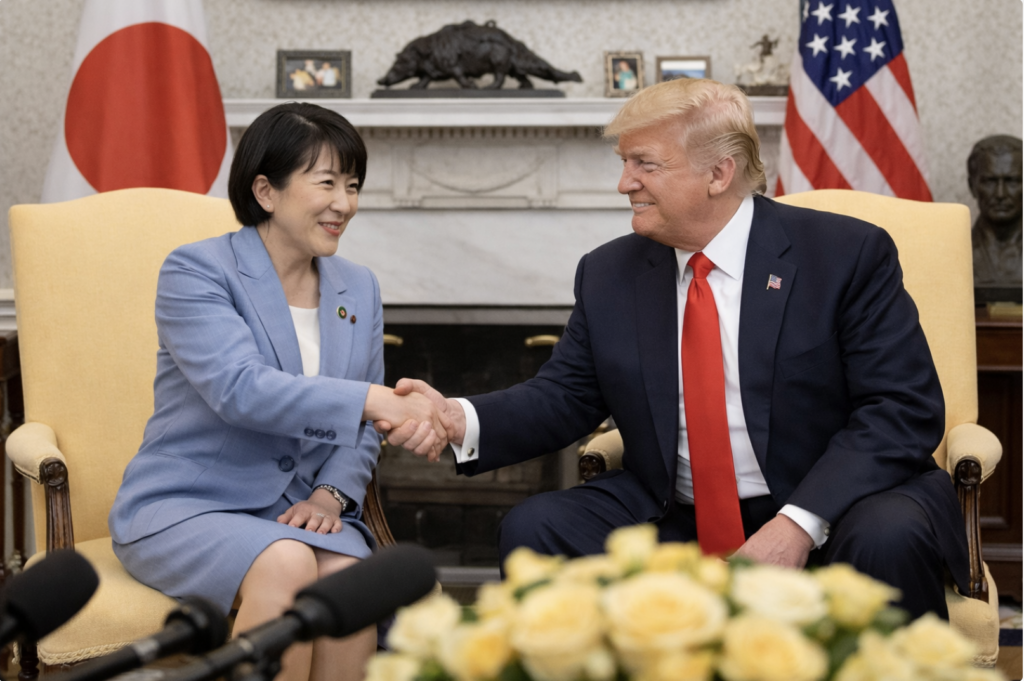
WASHINGTON — The United States and Japan have agreed to a sweeping new energy partnership centered on advanced nuclear technology and natural gas infrastructure, marking one of the largest bilateral industrial investments between the two allies in recent years.
Under the agreement, the two countries will jointly support a $40 billion initiative to build next-generation nuclear reactors in Tennessee and Alabama, alongside an additional $33 billion investment in natural gas power facilities in Pennsylvania and Texas. The plan was formalized during a visit to Washington by Japanese Prime Minister Sanae Takaichi, where she met with President Donald Trump.
Officials described the projects as a cornerstone of a broader strategy to strengthen energy security while accelerating economic growth in both nations. The nuclear component will focus on small modular reactors (SMRs)—compact, factory-built units widely viewed as a more flexible and cost-efficient alternative to traditional nuclear plants.
The joint statement emphasized that SMRs represent “a next-generation stable energy source” capable of stabilizing electricity prices in the United States while reinforcing U.S.-Japan leadership in the global competition for clean and reliable energy technologies.
A Strategic Trade-Off
The announcement builds on a broader economic framework negotiated last year, when Japan pledged up to $550 billion in U.S. investments in exchange for reduced American tariffs on Japanese exports. The current energy projects represent a significant portion of that commitment, following an initial $36 billion tranche announced earlier this year by Japanese corporations.
Analysts in both countries view the deal as a calculated trade-off: Tokyo secures improved trade conditions and strengthens its industrial foothold in the United States, while Washington attracts large-scale foreign capital into critical infrastructure sectors.
Energy Security Meets Geopolitics
The timing of the agreement reflects mounting global concerns over energy reliability and supply chain resilience. In recent years, disruptions tied to geopolitical tensions—including the war in Ukraine and instability in global fuel markets—have prompted advanced economies to diversify energy sources and reduce dependence on volatile imports.
Small modular reactors, in particular, have gained renewed attention in policy circles in the United States, Europe and Asia. Proponents argue they can be deployed more quickly and safely than conventional nuclear plants, offering a low-carbon complement to renewable energy. Critics, however, caution that the technology remains commercially unproven at scale and faces regulatory and cost hurdles.
Meanwhile, the parallel investment in natural gas infrastructure underscores a pragmatic approach: while nuclear and renewable technologies expand, gas remains a critical bridge fuel for maintaining grid stability.
Industrial Policy and Global Competition
The agreement also highlights intensifying competition in advanced energy technologies, especially with China and Russia expanding their own nuclear export capabilities. By jointly developing SMR projects domestically, U.S. and Japanese firms aim to position themselves as leading suppliers in a future global market.
Industry observers note that the collaboration could accelerate standardization and reduce costs, potentially opening export opportunities to emerging economies seeking reliable and lower-emission power sources.
Economic Impact at Home
In the United States, the projects are expected to generate thousands of construction and engineering jobs across the participating states, while revitalizing local manufacturing supply chains tied to energy infrastructure.
For Japan, whose domestic energy strategy has been reshaped since the Fukushima disaster, overseas investment offers a pathway to maintain its technological expertise and influence in the nuclear sector.
Outlook
While the agreement signals strong political alignment, its long-term success will depend on execution—particularly the ability to deliver SMR projects on time and within budget. Regulatory approvals, financing structures and public acceptance will all play decisive roles.
Still, the scale and ambition of the initiative underscore a broader shift: energy policy is increasingly being shaped not only by climate goals, but by economic strategy and geopolitical competition.