
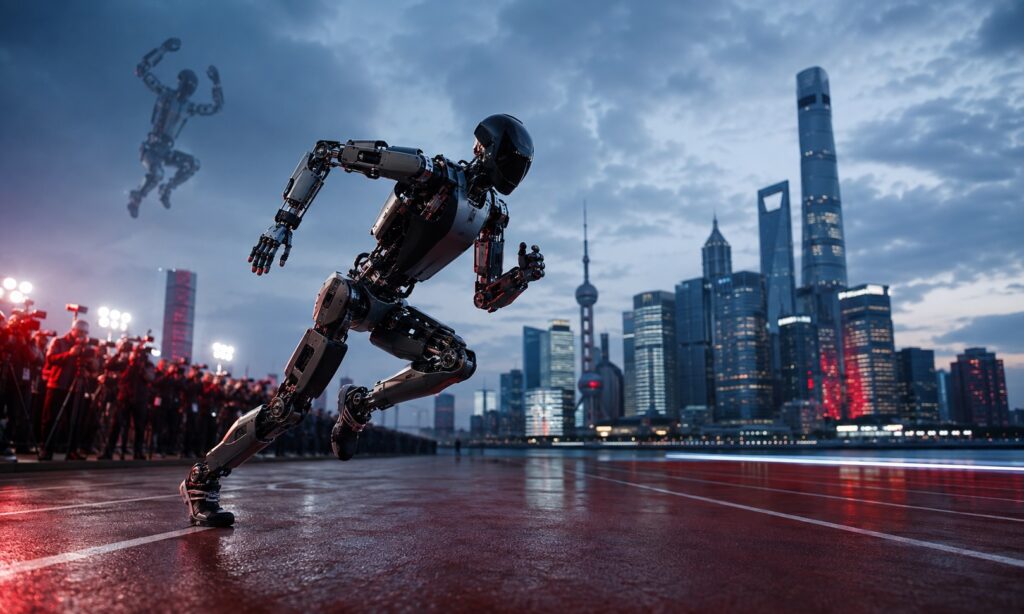
BEIJING, China — In a 30-second promotional video, a slender humanoid robot crouches, launches itself upward and later races across a track with an ungainly but startlingly fast stride.
Unitree Robotics calls the machine “Superman.” The Hangzhou company says the prototype, built in just over three months, can perform a two-meter standing jump and reach 12.66 meters per second — roughly 45.6 kilometers, or 28.3 miles, per hour. Its legs measure only 0.85 meters.
The timing was as notable as the performance. Unitree released the video two days before its shares were scheduled to begin trading on Shanghai’s STAR Market. The “market debut” accompanying the robot’s unveiling refers to Unitree’s initial public offering, not to a commercial launch of Superman.
No price, production schedule or customer application has been announced for the machine. Unitree itself describes it as a work in progress. The company’s official preview says substantial improvement remains possible.
A Superhuman Claim, With Human-Sized Caveats
At face value, Superman’s claimed speed narrowly exceeds estimates of Usain Bolt’s peak velocity during his world-record 100-metre race in Berlin. But the comparison joins two different measurements: a robot’s reported maximum speed and a sprinter’s performance over a complete, independently timed race.
Bolt’s recognized record remains 9.58 seconds. Unitree has not published a full 100-metre time, a detailed testing protocol or data showing how long Superman sustained its maximum speed. Nor has it disclosed payload, battery endurance, surface conditions or repeatability. The two-meter jump also lacks a standardized explanation of whether the measurement represents obstacle clearance, foot elevation or another metric. TechNode noted that the figures remain company claims and do not indicate commercial production.
Even so, the demonstration carries a meaningful technical signal. Fast bipedal movement requires powerful joints, rapid feedback and continuous control of balance, impact and weight transfer. What it does not establish is equally important: the video offers no evidence of general-purpose intelligence, autonomous decision-making or the capacity to perform useful work for hours without human supervision.
A Valuation Built for the Future
Unitree’s offering is priced at 150.80 yuan a share and values the company at about 61 billion yuan, or roughly $9 billion. It raised 6.1 billion yuan by selling 10 percent of its enlarged capital. Retail demand exceeded the available allocation by more than 8,000 times, leaving applicants with a winning rate of about 0.018 percent. The valuation amounts to approximately 219 times 2025 earnings and 36 times sales. Reuters described the demand as a sign of intense investor enthusiasm — and of considerable expectations already embedded in the price.
Chinese coverage has mixed technological pride with financial caution. A commentary distributed by TMTPost argued that Unitree’s publicity strategy had shifted from making robots appear human to presenting them as physically “superhuman,” a simpler and more viral message than factory productivity statistics. Caixin said Unitree’s trading performance could become a valuation benchmark for as many as 30 to 50 other robotics companies considering Hong Kong listings.
But domestic financial reporting has also emphasized the cost of those expectations. Securities Times noted that Unitree’s price-to-sales ratio exceeds the average of comparable companies. It reported that first-quarter revenue rose 68.5 percent from a year earlier while attributable net profit fell 47.7 percent. On Tuesday, several Chinese robotics-related shares initially climbed and then surrendered part of their gains, suggesting that excitement over the listing was already being weighed against valuation risk.
The Harder Test Begins After the Finish Line
The central question for Unitree and its competitors is no longer whether humanoids can perform memorable demonstrations. It is whether they can work reliably and economically.
That debate will dominate the World Robot Conference, opening in Beijing on Wednesday with more than 300 exhibitors, 2,000 displays and 150 planned product launches. The accompanying Humanoid Robot Games will include factory assembly, warehousing, hotel service, cable connection and electric-vehicle charging — tasks designed to test persistence, dexterity and recovery from errors rather than brief bursts of athleticism. Beijing’s conference program explicitly emphasizes procurement and real-world deployment.
The economics remain difficult. A robotics analyst interviewed by Reuters estimated that 50 to 70 percent of humanoids produced this year could be used chiefly in “data factories,” collecting information to train robots rather than doing productive work for outside customers. Guotai Securities calculated that an industrial humanoid might need to cost about 160,000 yuan, including maintenance, to repay itself within two years. Current systems commonly cost 300,000 to 500,000 yuan, according to the Berlin-based research group MERICS.
Unitree nevertheless possesses an advantage many Western rivals lack: scale. The company says it had produced and delivered about 18,000 bipedal humanoids across its models by July. It is already profitable and operates within China’s dense network of motor, actuator, battery and precision-component suppliers.
A Robot Caught in a Wider Contest
Superman is also entering an increasingly political market. In July, the United States placed foreign-produced advanced mobile robots on the Federal Communications Commission’s Covered List, generally preventing new models from obtaining the authorization required for American sale unless they receive conditional approval. Previously authorized products remain available, but Unitree has warned that future models could be excluded. The FCC’s guidance frames the restrictions around cybersecurity and supply-chain risks.
The international response reflects a broader anxiety: China has become particularly effective at transforming robotics research into inexpensive, mass-produced hardware. A Reuters investigation published Tuesday traced elements of Unitree’s quadruped designs to openly published, American military-funded research. The researchers interviewed did not call for secrecy; they argued that the United States needed stronger manufacturing capacity and faster commercialization.
That may be the more consequential meaning of Superman. The robot is simultaneously an engineering achievement, a tightly choreographed marketing event and a symbol of China’s ability to turn laboratory advances into visible products at speed.
Its decisive race will not be against Usain Bolt. It will be against high costs, limited autonomy, safety requirements and the patience of customers and investors. On Wednesday, the stock market will begin placing a price on how quickly Unitree can close that distance.