
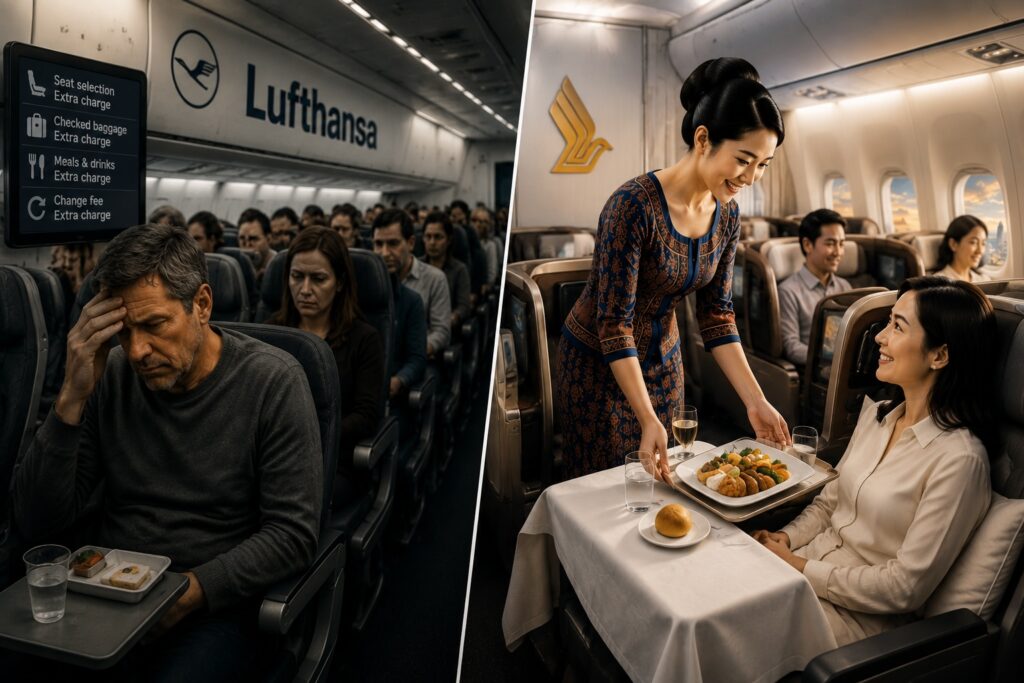
FRANKFURT, Germany – For decades, Lufthansa built its reputation on reliability, a vast European network and the prestige of being Germany’s national carrier. But among many long-haul travelers, that reputation has been steadily challenged by a different perception: a premium airline increasingly charging extra for services that were once considered part of the ticket.
The latest flashpoint is Lufthansa Group’s decision to charge many Economy and Premium Economy passengers for changing an automatically assigned seat during online check-in on long-haul flights—a privilege that had previously remained free for most Economy fares. The policy now extends across Lufthansa, SWISS, Austrian Airlines, Brussels Airlines and Discover Airlines, with only the most flexible—and expensive—fares exempt from the new restriction.
A Premium Brand, a Low-Cost Playbook?
For critics, the seat-selection policy is not an isolated measure but part of a broader trend.
Over the past decade, Lufthansa has steadily expanded ancillary revenues through paid seat reservations, fare segmentation and optional services. While these strategies have become commonplace across the airline industry, many travelers argue that Lufthansa is increasingly adopting the commercial tactics of low-cost carriers without matching them with lower ticket prices.
The contrast is particularly noticeable on long-haul routes to Asia.
When fares are comparable, passengers often compare more than schedules—they compare the overall experience. And this is where Lufthansa faces perhaps its greatest competitive challenge.
The Asian Benchmark
Airlines such as Singapore Airlines, ANA, Japan Airlines, EVA Air, Korean Air and Cathay Pacific continue to enjoy strong international reputations for attentive cabin service, consistently high catering standards and a customer experience that many frequent travelers regard as more refined.
While several Asian carriers also charge for advance seat reservations in certain fare classes, many still allow passengers to select available standard seats free of charge during online check-in or offer more generous flexibility than Lufthansa’s newest policy.
For leisure travelers, families and premium economy passengers, that distinction matters.
“If the fare is similar, why would I voluntarily choose the airline offering fewer included services?” has become an increasingly common sentiment across travel forums and customer discussions.
The Service Gap
The criticism extends well beyond seat selection.
For years, Lufthansa has faced recurring complaints from passengers regarding inconsistent cabin service, variable crew friendliness and catering that many travelers consider less competitive than that offered by leading Asian airlines.
These concerns do not reflect every passenger’s experience, and Lufthansa continues to receive positive reviews from many customers. Nevertheless, the recurring themes have become increasingly prominent in customer feedback and industry discussions.
In contrast, several Asian airlines have built their brands around consistency, hospitality and service culture—attributes that remain difficult to replicate through operational efficiency alone.
Loyalty Has Limits
Lufthansa retains important competitive advantages.
Its extensive European route network, strong corporate contracts, Star Alliance connectivity and direct flights from German airports continue to attract business travelers and frequent flyers. High-status Miles & More members also remain exempt from many of the new seat-selection restrictions.
But leisure travelers are generally less tied to airline loyalty.
For passengers paying out of their own pocket, service quality, transparency and value increasingly outweigh national affiliation.
Many travel analysts note that ancillary revenue has become an essential part of airline profitability worldwide. Yet there is also a commercial risk: every new surcharge invites customers to reconsider what exactly distinguishes a premium airline from a low-cost competitor.
The Competitive Test Ahead
Whether Lufthansa’s strategy succeeds will ultimately be determined not by headlines but by booking behavior.
If passengers continue choosing Lufthansa despite additional fees, the airline’s revenue strategy will likely be validated.
If, however, increasing numbers of long-haul travelers decide that airlines such as Singapore Airlines, ANA, Japan Airlines or EVA Air offer a more compelling overall product for a similar fare, Lufthansa may discover that ancillary revenue has an unintended cost: weakening one of the brand’s most valuable assets—its premium reputation.
In aviation, trust is built over decades but can be eroded one surcharge at a time. (AT/hz)