
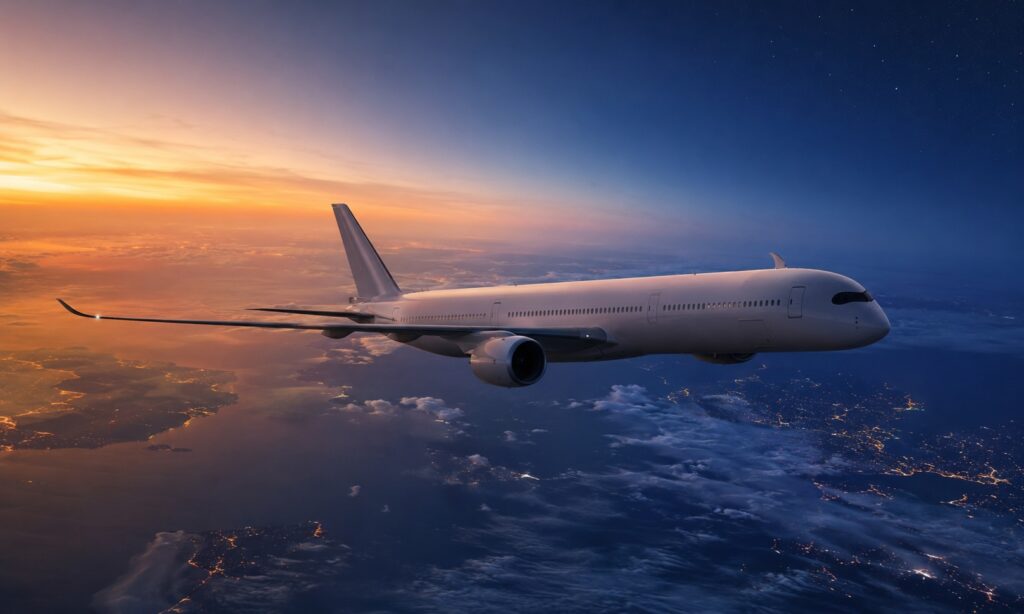
TOULOUSE, France — An Airbus A350 designed for the world’s longest passenger routes landed in Toulouse on Tuesday after remaining airborne for 24 hours and 24 minutes, completing a record-setting test that took the aircraft across three continents, two oceans and two cycles of sunrise and sunset.
The A350-1000ULR traveled roughly 23,075 kilometers, or 14,338 miles, after departing Melbourne. Only Airbus flight-test personnel, engineers and representatives of Qantas, the Australian airline for which the aircraft is being developed, were aboard.
The flight was not a normal passenger service, and its distance was greater than the routes Qantas ultimately plans to operate. But it marked a critical stage in the certification campaign for “Project Sunrise,” the airline’s long-running effort to connect Australia’s east coast directly with Europe and the United States.
Airbus said the test was intended to demonstrate that the aircraft could support a 23-hour gate-to-gate operation, providing sufficient reserves for an anticipated maximum flight time of about 21 hours and 40 minutes, as well as taxiing, holding and possible diversions.
An Aircraft Reworked for Extreme Range
The A350-1000ULR—short for Ultra Long Range—is based on Airbus’s largest A350 model but incorporates a rear center tank holding an additional 20,000 liters of fuel. Its fuel system, ventilation, galley refrigeration and cabin-noise controls have also been modified.
More than 1,000 sensors were installed on the test aircraft to measure fuel flow, temperature, oxygen concentration and cabin conditions. Engineers used heat-generating passenger dummies to simulate the thermal load of a full cabin while evaluating a new decentralized galley-cooling system.
The aircraft had flown nearly 17,000 kilometers from Toulouse to Melbourne a few days earlier, completing that journey in just over 19 hours. Its longer return flight followed a specially selected route and was designed to push the aircraft beyond the requirements of future scheduled services.
That distinction matters: the achievement was a development flight, not the inauguration of a 24-hour commercial route. Nevertheless, Airbus and Qantas described it as the longest nonstop flight completed by an airliner of this type, surpassing the endurance and distance associated with earlier record demonstrations.
Sydney to London, Without the Traditional Stop
Qantas has ordered 12 A350-1000ULRs, each configured for 238 passengers—substantially fewer than a conventional A350-1000 could carry. The reduced density leaves room for larger premium cabins and a dedicated “Wellbeing Zone,” where passengers will be able to stand, stretch and obtain refreshments.
The first aircraft is now scheduled for delivery in April 2027, following supply-chain delays. Qantas says tickets for Sydney-to-London service will go on sale in February 2027, with daily nonstop flights beginning in October. A Sydney-to-New York route is expected to follow.
The London service will cover approximately 17,000 kilometers and take between 19 and 22 hours, depending on winds and routing. Qantas estimates that eliminating the customary connection in Singapore, Dubai or another hub could shorten the total journey by as much as four hours.
Singapore Airlines currently operates the world’s longest regularly scheduled nonstop service, between Singapore and New York. Its flight lasts roughly 18½ hours, although the exact distance and duration vary with direction and weather.
Comfort Becomes a Scientific Question
The prospect of spending nearly an entire day in an aircraft has placed unusual emphasis on human endurance as well as engineering.
Qantas has worked with researchers at the University of Sydney’s Charles Perkins Centre to examine how carefully timed lighting, meals, sleep and exercise might reduce jet lag. Earlier research flights monitored travelers’ sleep patterns, movement and biological clocks, and preliminary findings suggested that adjusting the cabin environment could accelerate adaptation to a new time zone.
The new aircraft will use programmed lighting sequences intended to reproduce gradual sunrises and sunsets. Meal schedules will also be aligned with the destination time zone.
Still, aviation specialists have warned that a 20- to 22-hour journey may be particularly demanding for economy passengers, despite additional legroom and opportunities to move around. Remaining seated for extended periods can worsen fatigue and discomfort, while immobility is a recognized risk factor for blood clots in susceptible travelers.
A Commercial Bet—and an Environmental Trade-Off
For Qantas, Project Sunrise is as much a premium-business strategy as an aviation milestone. The airline expects travelers to pay more for avoiding a connection, and 41 percent of the aircraft’s seats will be in first, business or premium economy class.
The economics are less favorable for low-cost travel and heavy cargo. Carrying enough fuel for an ultra-long flight adds substantial weight, and some of that fuel is consumed simply to transport the remaining fuel. Favorable winds, optimized routing and strong demand for premium seats will therefore be important to profitability.
The environmental calculation is also complicated. A nonstop flight eliminates an additional takeoff and landing and may follow a more direct route, but extreme-range operations require exceptionally large fuel loads. Whether they produce fewer emissions per passenger than one-stop alternatives will depend on seat occupancy, aircraft weight, routing and the efficiency of the connecting flights they replace.
For Airbus, the Melbourne-to-Toulouse journey proved that the technical frontier could be pushed farther. For Qantas, the larger test will begin in 2027, when ordinary passengers—not engineers and carefully monitored equipment—are asked to spend nearly a full day in the sky.
Sources: Airbus, Quantas, Singapore Airlines, University of Sydney