
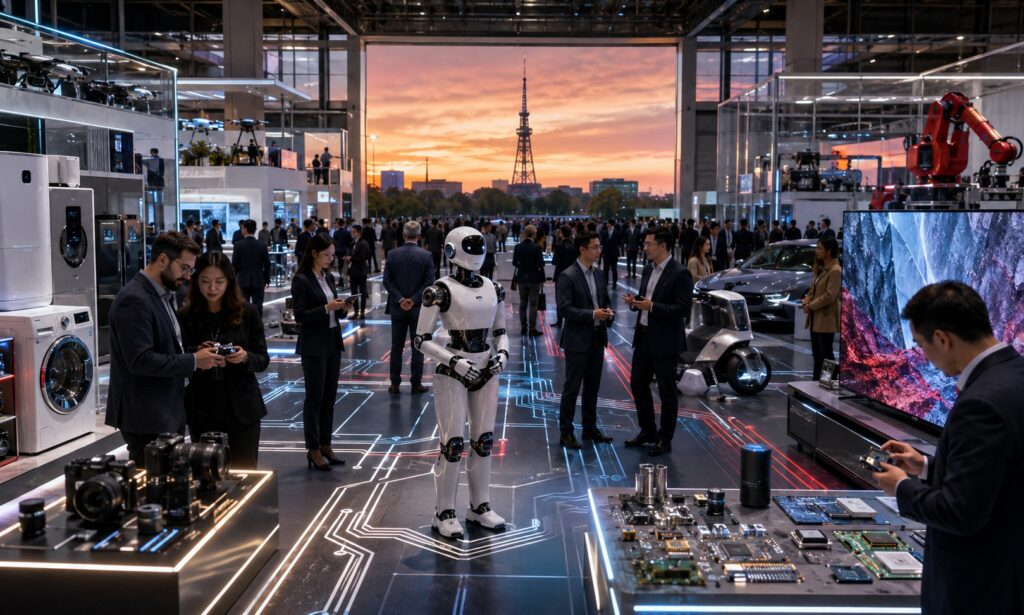
BERLIN, Germany — The future, as presented at this year’s IFA Berlin, will make coffee, monitor sleep, edit video, manage household energy and, if the demonstrations go according to plan, walk across the exhibition floor on two mechanical legs.
From Sept. 4 through 8, the century-old Berlin technology fair will fill the halls beneath the Funkturm with televisions, computers, kitchen appliances, electric vehicles, beauty devices and an expanding assortment of artificial-intelligence products. Organizers are promoting IFA 2026 at the scale of more than 1,900 exhibitors from 49 countries and more than 220,000 visitors. Trade visitors will have access daily from 9:30 a.m. to 6 p.m.; on the opening Friday, the first two and a half hours are reserved for professionals before the general public enters at noon.
The traditional opening tour on Sept. 4 is expected to include Germany’s digital minister, Karsten Wildberger, Berlin’s governing mayor, Kai Wegner, and the city’s economics senator, Franziska Giffey. But the deeper story of this year’s fair will be found less in the ceremonial procession than in the geography of the exhibitor list.
The Number Behind the Spectacle
IFA’s headline figure — more than 1,900 exhibitors — describes the anticipated scale of the event. A count of the fair’s live exhibitor directory on Aug. 8 produced 1,804 individual profiles, a number that may continue to change as companies are added, removed or registered under joint stands.
Of those profiles, 930 were assigned to China. That is roughly 52 percent of the currently published directory — an unusually large share for a European technology exhibition and an indication of how decisively the consumer-electronics supply chain has shifted eastward. The Chinese contingent ranges from globally recognizable brands such as Xiaomi, Dreame, Ecovacs and Ugreen to hundreds of component makers, appliance factories and contract manufacturers.
Using the country labels in the official directory, 1,133 profiles come from East, South and Southeast Asia. In addition to China, the list includes 72 exhibitors from Hong Kong, 66 from South Korea, 22 from Singapore, 21 from Taiwan, eight from India, five from Japan, four from Vietnam, three from the Philippines and two from Thailand. That narrower Asian group accounts for about 63 percent of all currently listed profiles.
Under a broader geographic definition that also includes Türkiye, Israel, Jordan, Kuwait, the United Arab Emirates and Cyprus, the Asian total rises to 1,174, or about 65 percent.
These figures require a qualification. They reflect the country assigned to each IFA profile, not necessarily a company’s ultimate ownership or headquarters. A Japanese or Korean multinational appearing through a German subsidiary may be counted as European, while Hong Kong is listed separately from mainland China. The directory is therefore best understood as a snapshot of the fair’s registered commercial presence, rather than a definitive census of corporate nationality.
China’s Presence Extends Beyond the Big Brands
China’s influence will be most visible in IFA Global Markets, the fair’s professional sourcing platform in Halls 26a, 26b and 26c. Open from Sept. 5 through 7, the strictly business-to-business event is designed for buyers, distributors, brands and sourcing specialists seeking manufacturers rather than finished consumer brands.
Its stands will cover OEM and ODM production, electronic components, circuit boards, IoT modules, sensors, motors, displays, packaging, prototyping and supply-chain services. The dense concentration of factories from Guangdong, Shenzhen, Ningbo, Dongguan and other Chinese manufacturing centers turns this section of IFA into something closer to an industrial marketplace than a conventional product show.
Elsewhere, Chinese companies will compete more visibly for European consumers. Xiaomi is scheduled in home entertainment, Dreame and Ecovacs in appliances, Ugreen in several connectivity and smart-home locations, and Unitree, Agibot and other robotics companies in the innovation halls.
The distinction is important: China is arriving at IFA both as a consumer brand power and as the manufacturing infrastructure behind products sold under other names. For retailers and procurement executives, the second role may be the more consequential one.
What Visitors Will Actually See
Artificial intelligence will be less a separate category than a layer applied across the entire fair. It will appear in personal computers, cameras, household robots, connected kitchens, health devices and software for retailers. The official show areas cover home appliances, entertainment, audio, computing and gaming, content creation, communication, smart homes, mobility, beauty technology and the new Retail Innovation Zone.
IFA Next, the start-up and research section, is expected to host about 300 exhibitors from roughly 25 countries. Its emphasis will be on humanoid and service robots, smart glasses, AI wearables, PetTech and experimental connected-living systems. Visitors are also promised robot football demonstrations by Berlin United, a team from Humboldt University. National pavilions from China, South Korea, Taiwan, Singapore, the Philippines and several European countries will reinforce the section’s international character.
The start-up program is built around an IFA Pitch Battle on the Dream Stage in Hall 25. Hardware companies compete in the first semifinal on Sept. 4 at 4:30 p.m.; software-oriented companies take the second round on Sept. 5 at the same time. The final is scheduled for Sept. 6 at 5 p.m. Investors admitted through IFA’s invitation program can also use a dedicated lab and matchmaking formats to meet founders.
Content creation is another major growth area. Its exhibition space is expanding by 70 percent and will occupy two halls for the first time, with cameras, drones, lenses, storage systems, studio equipment and AI-assisted editing tools. Samsung is sponsoring the Creator Hub at the Palais am Funkturm, while moving part of its trade and media program to Humboldt Carré in central Berlin from Sept. 2.
The audio section is also growing, from 2,700 to 3,660 square meters. Home technology, meanwhile, will be framed increasingly around energy efficiency, interoperability, privacy and the question of whether AI-powered appliances provide genuine convenience or simply introduce new layers of data collection.
Where the Business Begins Before the Doors Open
For senior executives, IFA effectively starts before the public fair.
From Sept. 2 to 4, the invitation-based CVC Open Innovation Summit Europe is expected to bring together about 80 corporate executives, technology entrepreneurs and investors from Europe, the United States and Asia. Its aim is to connect industrial companies with strategic capital and emerging technology. Applicants must be selected by the summit’s organizers.
On Sept. 3, the IFA Retail Leaders Summit will gather more than 100 senior and C-suite retail executives at the Palais am Funkturm. The program will address marketplaces, omnichannel sales, logistics, repairs, customer service and supply-chain resilience. It is an invitation-only event, reflecting IFA’s effort to create a protected setting for conversations that exhibitors may not want to conduct on a crowded stand.
The same evening, from 6 to 9 p.m., ShowStoppers will serve as IFA’s official media reception. More than 90 technology companies and about 900 journalists, analysts and influencers are expected at the South Entrance Hall. Admission is by invitation, but the products unveiled there will shape much of the first wave of international coverage.
The preceding Media Days on Sept. 2 and 3 include the IFA opening press conference and product presentations by companies including Acer, Hisense, Shokz, LG and FRITZ!. Access and registration requirements vary, and many sessions are reserved for accredited media.
The Essential Professional Program
Opening day, Sept. 4, concentrates several of the fair’s most visible events. The Innovation Stage will host a session on personal AI at 11 a.m. Discussions later in the day will address intelligent air systems, connected wellness and household robotics. At 2:45 p.m., the IFA Innovation Awards ceremony will recognize products for innovation, design and engineering, including the Best of IFA, Best Tech Innovation and Best Brand prizes.
On Sept. 5, the professional agenda shifts toward sustainability and industrial application. A panel beginning at 11 a.m. will examine how repair, refurbishment and longer product lifecycles can generate business beyond the first sale. Other sessions will address AI appliances, physical AI and the emotional design of machines.
Sept. 6 brings the IFA Next Pitch Battle final at 5 p.m., following sessions on sensory intelligence in the home and the commercial use of artificial intelligence in content creation.
Sept. 7 is the principal policy and retail day. The Smart Living Forum begins on the Dream Stage with discussions about the kitchen and home of the next decade: AI-assisted cooking, electrification, health data, privacy and human-centered design. A separate IFA Leaders & Policy Dialogue, organized with the German electrical-industry association ZVEI and IFA owner GFU, will bring business executives together with German and European political figures. Participation is by invitation. Its agenda includes regulation, European competitiveness and competition with China.
The Retail Innovation Zone will operate throughout the show as a professional hub for store technology, omnichannel strategies and new retail models. The associated trade lounge offers breakfast from 8 to 10 a.m., meeting space and additional services for participating retail groups. Trade visitors can also reserve expert-led guided tours of less than 90 minutes; places are limited but booking is included with a professional ticket.
Berlin’s Balancing Act
IFA’s 2026 edition arrives at a moment when Europe is trying to reconcile several competing objectives: access to affordable technology, stronger domestic industry, tighter rules for AI and data, and reduced dependence on foreign supply chains.
The fair will display that contradiction in physical form. European policymakers will discuss competitiveness and regulatory sovereignty while, only a few halls away, hundreds of Chinese suppliers offer the components, appliances and manufacturing capacity on which much of the industry still relies.
For ordinary visitors, the attraction will be immediate: brighter screens, quieter appliances, smarter cameras and robots that can walk, talk or prepare food. For professional visitors, the more important questions will concern margins, distribution, repair obligations, consumer data and who ultimately controls the platform connecting all those products.
IFA has always been part theater, part marketplace. In 2026, it will also be a map of technological power — and much of that map will point east. (AT/hz)
Note: Exhibitor figures are based on a count of IFA’s live 2026 directory on Aug. 8, 2026. The directory and event program remain subject to change.