
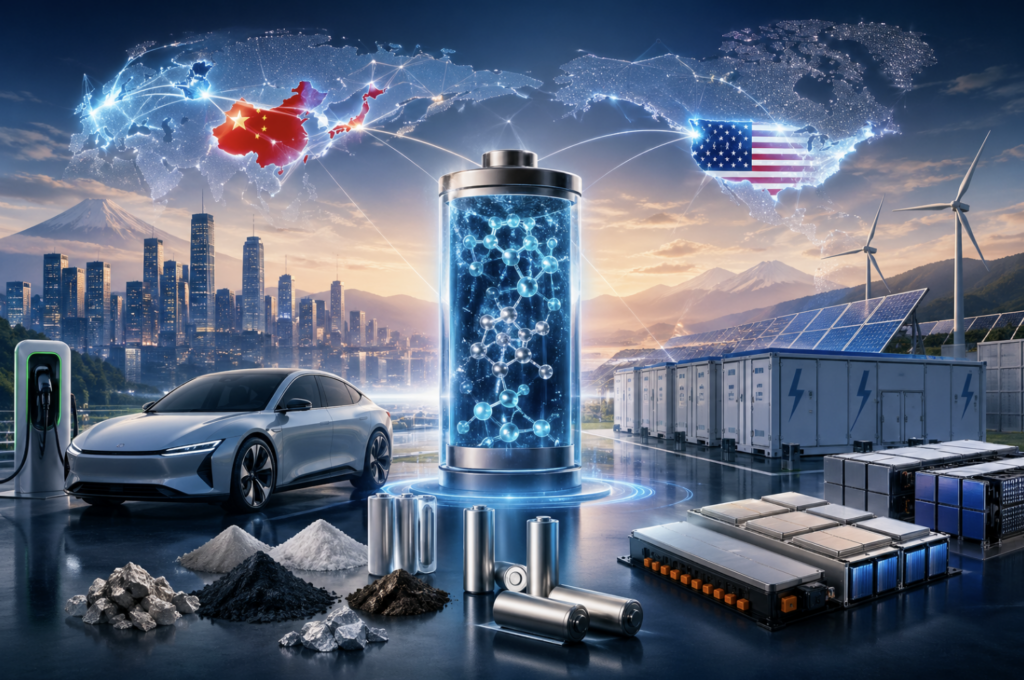
A Global Race Between Innovation, Scale, and Strategy
MUNICH, Germany – The race to build the battery of the future has become one of the defining industrial contests of the 21st century. Governments, automakers and technology firms across Asia, Europe and the United States are investing billions into next-generation energy storage systems that promise to transform transportation, stabilize power grids and reshape global supply chains.
At stake is not only technological leadership, but economic and geopolitical influence. Much like semiconductors before them, batteries are emerging as a strategic cornerstone of modern industry.
China’s Advantage: Scale Before Perfection
China has established itself as the undisputed leader in battery manufacturing, not by waiting for technological perfection, but by aggressively scaling what works today.
Companies such as CATL and BYD dominate global production and are already commercializing intermediate technologies, including semi-solid-state batteries and sodium-ion systems. These approaches sacrifice some performance in favor of faster deployment and lower costs.
Recent developments underscore this strategy. CATL has secured large-scale sodium-ion supply agreements, signaling that it has overcome key industrial challenges and is now capable of mass production.
China also leads the early commercialization of solid-state variants. Industry timelines suggest limited adoption of next-generation batteries by 2027 and mass production around 2030, with China setting technical standards as early as 2026.
At the same time, Chinese firms are pushing performance boundaries. Prototype solid-state cells have already demonstrated energy densities exceeding 400 Wh/kg and ranges above 1,000 kilometers.
The strategy is clear: dominate the present market while steadily advancing toward future technologies.
Japan’s Bet: Precision and Patents
If China leads in execution, Japan leads in long-term technological ambition.
Toyota, widely regarded as the global patent leader in solid-state battery technology, has spent more than a decade developing next-generation systems. Its goal is ambitious: batteries capable of delivering over 1,000 kilometers of range, charging in approximately 10 minutes, and lasting decades.
Japanese firms are taking a more cautious approach, focusing on durability, safety and scalability before commercialization. Industry projections suggest initial deployment between 2027 and 2028.
This strategy reflects a broader philosophy: introduce the technology only when it meets industrial-grade reliability.
The United States: Innovation Without Scale
In the United States, the battery race is being driven less by industrial giants and more by startups and venture-backed innovators.
Companies like QuantumScape are pursuing lithium-metal solid-state batteries, a technology often described as the “holy grail” of energy storage due to its potential for higher energy density, faster charging and improved safety.
Yet despite promising laboratory results, commercialization remains elusive. QuantumScape and similar firms are still pre-revenue, highlighting a persistent challenge: translating breakthroughs into scalable manufacturing.
The U.S. position, therefore, remains uncertain — technologically bold, but industrially behind.
Europe: Strong Science, Weak Scaling
Europe, including leading research institutions such as the Technical University of Munich, remains at the forefront of materials science and battery research. European automakers are investing heavily in partnerships and pilot projects, supported by regulatory pressure to decarbonize transport.
However, Europe lags behind Asia in large-scale production capacity. Its battery ecosystem is still developing, and much of its industrial supply chain remains dependent on external partners.
While Europe may help define the science of future batteries, it has yet to prove it can dominate their manufacturing.
The Technology Divide: One Race, Multiple Paths
Contrary to popular perception, there is no single “winning” battery technology. Instead, several competing approaches are evolving in parallel:
1. Advanced Lithium-Ion (Today’s Backbone)
Still the dominant technology, continuously improving in cost, performance and charging speed.
2. Semi-Solid-State Batteries (China’s Bridge Technology)
Already entering the market, offering incremental gains in safety and energy density.
3. Full Solid-State Batteries (The Long-Term Goal)
Promising breakthroughs in safety, energy density and charging times, with commercialization expected between 2027 and 2030.
4. Sodium-Ion Batteries (The Disruptive Alternative)
A lower-cost, resource-abundant solution gaining traction, particularly for stationary storage and entry-level electric vehicles.
Sodium-Ion Batteries: The Quiet Challenger
While solid-state batteries dominate headlines, sodium-ion technology is rapidly emerging as a critical pillar of the energy transition.
Unlike lithium, sodium is abundant, inexpensive and geopolitically stable. These characteristics make it particularly attractive for large-scale energy storage and low-cost mobility solutions.
China is again leading commercialization. Large contracts for sodium-ion batteries in grid storage indicate that the technology has moved beyond experimentation into industrial deployment. (Reuters)
However, sodium’s lower energy density limits its use in high-performance electric vehicles. Instead, it is expected to play a complementary role:
- powering affordable urban EVs
- stabilizing renewable energy grids
- reducing dependence on critical raw materials
In this sense, sodium-ion batteries may prove less glamorous than solid-state systems, but equally important to the broader energy ecosystem.
Timelines and Reality Checks
Despite rapid progress, the gap between laboratory breakthroughs and mass-market deployment remains significant.
Industry consensus suggests:
- 2024–2026: Semi-solid batteries enter limited production
- 2027: Early solid-state vehicles appear
- 2030+: Large-scale commercialization
These timelines reflect persistent challenges in materials stability, manufacturing scalability and cost reduction.
A Fragmented Future, Not a Single Winner
The global battery race is unlikely to produce a single dominant technology or country.
Instead, a layered ecosystem is emerging:
- China: dominates manufacturing and cost-driven innovation
- Japan: leads in long-term solid-state breakthroughs
- United States: drives high-risk, high-reward innovation
- Europe: anchors scientific research and regulatory frameworks
At the same time, different battery chemistries will serve different markets — from premium electric vehicles to grid storage and low-cost mobility.
Conclusion: Leadership Is Temporary
If there is one clear lesson from the current landscape, it is that leadership in battery technology is fluid.
China may lead today, but Japan’s technological depth, America’s innovation ecosystem and Europe’s research capabilities ensure that the race is far from settled.
The future of batteries will not be decided by a single breakthrough, but by the ability to balance performance, cost, scalability and timing.
And in that race, the finish line is still moving. (AT/hz)