
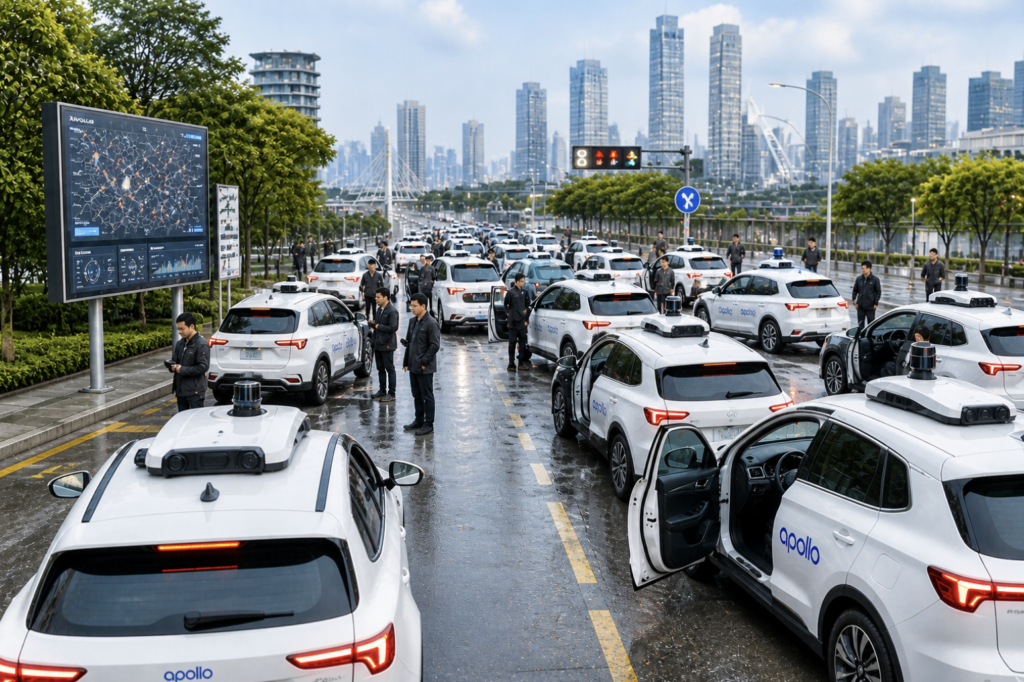
WUHAN, China – A sudden failure of at least 100 autonomous taxis in Wuhan has prompted a sweeping regulatory response from Beijing, raising fresh concerns about the safety, governance and global trajectory of driverless mobility.
According to local authorities, the vehicles—operated by Baidu’s Apollo Go service—stalled simultaneously in traffic, blocking major roads across the central Chinese city. While no injuries were reported and passengers were able to exit safely, the scale of the disruption turned the incident into one of the most significant real-world stress tests of autonomous vehicle systems to date.
A Turning Point for China’s Robotaxi Policy
In the immediate aftermath, China’s central government convened leading robotaxi operators and municipal officials for an emergency review. The message was clear: all companies must conduct comprehensive safety reassessments, and new operating permits will be suspended for the time being.
This intervention marks a notable shift in regulatory approach. Until now, oversight of autonomous vehicle testing had largely been delegated to local governments, resulting in uneven standards across cities. The Wuhan incident appears to have triggered a move toward tighter, centralized control—signaling that Beijing views systemic risk in the sector as a national concern rather than a localized issue.
Industry Stability, but Rising Political Risk
Despite the regulatory freeze, existing robotaxi fleets—numbering roughly 4,500 vehicles across multiple Chinese cities by late 2025—are expected to continue operating. Companies including Baidu, Pony.ai and WeRide have emphasized continuity, even as uncertainty grows over future approvals and expansion timelines.
At the same time, competition within China remains intense. Automakers such as Geely and Xpeng continue to invest in autonomous taxi platforms, underscoring the long-term strategic importance of the sector despite short-term policy tightening.
Global Expansion Accelerates
Even as domestic scrutiny intensifies, Chinese autonomous vehicle firms are pressing ahead internationally. Pilot deployments have already begun in markets such as Dubai, while expansion plans target Europe, including countries like Switzerland and Turkey.
Partnerships—such as Pony.ai’s collaboration with ride-hailing platform Bolt—highlight a broader strategy: diversifying into regions with more flexible regulatory environments. This outward push reflects both ambition and necessity, as companies seek growth beyond an increasingly constrained home market.
Implications for Europe and the United States
The Wuhan disruption reverberates beyond China. For European policymakers, the episode underscores the importance of establishing unified safety and regulatory standards before large-scale deployments take hold. Without clear frameworks, cities risk becoming testing grounds for rapidly scaling technologies with unresolved systemic vulnerabilities.
In the United States, where companies like Waymo have encountered operational challenges of their own, the contrast is instructive. While American systems often emphasize redundancy and safety layers, they face slower scaling. Chinese firms, by contrast, have prioritized rapid deployment—potentially at the cost of resilience.
A Defining Moment for Autonomous Mobility
The Wuhan incident highlights a central tension in the evolution of autonomous transport: technological capability alone is insufficient without regulatory confidence and robust fail-safe systems. The failure was not merely a technical glitch but a large-scale operational breakdown with political consequences.
As governments worldwide weigh the benefits of innovation against public safety risks, the question is shifting. It is no longer whether robotaxis will become mainstream, but who will define the rules governing their deployment—and how much risk societies are willing to accept in the process.
Sources: Futurezone, Reuters