
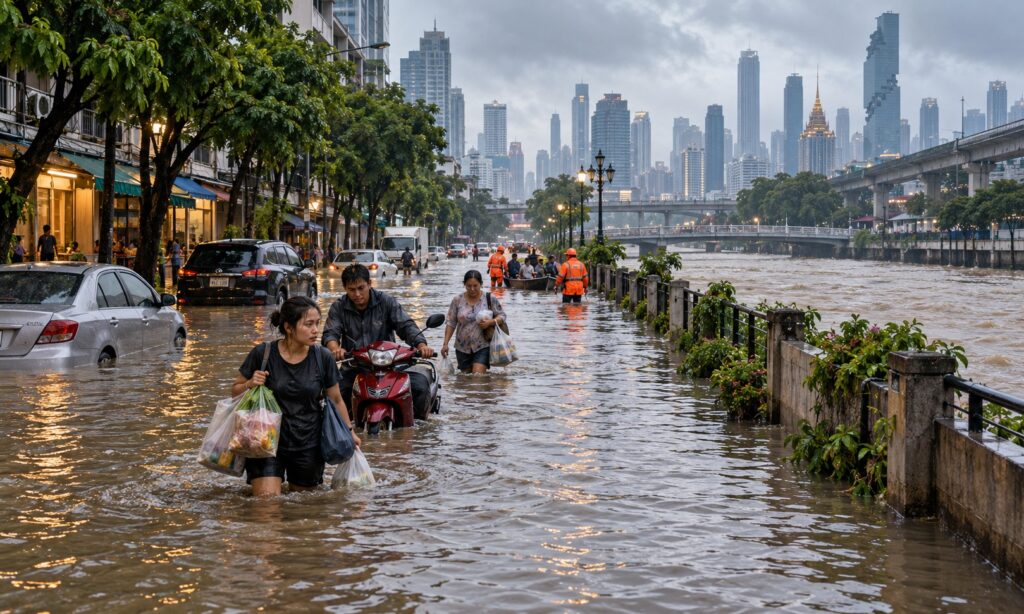
BANGKOK, Thailand — Bangkok declared all 50 districts disaster areas on Saturday after roughly 300 millimeters of rain fell in 48 hours, flooding homes, overwhelming roads and forcing residents to seek shelter. The declaration expands emergency response powers across the capital, including neighborhoods that remain dry.
By Saturday afternoon, Governor Chadchart Sittipunt said conditions had stabilized. Recovery, however, remained conditional: officials estimated that draining the accumulated water would require two or three days without further rain. “Our problem is that the canals are full,” he said, according to AFP.
A Drainage Crisis Becomes a National Test
The eastern and central parts of Bangkok have suffered particularly severe disruption. City officials reported flooding on 93 roads and critical water levels in five major canals. Pumps and drainage tunnels were operating at full capacity, while Bangkok-run schools were ordered closed for Monday, September 28.
More than 200 shelters opened across the city, according to the Associated Press. Nationwide, flooding had affected more than 84,000 people in 21 provinces by Saturday, underscoring the demands on emergency services beyond the capital.
Prime Minister Anutin Charnvirakul, joining an emergency meeting from London, directed agencies to coordinate their operations and share water-management data. His insistence that Bangkok’s flooding was a responsibility for the entire government highlighted a central challenge: drainage decisions in the capital depend partly on conditions and operations in neighboring provinces.
Disruption Reaches Travelers
The Thai Meteorological Department’s warning covered September 26–27, with the low-pressure system expected to move toward central Thailand. The U.S. Embassy also issued a nationwide heavy-rain and flooding alert on Saturday.
Suvarnabhumi and Don Mueang airports remained operational, according to Thailand’s Transport Ministry, although some flights were delayed and flooded roads complicated access. Several airlines introduced flexible travel arrangements for affected passengers—a sign that disruption on the ground was spreading through the travel economy.
The Shadow of 2011
The scenes have revived memories of Thailand’s devastating 2011 floods. But disaster specialist Seree Supratid and environmental academic Thon Thamrongnawasawat told The Nation that current conditions differ substantially. Seree cited northern river flows well below 2011 levels, while both warned that intense localized rainfall could still overwhelm urban drainage. Their assessment offers reassurance about the scale of the threat, without diminishing the emergency facing flooded neighborhoods.
The broader economic exposure remains considerable. In its 2025 climate and development assessment, the World Bank identified the Chao Phraya basin—accounting for 66 percent of Thailand’s GDP—as particularly vulnerable to flooding, and recommended investment in flood mitigation and water security. Saturday’s disruption gives those longer-term recommendations immediate relevance: keeping Bangkok functioning depends on protecting transport, businesses and homes as well as removing water from its streets.
Photo: AI Generated