
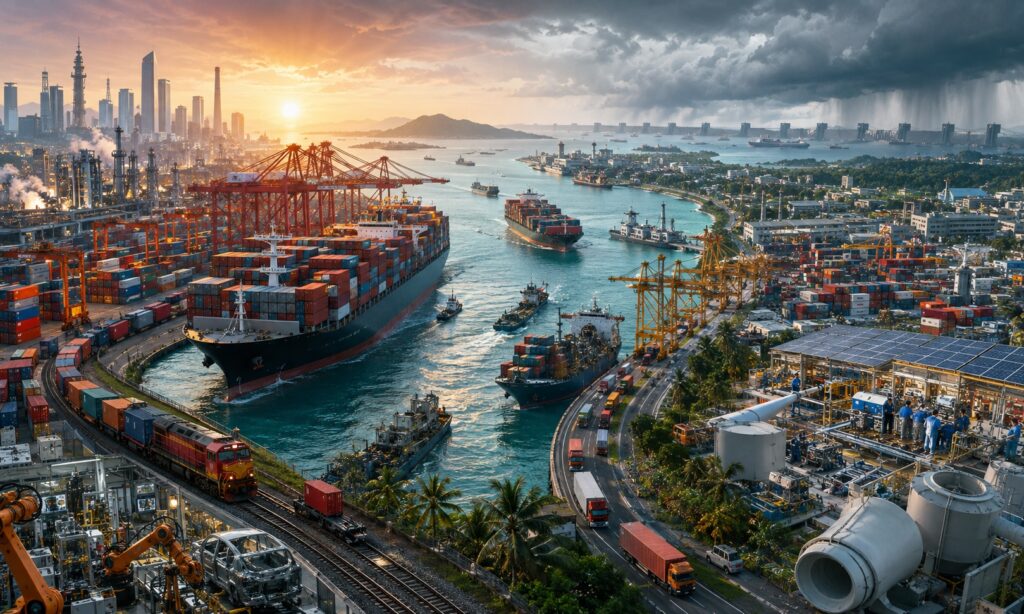
KUALA LUMPUR, Malaysia – China’s trade with Southeast Asia has passed a symbolic threshold, confirming that the region is no longer simply an alternative market for Chinese companies but an increasingly central part of China’s industrial and commercial system.
Two-way trade between China and the Association of Southeast Asian Nations reached $1.05 trillion in 2025, an increase of 7.4 percent from the previous year, Vice Minister of Commerce Yan Dong said this week. China has been ASEAN’s largest trading partner for 17 consecutive years, while ASEAN has ranked first among China’s trading partners for six years.
The expansion accelerated in 2026. Trade reached $744.41 billion during the first seven months, rising 24.7 percent from a year earlier and accounting for 21.8 percent of China’s total foreign trade, according to the Chinese government briefing. At that pace, annual commerce could approach $1.3 trillion, although seasonal changes and currency movements make a simple projection uncertain.
A New Center of Asian Manufacturing
The headline figure reflects more than stronger consumer demand. China and Southeast Asia increasingly function as a connected manufacturing network: Chinese machinery, electronics, chemicals and industrial components move south, while ASEAN factories process materials, assemble products and supply commodities and intermediate goods.
Research by the Lowy Institute found that China now provides more than 40 percent of ASEAN’s imported capital goods. More than 90 percent of the goods the region buys from China are used to support production, investment or economic activity rather than merely final consumption. That helps explain why trade has continued to expand despite geopolitical tensions and efforts by Western governments to reduce dependence on Chinese supply chains.
The statistics nevertheless require some care. ASEAN’s own database valued bilateral merchandise trade at $772.4 billion in 2024, considerably below the comparison implied by Chinese customs figures. Differences in valuation, timing, partner attribution and the treatment of re-exports can produce substantial gaps between national trade series. The $1.05 trillion milestone should therefore be understood specifically as a figure reported by China.
A Free-Trade Agreement Moves Into the Digital Era
The next stage of integration will be shaped by the China–ASEAN Free Trade Area 3.0 Upgrade Protocol, signed on Oct. 28, 2025. Unlike earlier agreements centered primarily on tariffs, the new framework includes digital and green commerce, supply-chain connectivity, competition policy and consumer protection.
Those priorities will dominate the 23rd China–ASEAN Expo, scheduled for Sept. 17 to 21 in Nanning. More than 2,200 Chinese companies and nearly 1,000 ASEAN businesses are expected to participate. Organizers are introducing a dedicated area displaying ASEAN countries’ technological needs, alongside an expanded artificial-intelligence exhibition and an “AI marketplace” offering more than 400 products for demonstration and purchase.
The event is intended to turn the upgraded agreement into commercial projects. Its deeper test, however, will be whether ASEAN companies gain greater access to China’s market and move into higher-value sectors — rather than primarily becoming customers, assembly partners or overseas production bases for Chinese industry.
The Imbalance Behind the Boom
China’s exports to ASEAN rose sharply in 2025, while its imports from the region declined. The Asia Society Policy Institute estimates that ASEAN’s aggregate trade deficit with China widened from $123 billion in 2023 to about $296 billion in 2025.
That imbalance is producing a divided response. ASEAN governments continue to welcome Chinese investment and inexpensive industrial inputs, but some are also protecting vulnerable domestic industries. Malaysia, for example, opened new investigations and reviews in August involving imports of coated-steel products from China and other regional suppliers.
Washington is watching the same trade flows for a different reason. The United States recorded a $327.4 billion goods deficit with ASEAN in 2025, up 44 percent, intensifying scrutiny of Chinese components, transshipment and rules of origin.
The announcement also arrived as 19 members of the Group of 20 — every member except China — backed language calling for action against nonmarket policies, excessive external surpluses and export-dependent growth. Beijing rejected that framing. China’s central-bank governor said the country did not deliberately pursue a trade surplus and remained committed to expanding domestic demand and economic openness.
The Meaning of the Milestone
The trillion-dollar mark establishes China and Southeast Asia as one of the world’s most consequential trading relationships. It also reveals the partnership’s central contradiction: the same Chinese capital goods and technologies that accelerate ASEAN’s industrialization can place intense pressure on its manufacturers and deepen dependence on Chinese supply chains.
FTA 3.0 may reduce commercial friction and open new areas of cooperation. Its durability, however, will depend less on how quickly total trade grows than on whether the benefits become more balanced — through stronger ASEAN exports, genuine technology transfer, locally created value and credible safeguards against disguised transshipment.
For China, ASEAN has become an indispensable economic partner. For Southeast Asia, China is both the engine of regional growth and the competitive force its governments must increasingly learn to contain.
Sources: Xinhua, Reuters, ASEAN Secretariat, Office of the United States Trade Representative, Office of the United States Trade Representative, Asia Society Policy Institute