
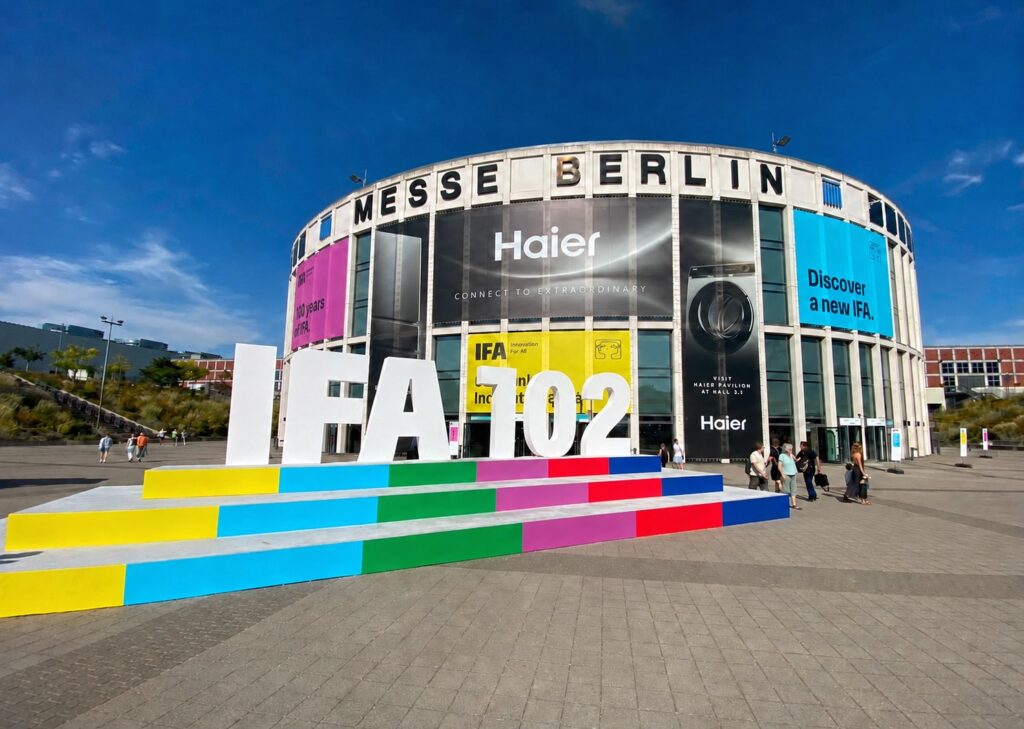
BERLIN, Germany — When the doors of Messe Berlin open on Friday morning, visitors will encounter a vision of domestic life in which refrigerators manage their contents, computers anticipate their owners’ needs and robots move from factory floors into kitchens, hospitals and living rooms.
IFA Berlin, the world’s largest event for consumer electronics, home appliances and future technology, officially runs from Sept. 4 through Sept. 8. Trade visitors will enter from 9:30 a.m. on Friday, while the exhibition opens to the general public at noon. Organizers are preparing for roughly 2,000 exhibitors, alongside product launches, demonstrations, conferences and meetings among manufacturers, retailers, investors and international buyers.
The scale reflects both the resilience of the technology industry and its growing uncertainty. Global sales are expanding again, but consumers remain selective, supply chains face new geopolitical strains and established manufacturers are confronting a wave of increasingly ambitious Asian competitors.
IFA’s task this year is therefore larger than unveiling the next generation of screens, computers and household appliances. It must persuade buyers that innovation is still worth paying for.
A Century-Old Fair Confronts a New Technology Cycle
First held in Berlin in December 1924 as the Great German Radio Exhibition, IFA is one of the world’s oldest surviving technology showcases. Its first edition attracted about 180,000 visitors and 242 exhibitors. Over the following century, the fair became associated with milestones including early electronic television, magnetic recording and the compact cassette.
The modern event is vastly broader. Its exhibition areas now encompass home appliances, entertainment, computing and gaming, communications, audio, smart homes, beauty and health technology, mobility, digital content creation and international manufacturing.
Last year, IFA drew around 220,000 visitors from 140 countries and more than 1,900 exhibitors from 49 countries, providing the most useful benchmark for the scale of the 2026 edition. More than 14,500 business meetings were arranged through the show’s app, demonstrating that IFA remains as much a commercial marketplace as a public exhibition.
Friday’s stage program begins with an opening keynote from Jack Huynh, an AMD executive, on the emerging era of personal artificial intelligence. Xiaomi, making its IFA debut, is presenting its largest exhibition yet of a connected “Human × Car × Home” ecosystem, a sign of the growing importance of Chinese technology companies in Europe.
A Growing Market — With Consumers Holding Back
Figures presented at IFA’s official press conference this week show a global technology and durable-goods market that has recovered in value, though not evenly in volume.
Sales in the first half of 2026 reached approximately $430.5 billion, excluding North America and Russia, an increase of 6 percent in dollar terms from the previous year. Measured in local currencies, however, the market was worth about $428 billion and grew only 2.4 percent, indicating that exchange-rate movements accounted for part of the apparent acceleration.
The regional picture was similarly uneven. Sales rose 15 percent in the Middle East and Africa and 12 percent in emerging Asia. Developed Asian markets and Latin America each grew by about 6 percent, while Western Europe advanced 2 percent and Eastern Europe 1 percent. China, the largest single market in the data, declined 5 percent to approximately $142.9 billion.
For the full year, NielsenIQ forecasts global technology and durable-goods sales of $1.4 trillion, up 5.1 percent. Yet its consumer research also suggests that growth is becoming harder to secure: 63 percent of buyers exhibit high price sensitivity, and 56 percent say they have postponed a technology purchase because it was too expensive or because they were waiting for a discount.
The distinction between sales value and unit volume is telling. According to the conference data, first-half technology sales increased 2 percent in local currencies even as the number of products sold fell by roughly the same amount. Telecommunications revenue rose 4 percent while unit sales declined 5 percent; information-technology revenue increased 3 percent despite a 7 percent fall in volume.
The market, in other words, is not being lifted by indiscriminate consumption. It is being supported by buyers choosing fewer, more capable and often more expensive products.
Innovation Must Demonstrate Its Value
The strongest categories offer a guide to what visitors can expect in Berlin.
Sales of smartphones with at least 256 gigabytes of storage increased 25 percent in the first half of the year. Space-efficient refrigerators rose 24 percent, espresso machines 21 percent, robot vacuum cleaners and artificial-intelligence computers 18 percent each, and televisions measuring 75 inches or more 14 percent.
These are not merely replacement products. They offer an easily understood improvement: greater storage, less manual work, better use of space, automation or a visibly larger entertainment experience.
That calculation will shape the exhibition floor. AI will appear not as a separate category but as a layer running through personal computers, televisions, appliances, health devices and retail services. Wearables, robotics and AI were identified at the press conference as the three major forces likely to determine the industry’s next phase of growth.
Visitors can also expect hands-on demonstrations rather than conventional display cases. IFA’s 2026 program includes humanoid robots, smart glasses, connected kitchens, e-bikes and scooters, beauty treatments, gaming experiences and a 200-meter mobility test track. A new Retail Innovation Zone will examine how artificial intelligence, social commerce and digital marketplaces are changing the relationship between manufacturers, stores and consumers.
Online retail remains central to that transition. The conference figures show online technology sales growing 8 percent in the first half, compared with 5 percent for physical stores. The gap was especially wide in small domestic appliances, information technology and consumer electronics. Telecommunications was the exception, with online and offline sales each rising 7 percent.
Startups Move Toward the Center of the Fair
Some of IFA’s most consequential products may come not from its largest exhibitors but from the smaller companies gathered in Hall 25.
IFA Next, the fair’s startup and emerging-technology area, is expected to host about 300 exhibitors. Companies, research institutions and national pavilions from at least 25 countries will present technologies ranging from humanoid robots and extended reality to intelligent wearables, climate technology, PetTech and connected living.
International pavilions include participants from Italy, South Korea, Taiwan, Singapore, the Philippines and China. Announced exhibitors span robotics companies such as Unitree, AGIBOT, Deep Robotics and Cozio Robotics, alongside younger businesses working on smart glasses, assistive systems and AI tools for meetings and everyday work.
The area is designed not only for exhibition but for financing and commercial discovery. Founders will meet retailers, corporate partners and investors, while the IFA Next investor program offers matchmaking and access to more than 1,100 participating investors.
The IFA Pitch Battle gives selected startups a more public test. Semifinals will be held on Sept. 4 and 5, followed by the final on Sept. 6. Founders will present their businesses before industry judges, investors and a live audience, competing for recognition and opportunities provided by the competition’s partners.
Startups are also eligible for the IFA Innovation Awards, which are judged by an independent international panel of technology journalists and industry experts. The awards recognize achievements in design, engineering and market impact across fields including artificial intelligence, sustainability, smart homes, health, audio and next-generation technology. The leading distinctions — Best of IFA, Best Tech Innovation and Best Brand — will be presented on Friday afternoon.
For a young company, the award may carry more practical value than a trophy: international press exposure, credibility with retailers and investors, and the right to use the official award certification in future marketing.
The Global Contest Comes to Berlin
IFA’s international character is particularly important at a moment when the geography of the technology business is changing.
Chinese brands are expanding rapidly beyond their domestic market, while companies in Europe, Japan, South Korea and the United States are investing heavily in AI-enabled products and more integrated consumer ecosystems. At the same time, manufacturers face memory-component shortages, currency volatility, corporate consolidation and risks to shipping routes created by conflict in the Middle East.
Berlin will provide a concentrated view of that competition. European appliance makers will emphasize engineering, durability and efficiency. American semiconductor companies will promote the arrival of personal AI. South Korean and Japanese groups will defend their positions in displays, entertainment and connected homes. Chinese manufacturers will present increasingly complete ecosystems rather than isolated, lower-cost devices.
The spectacle will be considerable: robots playing football, machines walking a runway, giant televisions, AI computers and appliances capable of making decisions once left to their owners.
But the more important question will be quieter. In a market where consumers are delaying purchases and comparing value more closely, the winners will not necessarily be those offering the most technology. They will be the companies — established or newly founded — that can explain why their technology deserves a place in people’s lives. (AT/hz)